MCQGeeks
CBSE
JEE
NTSE
NEET
English
UK Quiz
Quiz
Driving Test
Practice
Games
Driving Test
Florida
Florida Car Driving Permit Test-9
Answers
Q.1.
When parking your vehicle downhill on a two-way street:
Turn your wheels to the right.
Turn your wheels to the left.
Keep your wheels pointed straight ahead.
Leave your transmission in neutral.
Q.2.
At night, it is hardest to see:
Road signs.
Pedestrians.
Other motorists.
Street lights.
Q.3.
Many crashes are caused by:
Drivers traveling too fast for conditions.
Drivers consistently checking their mirrors and blind spots.
Drivers yielding the right-of-way.
Drivers maintaining a four-second following distance.
Q.4.
It is important to be alert to motorcycles because:
They are more difficult to see than cars.
They rarely use their headlights.
Motorcyclists are less skilled drivers than other motorists.
All of the above.
Q.5.
If two drivers arrive at the same time to an open intersection:
The driver on the right has the right-of-way.
The driver on the left has the right-of-way.
One driver may continue driving without stopping.
One driver should honk to indicate that they are giving up the right-of-way.
Q.6.
Roads become very slippery:
The day after it rains.
When it has been raining for an hour or more.
For the first 10 to 15 minutes of a rainstorm.
Right after the rain has stopped.
Q.7.
Before turning, you should:
Use your signal.
Turn the wheel.
Increase your speed.
Change lanes.
Q.8.
Your tire blows out while you are driving. You should:
Slam on your brakes.
Hold your steering wheel tightly and slow to a stop.
Keep driving normally.
Turn on your emergency flashers and continue driving.
Q.9.
Which is the most common cause of traffic crashes?
New drivers
Human error
Bad weather
Bad roads
Q.10.
Which of the following must you obey over the other three?
A steady red light
A police officer
A stop sign
A flashing red light
Q.11.
A steady yellow traffic signal means that a ____ light will soon appear.
Flashing yellow
Steady green
Steady red
Flashing red
Q.12.
When approaching railroad tracks, you should:
Look, listen, slow down, and be prepared to stop.
Speed up to cross the tracks before the gate is lowered.
Try to drive around a lowered gate.
Not pay attention to how many tracks there are to cross.
Q.13.
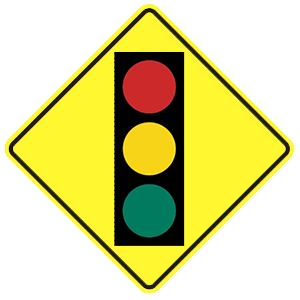
This sign means:
Emergency vehicles ahead.
Uncontrolled intersection ahead.
Four-way stop ahead.
Traffic signal ahead.
Q.14.
Road rage and aggressive driving may be reduced by:
Allowing extra travel time.
Obeying posted speed limits.
Using proper turn signals.
All of the above.
Q.15.
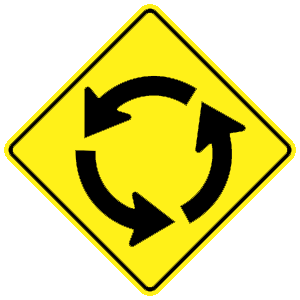
This sign means:
Roundabout ahead.
Lane ends, merge left.
Turn around.
Curve ahead.
Q.16.
What should you do if your vehicle’s right wheels leave the pavement?
Stop quickly.
Immediately pull all the way off of the road and get back on when it is safe.
Accelerate and steer back on the road quickly.
Take your foot off the accelerator, slow down, then ease back onto the road when it is safe to do so.
Q.17.
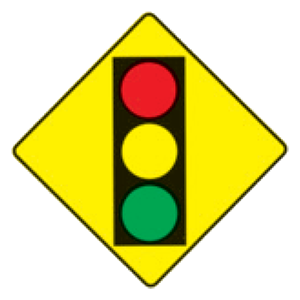
This sign means:
Stop sign ahead.
Lane closed ahead.
Railroad crossing ahead.
Traffic signal ahead.
Q.18.
If you stop at a railroad crossing with more than one track:
Wait to proceed until you have a clear view of all tracks.
Stop on the first railroad track and watch for another train.
Go through as soon as the train passes.
Go through when one of the tracks is free.
Q.19.
Railroad crossings should always be considered:
Safe to cross, as it is unlikely that a train will be coming.
Dangerous.
Safe locations to park a car.
A place where it is required to stop
Q.20.
While operating a motor vehicle, drivers are permitted to text:
At stop lights.
By using voice-to-text.
Under no circumstances.
If they can send the text without looking at the phone.
Q.21.
A pedestrian starts to cross in front of your vehicle. You should:
Flash your lights.
Slow down.
Speed up and pass in front of the pedestrian.
Stop and let the pedestrian cross.
Q.22.
The best way to avoid hydroplaning is to:
Keep your tires properly maintained.
Slow down when roads are wet or slushy.
Watch out for standing water or puddles.
All of the above.
Q.23.
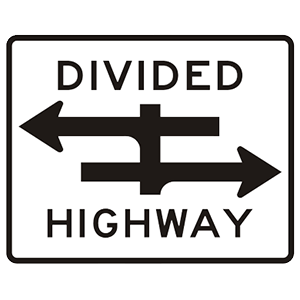
This sign means:
You must turn left or right.
You are approaching a T intersection.
The road that you are on intersects with a divided highway.
You are on an overpass above a divided highway.
Q.24.
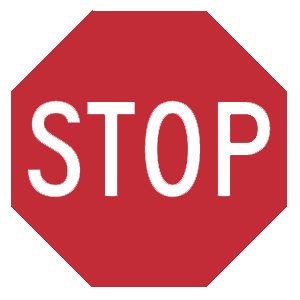
This road sign means:
Slow down or stop.
Stop, if necessary.
You must come to a complete stop.
Drive with caution and be ready to stop.
Q.25.
Your first response to reduced visibility should be:
Turning on your headlights.
Reducing your speed.
Turning on your windshield wipers.
Looking for road edge markings to guide you.
Q.26.
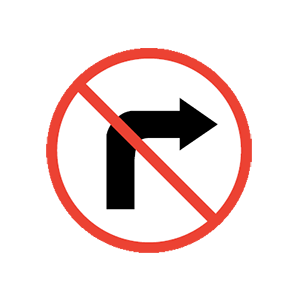
This road sign means:
Turn right after making a complete stop.
Right turns are not permitted.
Left turns are permitted.
None of the above.
Q.27.
When the road is marked with a solid yellow line and a broken yellow line, with the broken line next to your lane, you may pass:
Only in an emergency.
If you are on an expressway.
If traffic is clear.
Only at an intersection.
Q.28.
Posters, signs, and stickers on the windshield and windows:
Are a fun way to personalize your vehicle.
Are permitted if they allow the driver at least a little visibility.
Are prohibited, unless they are otherwise specifically required by law.
Are permitted only if they do not contain offensive language.
Q.29.
When driving under icy or snowy conditions, which driving technique will help drivers avoid crashes?
Add extra weight to their vehicles to improve traction.
Get off the highways as quickly as possible.
Engage the four-wheel drive on their vehicles.
Reduce their speed and increase their following distance.
Q.30.
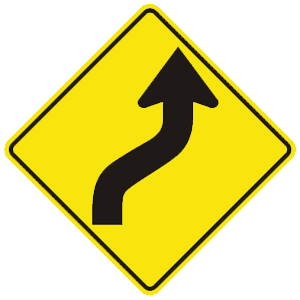
This road sign means:
Road construction ahead.
The road ahead curves left, then right.
The road ahead curves right, then left.
Steep grade ahead.
Q.31.
When should you adjust your mirrors?
Before turning on your engine.
While backing out of your driveway.
When approaching speeds of 55 mph.
When completing a turn.
Q.32.
You experience an incident at work that has left you feeling angry. When you get to your car, you should:
Play the radio loudly so you won’t think about it.
Drive fast on the interstate to let off steam.
Take a few minutes to cool off before you begin your drive home.
Stop at your favorite bar and have a few drinks before driving home.
Q.33.
The risk of hydroplaning can can be reduced by driving:
Through shallow water.
More quickly.
More slowly.
Through deep water.
Q.34.
To safely pass a bicycle, you should:
Honk at the bicyclist to let them know you're trying to pass.
Drive in the bicycle lane until you get a chance to pass.
Slow down and give them as much space as possible.
Rush ahead to pull in front of the bicyclist.
Q.35.
When approaching a flashing red traffic light, drivers should:
Drive through the intersection if there is no crossing traffic.
Continue driving, as they have the right-of-way.
Stop if a police officer is nearby.
Treat the light like a stop sign.
Q.36.
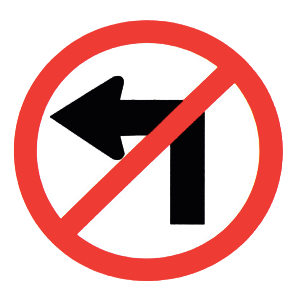
This sign means:
All traffic must turn left.
No left turn.
No U-turn.
Truck route to the left.
Q.37.
Traffic signals sometimes display arrows to control turns from specific lanes. A solid red arrow:
Is never used as a traffic signal.
Has the same meaning as a circular red traffic light.
Means that drivers may turn in the direction indicated by the arrow.
Means that the traffic the arrow is pointing toward must stop.
Q.38.
You are making a left turn from a two-way street onto a one-way street. When you have completed the turn, your car should be:
In the right lane of the street.
In the center of the street.
In the left lane of the street.
In the lane with the least traffic.
Q.39.
Double solid yellow lines painted down the middle of the road mean:
Railroad crossing ahead.
Pedestrian crossing ahead.
Passing is not permitted from either direction.
Passing is permitted from either direction.
Q.40.
You should be cautious when passing a bicycle because:
You are moving faster than the bicycle.
The bicycle always has the right-of-way.
Oncoming traffic may not see you pull out to pass the bicycle.
The cyclist may have to swerve into traffic to avoid an object on the road.
Q.41.
When is it illegal to drive below the speed limit?
When driving slowly disrupts the normal flow of traffic
When in heavy traffic in a construction zone
Only when driving in rural areas.
When driving under adverse weather conditions
Q.42.
A yellow and black diamond-shaped sign:
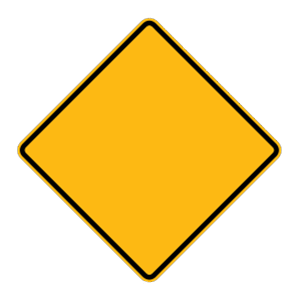
Warns you about conditions on or near the road.
Helps direct you to cities and towns ahead.
Tells you about traffic laws and regulations.
Tells you about road construction ahead.
Q.43.
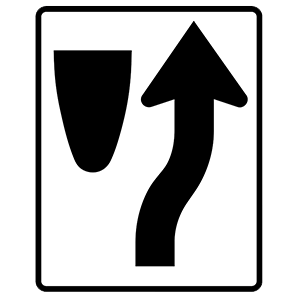
This sign means:
Divided highway ends.
One-way traffic ahead.
Two-way traffic ahead.
Keep to the right.
Q.44.
You notice that the driver in the vehicle ahead of you is driving with one hand and talking to a passenger. You should:
Give the vehicle extra space.
Know that the driver in the vehicle ahead is reducing their safety margin by being an inattentive driver.
Avoid following the driver's example.
All of the above.
Q.45.
The most effective thing you can do to reduce your risk of being injured or killed in a traffic crash is to:
Wear your seat belt.
Limit your driving to weekdays.
Stay in the right lane on multilane highways.
Limit your driving to hours between 3:00 p.m. and 6:00 p.m.
Q.46.
You are entering a crowded freeway. What should you do to merge into traffic?
Use your side and rearview mirrors and check your blind spots.
Use the acceleration lane to adjust your speed to match the speed of freeway traffic.
Yield to traffic already on the freeway.
All of the above.
Q.47.
On a freeway, you realize you missed your turn or exit. You should:
Make the turn quickly from your lane of travel.
Stop and back up.
Continue driving until you reach the next turn, exit, or other location where you can safely turn around.
Signal other drivers to stop so you can turn.
Q.48.
A flashing red traffic signal at an intersection has the same requirements as:
A slow sign.
A yield sign.
A stop sign.
An intersection sign.
Q.49.
If involved in an accident, a driver should:
Stop their vehicle at or near the scene.
Not stand or walk in traffic lanes.
Turn off the ignitions of wrecked vehicles.
All of the above.
Q.50.
Accruing ____ points on your license within a 36-month period will result in suspension of your license for one year.
24 or more
21 to 23
18 to 20
15 to 17
Support mcqgeeks.com by disabling your adblocker.
×
Please disable the adBlock and continue.
Thank you.
Reload page