MCQGeeks
CBSE
JEE
NTSE
NEET
English
UK Quiz
Quiz
Driving Test
Practice
Games
Driving Test
Georgia
Georgia Car Driving Permit Test-9
Answers
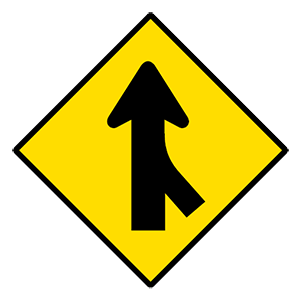
Q.1.
This sign is used to warn drivers that:
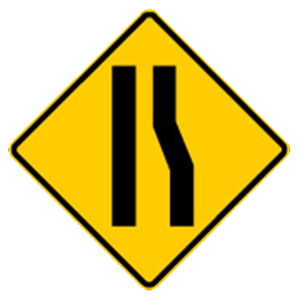
The right lane is ending and traffic should merge left.
The road curves ahead.
There are upcoming intersections.
Q.2.
This sign means:
One-way traffic.
Intersection ahead.
Merging traffic from the right.
Q.3.
This sign means:
Road construction/maintenance area.
Side road.
Railroad ahead.
Q.4.
Double solid yellow line markings down the center of a road indicate that passing is:
Allowed from both directions.
Allowed only from your direction of travel.
Not allowed from either direction.
Q.5.
What message will be found on this yellow pennant-shaped sign?
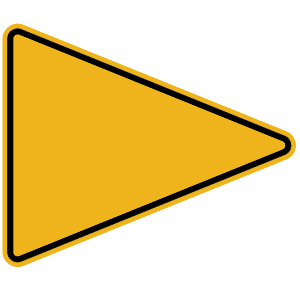
Right turns only.
Right turns permitted.
No passing zone.
Q.6.
A solid yellow arrow on a traffic signal means:
You should speed up so you can make the turn before the light changes.
You do not need to signal to turn from the indicated lane.
You should prepare to stop and yield the right-of-way to oncoming traffic.
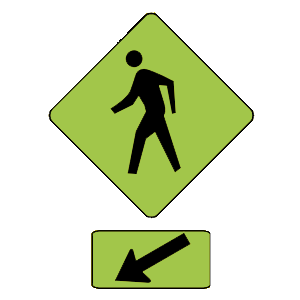
Q.7.
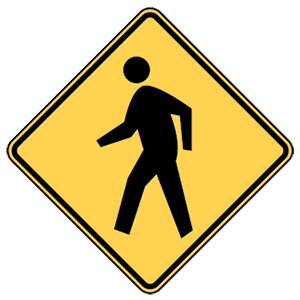
This sign means:
Pedestrian crossing.
Side road.
Railroad ahead.
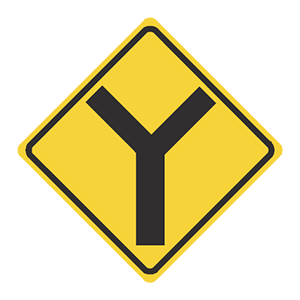
Q.8.
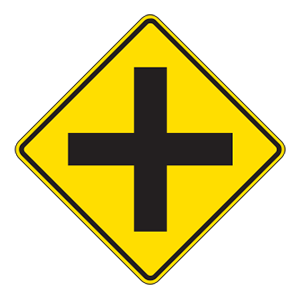
This road sign means:
The roadway ends ahead.
Drivers must bear either right or left.
A four-way intersection is ahead.
Q.9.
If you are involved in an accident, one of the immediate requirements is to:
Render aid to the injured.
Notify your insurance agent.
Notify the Secretary of State's Office.
Q.10.
What message will be found on a red octagon-shaped sign?
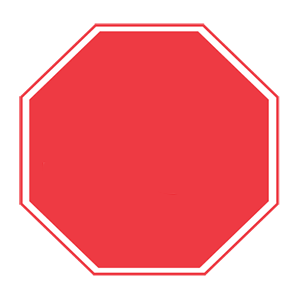
Do not enter.
One-way.
Stop.
Q.11.
This road sign means:
Pedestrian crossing.
School crossing.
Jogging trail.
Q.12.
When driving at night on a dimly lit street, you should:
Drive slowly enough that you can stop within the area illuminated by your headlights.
Turn on your high beam headlights to better see the vehicles ahead of you.
Keep the instrument panel lights bright to be more visible to other drivers.
Q.13.
Only ____ can lower blood alcohol concentration (BAC) and reduce alcohol's effects on a body.
Drinking caffeine
Eating foods high in fat
Time
Q.14.
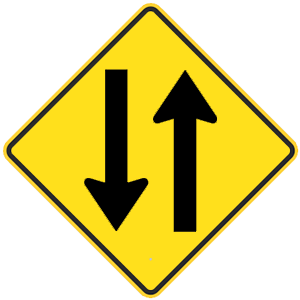
This sign means:
Four-lane traffic ahead.
Divided highway ahead.
Two-way traffic ahead.
Q.15.
When passing another car, you have enough space to return to the driving lane:
If the other driver signals for you to re-enter the lane.
If you look over your shoulder and see the passed car behind you.
If you can see both of the passed vehicle's headlights in your rearview mirror.
Q.16.
Allow extra space in front of your vehicle when following a:
Station wagon.
Passenger vehicle.
Motorcycle.
Q.17.
When passing another vehicle, it is safe to return to your lane if you:
Cannot see the vehicle directly to your right.
See the vehicle’s headlights in your rearview mirror.
Have passed the other vehicle’s front bumper.
Q.18.
If a truck or bus is making a right turn where you also need to make a right turn, you should:
Quickly turn before the truck or bus is able to.
Wait until the truck or bus turns before you turn.
Squeeze between the truck or bus and the curb.
Q.19.
"No passing zone" signs tell drivers:
To speed up slightly.
That it is not safe to pass.
To maintain a steady speed.
Q.20.
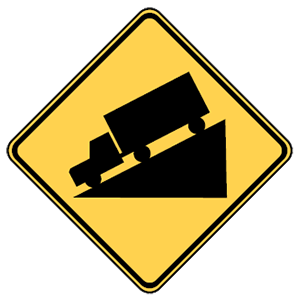
This road sign means:
Intersection ahead.
Merging traffic.
Steep hill ahead.
Q.21.
When driving on gravel or dirt roads:
Your tires grip the road better than when you are driving on pavement.
Your tires do not have as much traction as they do on pavement, so you must slow down.
Visibility is better than on pavement.
Q.22.
If you must park your vehicle in an area not usually used for parking:
Park with your reverse lights on.
Make sure your vehicle is visible to drivers approaching from any direction.
Park five feet from the curb.
Q.23.
A solid yellow line on your side of the centerline means:
Reduce your speed.
Traffic light ahead.
Do not pass.
Q.24.
This sign shows one type of:
Intersection.
Road curve.
Right turn.
Q.25.
If you want to enter the freeway but you don't see a gap in traffic, you should:
Maintain your speed and force the other drivers to create a gap.
Slow down on the ramp to wait for a gap.
Stop at the end of the ramp to wait for a gap.
Q.26.
If you are driving near a large commercial vehicle, you should:
Follow the large vehicle closely to reduce wind drag on your vehicle.
Avoid driving beside it for long stretches of time.
Drive on its right side when on curves and hills.
Q.27.
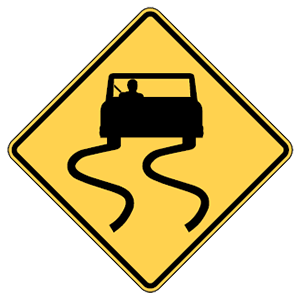
This road sign means:
Steep grade ahead.
The road ahead winds with a series of turns or curves.
Slippery when wet.
Q.28.
Reaction time is slower after:
Drinking alcohol.
Sleeping.
Working hard.
Q.29.
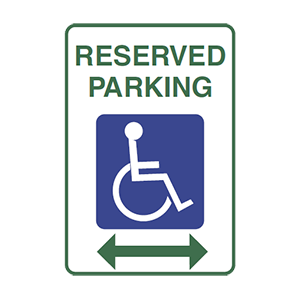
This sign means:
Reserved parking for persons with disabilities.
Slow-moving vehicle.
No U-turn.
Q.30.
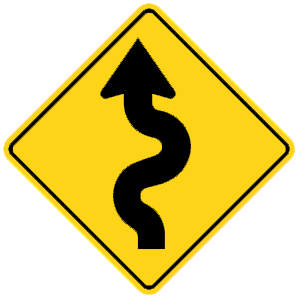
This road sign means:
Sharp turn to the right ahead.
Upcoming sharp left and right turns.
Winding road ahead.
Q.31.
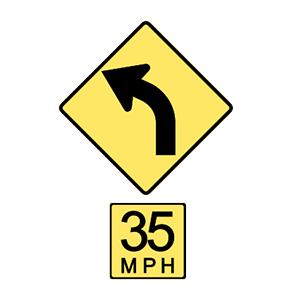
This sign means:
There is a 35 mph speed zone after the curve ahead.
Drive no slower than 35 mph around the upcoming curve.
Approach the upcoming curve at a speed of 35 mph or slower.
Q.32.
This sign means:
Pedestrians walking along the road ahead.
Pedestrian crossing ahead.
Pedestrians must not cross here.
Q.33.
Drivers are required to obey instructions from:
Security guards patrolling parking lots.
Other drivers whose vehicles are broken down on the roadway.
Flaggers (signal persons) at construction sites.
Q.34.
What does this road sign indicate?
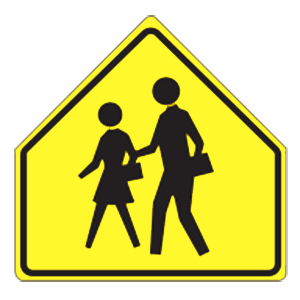
Directions for children
School zone ahead
Playground area ahead
Q.35.
What is the only medically proven method of removing alcohol or other drug combinations from your system?
Breathe in some fresh air.
Give your body time.
Drink coffee.
Q.36.
This sign means you are approaching a railroad crossing that does not have a signal. You should:
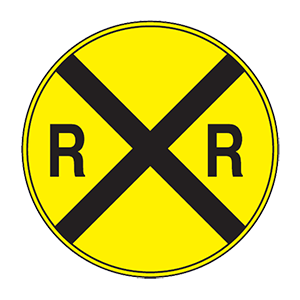
Come to a complete stop.
Proceed at a consistent speed while looking and listening for approaching trains.
Slow down, look both ways, listen for any trains, and be prepared to stop if any trains are nearby.
Q.37.
This sign means:
No U-turn.
No left turn.
No right turn.
Q.38.
This road sign means:
Drive with caution and be ready to stop.
You must come to a complete stop.
Stop, if necessary.
Q.39.
A driver should:
Assume all drivers automatically obey the right-of-way rules.
Assume most drivers obey the right-of-way rules.
Always be prepared to yield the right-of-way.
Q.40.
Driving under the influence of any medication which impairs your driving is permitted:
Under no circumstances.
If you don't feel drowsy.
If it is prescribed by a physician.
Support mcqgeeks.com by disabling your adblocker.
×
Please disable the adBlock and continue.
Thank you.
Reload page