MCQGeeks
CBSE
JEE
NTSE
NEET
English
UK Quiz
Quiz
Driving Test
Practice
Games
Driving Test
Hawaii
Hawaii Car Driving Permit Test-14
Answers
Q.1.
Traffic regulations require drivers to display a turn signal for at least ____ before making a turn or lane change.
50 feet
75 feet
100 feet
25 feet
Q.2.
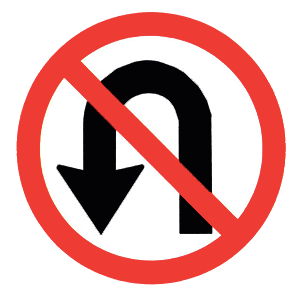
This sign means:
No left turn.
No stopping.
No U-turn.
Detour ahead.
Q.3.
When approaching a traffic signal displaying a steady yellow arrow, drivers:
Should merge into a lane in the direction of the arrow.
Should slow to a stop, if it is safe to do so.
May turn left after yielding to oncoming traffic and pedestrians.
Have the right-of-way and may expect oncoming traffic to stop for them.
Q.4.
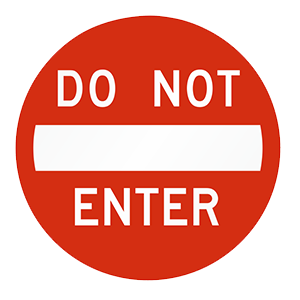
This road sign means:
You are about to enter a one-way street from the wrong direction.
U-turns are prohibited.
You may proceed if the way is clear.
Come to a complete stop before proceeding.
Q.5.
Your tire blows out while you are driving. You should:
Slam on your brakes.
Hold your steering wheel tightly and slow to a stop.
Keep driving normally.
Turn on your emergency flashers and continue driving.
Q.6.
You are coming to an intersection and have a green light. Pedestrians are crossing against the red. You should:
Honk your horn.
Speed up and pass in front of the pedestrians.
Stop to let the pedestrians cross safely.
Drive close to the pedestrians and frighten them so they’ll think twice before crossing against a red light.
Q.7.
The correct way to use a freeway exit ramp is to:
Slow down before entering the exit ramp.
Slow down once moving onto the exit ramp.
Keep your speed constant once in the exit ramp.
Pass slower traffic in the exit ramp.
Q.8.
Which of the following statements is true?
White lines separate lanes of traffic moving in the same direction.
White lines separate lanes of traffic moving in opposite directions.
Yellow lines separate lanes of traffic moving in the same direction.
None of the above.
Q.9.
If you are involved in an accident and the accident scene is not readily visible to oncoming traffic, you should:
Have someone warn approaching traffic.
Let oncoming traffic watch out for themselves.
Let the police handle everything.
Assume other drivers will have heard the crash.
Q.10.
A red flashing traffic light has the same meaning as a:
Solid red light.
Stop sign.
Yield sign.
Caution sign.
Q.11.
You should be cautious when passing a bicycle because:
You are moving faster than the bicycle.
The bicycle always has the right-of-way.
Oncoming traffic may not see you pull out to pass the bicycle.
The cyclist may have to swerve into traffic to avoid an object on the road.
Q.12.
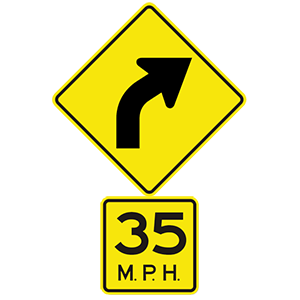
This road sign means:
The road ahead curves right. Slow down to the safe speed indicated.
Divided highway begins. Slow down to the safe speed indicated.
Merge. Slow down to the safe speed indicated.
Winding road ahead. Slow down to the safe speed indicated.
Q.13.
Road rage and aggressive driving may be reduced by:
Allowing extra travel time.
Obeying posted speed limits.
Using proper turn signals.
All of the above.
Q.14.
A single broken yellow line down the center of a two-lane road indicates:
Lanes are moving in opposite directions and drivers are not permitted to pass.
Lanes are moving in opposite directions and drivers are permitted to pass when it is safe to do so.
Lanes are moving in the same direction and drivers are not permitted to pass.
Lanes are moving in the same direction and drivers are permitted to pass when it is safe to do so.
Q.15.
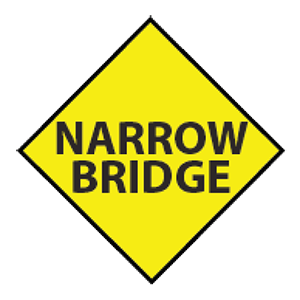
This sign means:
Trucks are permitted on an upcoming narrow bridge.
The bridge ahead is open to one-way traffic only.
The bridge ahead is wide enough for only one car at a time.
The bridge ahead may be too narrow to meet or pass a truck.
Q.16.
Distracted driving is:
Very uncommon.
Extremely risky behavior.
Nothing to be concerned about.
No less safe than driving under any other conditions.
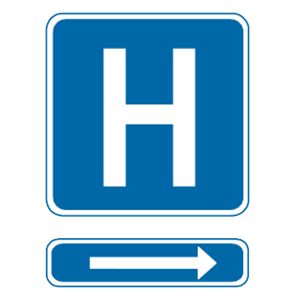
Q.17.
This sign means:
Highway changes ahead and to the right.
Hiking trails ahead and to the right.
Hotel ahead and to the right.
Hospital ahead and to the right.
Q.18.
Another driver is trying to pass your car. You should:
Pull off the road.
Signal to the other driver when it is safe for them to pass.
Check for oncoming traffic and adjust your speed to allow safe passing.
Speed up.
Q.19.
How can you lower the risk of hydroplaning?
Do not speed when the roads are wet.
Use tires with proper air pressure.
Replace tires with bad tread.
All of the above.
Q.20.
A driver who is taking a non-prescription drug should:
Read the labels on the drug before driving.
Drink alcohol instead.
Continue to drive regardless of any warning labels.
Drive only during daylight hours.
Q.21.
Regulatory signs are usually ____ and should always be obeyed.
White
Blue
Green
Orange
Q.22.
The act of turning your head and checking your blind spot before changing lanes, driving away from a curb, or merging your vehicle into traffic is:
A bad driving habit.
A good driving habit.
Unnecessary.
Not necessary if you use the rearview mirror.
Q.23.
You may pass a school bus from the front or rear on an undivided roadway:
Under no circumstances.
When the red lamps on the school bus are flashing.
When the red lamps on the school bus are not flashing.
At anytime, if you drive slowly.
Q.24.
When you are in a line of traffic that is crossing a railroad track that has no signals or gates:
You have the right-of-way and do not need to check for trains.
You may pass slower drivers while crossing the track.
You need to make sure there is space for your vehicle to get all the way across the tracks without stopping.
All of the above
Q.25.
Safety belts:
Should be worn at all times when driving or riding in a vehicle.
Should be worn only when traveling at high speeds.
Should be worn loosely.
Can only prevent drivers from injury.
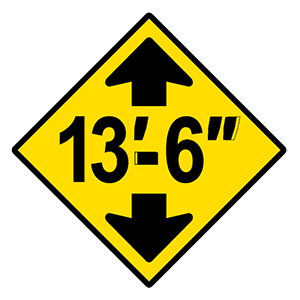
Q.26.
This road sign means:
Steep grade ahead.
Pedestrian crossing ahead.
Low ground railroad crossing.
Low clearance.
Q.27.
When you see this sign, it means:
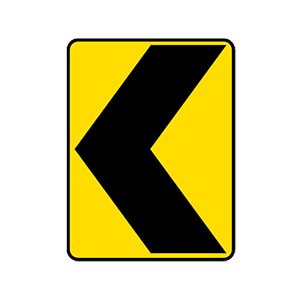
There is an object on the roadway.
Traffic is coming from the right.
The road is curving sharply to the left.
There is a merge point ahead.
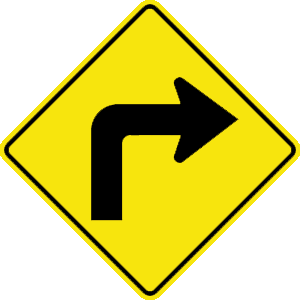
Q.28.
This road sign means:
One-way road.
No right turn.
Exit.
Sharp right turn in the road ahead.
Q.29.
When riding in a vehicle, small children:
May be safely held by a strong adult.
Will be safe if they are standing on the floor in the back of the vehicle.
Will not be hurt in an accident because they are small.
Must never be allowed to ride while standing in the vehicle.
Q.30.
A seat belt should be adjusted so that it:
Is loose.
Is buckled snugly across your hip bones and lower abdomen.
Is hidden beneath the seat.
Keeps the seat belt buzzer or light from operating.
Support mcqgeeks.com by disabling your adblocker.
×
Please disable the adBlock and continue.
Thank you.
Reload page