MCQGeeks
CBSE
JEE
NTSE
NEET
English
UK Quiz
Quiz
Driving Test
Practice
Games
Driving Test
Hawaii
Hawaii Car Driving Permit Test-24
Answers
Q.1.
Traffic signals sometimes display arrows to control turns from specific lanes. A green arrow:
Is used only on one-way streets.
Has the same meaning as a circular green traffic light, but traffic must turn in the direction indicated by the arrow.
Means that you may proceed, but only if the green arrow is accompanied by a circular green light.
Points the way to an airport.
Q.2.
You are driving at night and another vehicle is approaching from the opposite direction. Your headlights:
Should be on their high beam setting.
Should be on their low beam setting.
Should be off. Use your parking lights.
May be on either their high or low beam setting.
Q.3.
If a flagger is directing traffic in a construction zone, you must:
Follow the directions given by the flagger.
Copy what surrounding traffic is doing, despite the flagger's instructions.
Assume the flagger is not supposed to be directing traffic.
Follow the laws that would be in place if the area was not under construction.
Q.4.
While backing, you should:
Rely only on your mirrors.
Flash your lights.
Open your door to see if it is safe to proceed.
Turn your head and look through the rear window.
Q.5.
Drivers who eat and drink while driving:
Make no driving errors.
Have trouble driving slowly.
Are better drivers because they are not hungry.
Have trouble controlling their vehicles.
Q.6.
Many crashes are caused by:
Drivers traveling too fast for conditions.
Drivers consistently checking their mirrors and blind spots.
Drivers yielding the right-of-way.
Drivers maintaining a four-second following distance.
Q.7.
If an officer is directing traffic at a working traffic light, drivers should:
Follow the directions indicated by the traffic light.
Follow the directions given by the officer.
Honk at the officer.
Check to see what the cars next to them are doing.
Q.8.
If traffic signals at an intersection are not functioning due to a power outage:
Park your vehicle as far off the road as possible and wait for power to be restored.
Use hand signals to indicate your intentions to other drivers.
Turn on your hazard lights and proceed through the intersection without stopping.
Treat the intersection as a four-way stop.
Q.9.
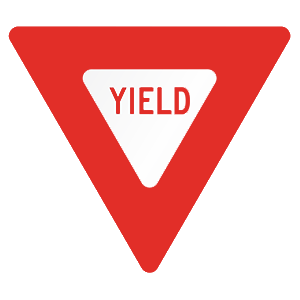
This is a ____ sign.
Stop
Wrong way
Yield
Do not enter
Q.10.
A pedestrian starts to cross in front of your vehicle. You should:
Flash your lights.
Slow down.
Speed up and pass in front of the pedestrian.
Stop and let the pedestrian cross.
Q.11.
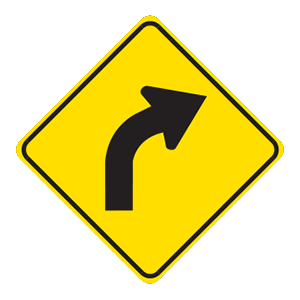
This sign means:
Curve ahead.
Roadwork ahead.
Merging traffic.
No left turn.
Q.12.
Alcoholic beverages will affect you:
More rapidly after you have just eaten.
More rapidly on an empty stomach.
In the same way at all times.
Only if you have more than two drinks.
Q.13.
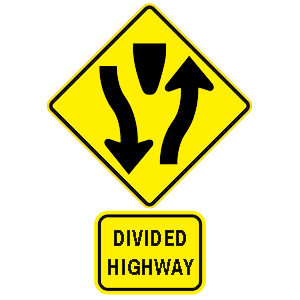
This sign means:
One-way traffic.
Divided highway ahead.
Two-way traffic.
Keep left.
Q.14.
Night driving can be more difficult than driving during the day because:
Cars overheat more quickly at night.
Visibility is reduced in the dark.
It is more likely to be raining at night.
You are more likely to encounter a motorcycle at night.
Q.15.
An inattentive driver is a driver who:
Stares at objects off the roadway or daydreams while driving.
Maintains eye contact during a conversation with a passenger while driving.
Only watches the vehicle ahead of their vehicle.
All of the above.
Q.16.
When getting ready to change lanes, you should:
Check your side view mirror.
Check your rearview mirror.
Quickly turn your head to check for other vehicles.
All of the above.
Q.17.
If you stop at a railroad crossing with more than one track:
Wait to proceed until you have a clear view of all tracks.
Stop on the first railroad track and watch for another train.
Go through as soon as the train passes.
Go through when one of the tracks is free.
Q.18.
To pass a slower-moving vehicle on a two-lane, two-way road, you must:
Not cross the centerline.
Flash your lights at oncoming traffic.
Use the shoulder.
Use the lane that belongs to oncoming traffic.
Q.19.
Allow a larger space cushion than usual when stopping:
On an incline.
At an intersection.
At a stop sign.
At a toll plaza.
Q.20.
When driving in bad weather, drivers should:
Increase their speed to reach their final destination more quickly.
Decrease their following distance.
Increase their following distance.
None of the above.
Q.21.
You may park or stop along the shoulder of the freeway:
As long as you turn on your four-way (emergency) flashers.
If no part of your vehicle is on the road.
If you need to look at a map for directions.
Only if you have an emergency.
Q.22.
Which of the following must you obey over the other three?
A steady red light
A police officer
A stop sign
A flashing red light
Q.23.
From top to bottom, the following is the proper order for traffic lights:
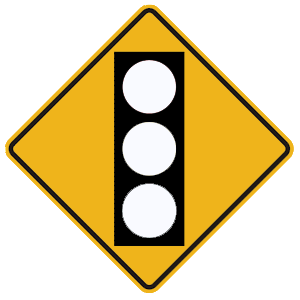
Red, yellow, green.
Red, green, yellow.
Green, red, yellow.
Green, yellow, red.
Q.24.
Before passing another vehicle, you should signal:
Just before changing lanes.
At any time.
After changing lanes.
Early enough for others to know your plans.
Q.25.
Newer vehicles have equipment warning lamps installed on the instrument panel. Which of the following statements is correct?
All lamps should be illuminated when the ignition switch is first turned on before the engine is started.
No lamps should illuminate until the engine is running.
The lamps should never illuminate unless there is a malfunction.
The lamps will only illuminate if the headlights are turned on.
Q.26.
If two drivers arrive at the same time to an open intersection:
The driver on the right has the right-of-way.
The driver on the left has the right-of-way.
One driver may continue driving without stopping.
One driver should honk to indicate that they are giving up the right-of-way.
Q.27.
What does an orange-colored sign indicate?
The start of a no passing zone.
A railroad crossing is ahead.
A school zone is ahead.
The presence of construction work.
Q.28.
A police officer asks you to take a test determining the amount of alcohol in your blood. You:
Do not have to take the test if you can prove that you weren’t drinking
Must take the test or risk losing your license.
Do not have to take the test if you have not violated any traffic rule.
Must take the test or risk a fine.
Q.29.
A solid yellow “X” over a traffic lane means:
That drivers must move out of the indicated lane because it is about to be used by oncoming traffic.
That drivers may drive regularly in the indicated lane.
That the indicated lane is for left turns only.
That drivers may use the indicated lane, but should drive with caution.
Q.30.
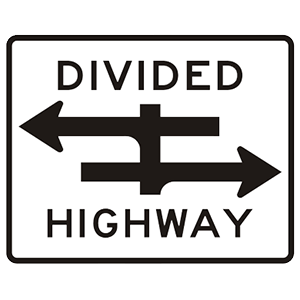
This sign means:
You must turn left or right.
You are approaching a T intersection.
The road that you are on intersects with a divided highway.
You are on an overpass above a divided highway.
Support mcqgeeks.com by disabling your adblocker.
×
Please disable the adBlock and continue.
Thank you.
Reload page