MCQGeeks
CBSE
JEE
NTSE
NEET
English
UK Quiz
Quiz
Driving Test
Practice
Games
Driving Test
Hawaii
Hawaii Car Driving Permit Test-9
Answers
Q.1.
Two vehicles are driving side by side ahead of your vehicle and you are in a hurry. You should:
Drive closely behind the vehicle in the left lane and flash your headlights.
Drive closely behind the vehicle in the right lane.
Drive in either lane with a two-second time interval between you and the vehicle ahead.
Quickly switch back and forth between the lanes.
Q.2.
Certain highway signs require drivers to obey an indicated instruction. Such signs are known as:
Regulatory signs.
Warning signs.
Information signs.
Guide signs.
Q.3.
Regulatory signs:
Are placed in every location where there is a present danger.
Indicate what a driver must or must not do.
Are diamond-shaped and yellow or green.
May warn drivers that they are approaching a school zone.
Q.4.
You wish to drive a heavy truck in Hawaii. You must:
Be at least 21 years old.
Have a valid driver license for the category of vehicle you wish to drive.
Have no special qualifications.
Drive the truck only on truck routes.
Q.5.
When you park uphill on a street with a curb:
Keep the front wheel straight and set the parking brake.
Turn the front wheels away from the curb.
Turn the front wheels toward the curb.
Turn the back wheels into the curb.
Q.6.
Motorcycles are entitled to:
The bicycle lane.
The same full lane width as other motor vehicles.
Half the width of a lane.
The width of the sidewalk.
Q.7.
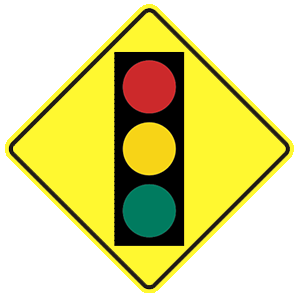
This sign means:
Emergency vehicles ahead.
Uncontrolled intersection ahead.
Four-way stop ahead.
Traffic signal ahead.
Q.8.
Anything that requires you to ____ could cause you to crash.
Take your eyes off the road
Take your hands off the wheel
Take your attention away from the task of driving
All of the above
Q.9.
From the center lane, which maneuver(s) can you perform?
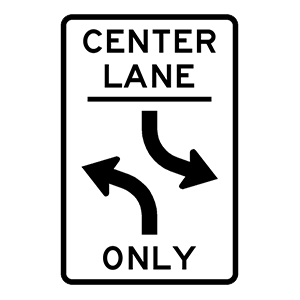
You may make left turns.
You may make U-turns.
You may pass slow-moving traffic.
All of the above.
Q.10.
If not otherwise prohibited by a sign, a driver stopped at a solid red traffic light may:
Turn right after yielding to other traffic and pedestrians.
Never turn right.
Turn right at any time.
Turn right only after sounding their horn.
Q.11.
You are driving when your power steering stops working. You should:
Honk your horn and turn off the ignition.
Turn on your hazard lights and brace yourself.
Work hard to steer, reduce your speed, drive to a safe area, and stop.
Slam on your brakes.
Q.12.
A flashing red light on a traffic signal means:
The same thing as a stop sign.
The traffic signal is broken.
You do not have to come to a complete stop.
Driving conditions are dangerous.
Q.13.
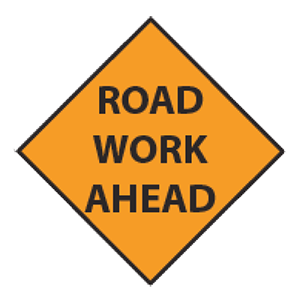
This sign means:
There is a detour ahead.
You must stop for flaggers.
The road ahead is closed to traffic.
The highway ahead is undergoing maintenance.
Q.14.
Which of the following does not happen after drinking?
Your reflexes and reaction time slow down.
Your judgement of speed and distance is distorted.
You are less alert.
You calm down and can concentrate better.
Q.15.
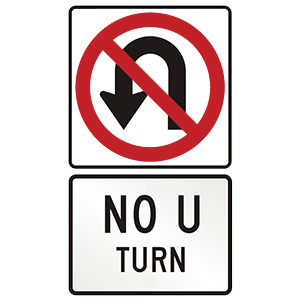
This sign means:
U-turns are prohibited.
U-turns are permitted.
Winding road ahead.
Sharp left turn ahead.
Q.16.
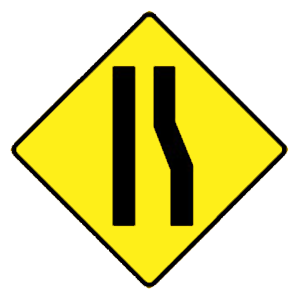
This road sign means:
Road widens ahead.
Lane reduction; the right lane ends soon.
Highway entrance ramp ahead.
Lane reduction; the left lane ends soon.
Q.17.
Which of the following lights indicates that you should slow down and proceed with caution at an intersection?
A flashing yellow light
A flashing red light
A solid yellow light
A solid red light
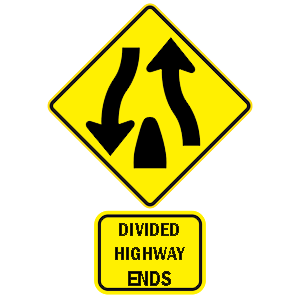
Q.18.
This sign means:
One-way traffic.
Divided highway ends.
Two-way traffic.
Keep left.
Q.19.
Distracted driving may be caused by:
Eating, drinking, or smoking.
Talking or texting on a cellular phone.
Changing a radio station or CD.
All of the above.
Q.20.
An inattentive driver is a driver who:
Stares at objects off the roadway or daydreams while driving.
Maintains eye contact during a conversation with a passenger while driving.
Only watches the vehicle ahead of their vehicle.
All of the above.
Q.21.
You are driving forward out of your driveway. You:
Must come to a complete stop before crossing the sidewalk area.
Must slow down before crossing the sidewalk area.
Have the right-of-way over pedestrians in the sidewalk area.
Can cross the sidewalk area without stopping if you first honk your horn.
Q.22.
To enter a freeway:
Signal, yield to existing traffic, and enter at the same speed that traffic is moving.
Signal and enter the freeway. Freeway traffic must yield.
Drive slowly so you can check traffic.
Always come to a complete stop first.
Q.23.
A bicyclist who doesn’t obey traffic laws:
Is in the right because bicyclists don’t have to obey traffic laws.
Can be ticketed.
Will always receive a warning from law enforcement.
Will have their bicycle impounded.
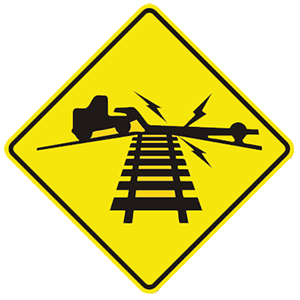
Q.24.
This road sign means:
No passing zone.
Winding road.
Pedestrian crossing.
Low ground railroad crossing.
Q.25.
When turning left at an intersection or into any driveway, you:
Should leave room on your right for other vehicles to pass.
Must yield to vehicles approaching from the opposite direction.
Must not cross any solid yellow line.
Must not block vehicles approaching from behind your vehicle.
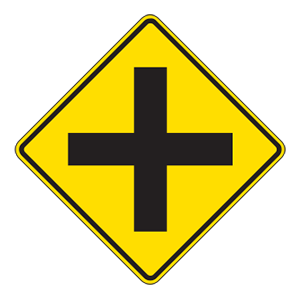
Q.26.
This sign means:
Crossroad ahead.
Flagger ahead.
Lane ends.
Turn right or go straight.
Q.27.
When approaching a traffic signal displaying a steady green arrow, drivers:
Should merge into a lane in the direction of the arrow.
Should slow to a stop, if it is safe to do so.
May turn in the direction of the arrow after yielding to traffic and pedestrians already in the intersection.
May drive straight through the intersection.
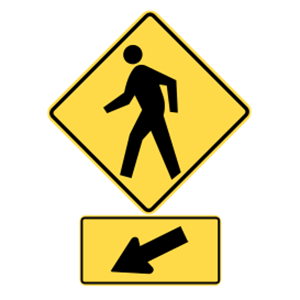
Q.28.
This sign means:
Pedestrians walking along the road ahead.
Pedestrian crossing ahead.
Pedestrians must not cross here.
Be alert for construction workers on the road.
Q.29.
If there are two railroad tracks next to each other:
It is always safe to proceed after one train passes.
You must always stop before crossing the tracks.
When one train passes, look for another train on the other track before proceeding.
Honk your horn as you cross the tracks.
Q.30.
If your wheels drop off the pavement and onto the shoulder of the road, you should:
Brake hard and turn sharply back onto the pavement.
Stop your car on the edge of the road.
Slow down and very carefully turn back onto the pavement.
Maintain your speed and turn sharply back onto the pavement.
Support mcqgeeks.com by disabling your adblocker.
×
Please disable the adBlock and continue.
Thank you.
Reload page