MCQGeeks
CBSE
JEE
NTSE
NEET
English
UK Quiz
Quiz
Driving Test
Practice
Games
Driving Test
Hawaii
Hawaii Motorcycle Driving Permit Test-14
Answers
Q.1.
More than half of all crashes:
Occur at speeds greater than 35 mph.
Are caused by worn tires.
Happen in the dark.
Involve riders who have little experience on their motorcycles.
Q.2.
The front brake:
Should only be used when you need to stop quickly.
Should be used only under slippery conditions.
Is not as effective as the rear brake.
Is safe to use, if used properly.
Q.3.
If a friend has been drinking alcohol and wants to drive, which of the following should you not do?
Encourage friends to talk them out of driving.
Arrange for other transportation.
Tell them to take less-crowded roads.
Slow their pace of drinking.
Q.4.
The minimum fine that you may be charged for riding without proof of insurance is:
$25.
$50.
$100.
$200.
Q.5.
When consumed together, the effects of alcohol and drugs:
Can be more pronounced than when either is consumed alone.
Are less dangerous than when either is consumed alone.
Are usually minimal.
Often balance out.
Q.6.
It is most important to flash your brake light when:
Passing another vehicle.
You will be slowing down suddenly.
There is a stop sign ahead.
Your signals do not work.
Q.7.
A passenger should never:
Wear a helmet.
Lean when the operator leans.
Wear clothing that is tight.
Ride sidesaddle.
Q.8.
Usually, a good way to handle a tailgater is to:
Move onto the shoulder to get out of their way.
Speed up and put distance between you and the tailgater.
Ignore them.
Change lanes and let them pass.
Q.9.
When should your rearview mirror be adjusted?
After starting the motorcycle
Before starting the motorcycle
During the ride
At a traffic signal
Q.10.
Where is the greatest potential for conflict between a motorcycle and other traffic?
Intersections
Highways
Parking lots
Residential areas
Q.11.
Where is the greatest potential for conflict between motorcycle operators and other drivers?
At intersections
On highways
On rural roads
In parking lots
Q.12.
What is the best lane position for a motorcycle?
The left position
The center position
The right position
There is no single best lane position.
Q.13.
Where is the clutch lever usually located?
On the left handgrip
On the right handgrip
Near the left footrest
Near the right footrest
Q.14.
When riding at night, you should:
Be flexible about your lane position and adjust to changing conditions.
Travel at a faster speed than usual to get to your destination more quickly.
Always use your low beam headlight to see better.
Decrease your following distance so you can be as close as possible to the vehicle ahead.
Q.15.
A group of riders should pass another vehicle:
In a staggered formation.
In a pyramid formation.
One at a time.
In a splintered formation.
Q.16.
Which of the following will help you ride safely on slippery surfaces?
Using only the front brake
Using both brakes
Using the center lane
Maintaining or increasing your speed
Q.17.
Which of the following is not an example of a slippery surface?
A dirt or gravel road
A strip of oil in the center of a lane
Mud on pavement
Dry pavement
Q.18.
A motorcycle passenger should:
Put their feet on the operator's footrests.
Sit sidesaddle.
Wear the same protective gear as the operator.
Make the operator sit closer to the handlebars than usual.
Q.19.
Where is the engine cut-off switch usually located?
Near the left handgrip
Near the right handgrip
Near the left footrest
Near the right footrest
Q.20.
To carry a passenger, you may need to adjust all of the following, except:
Tire pressure.
Mirror positions.
Headlight position.
Brake light position.
Q.21.
What does this hand signal mean?
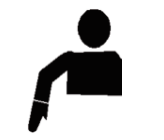
Slow or stop
Left turn
Right turn
Backing up
Q.22.
When riding in fog, you should:
Use your high beam headlight.
Use your low beam headlight.
Use no lights.
Alternate between the low and high beams.
Q.23.
If the throttle is stuck, you should:
Jump off the motorcycle.
Apply the brakes.
Twist the throttle back and forth several times.
Not try to twist the throttle.
Q.24.
When riding in traffic, it is important to remember that motorcycles:
Are too small to have blind spots.
Have blind spots that are too small to cause any problems.
Have blind spots that require head checks.
Have only one blind spot.
Q.25.
Which vest or jacket color would best help you to be seen?
Red
Black
Silver
Blue
Support mcqgeeks.com by disabling your adblocker.
×
Please disable the adBlock and continue.
Thank you.
Reload page