MCQGeeks
CBSE
JEE
NTSE
NEET
English
UK Quiz
Quiz
Driving Test
Practice
Games
Driving Test
Idaho
Idaho Car Driving Permit Test-14
Answers
Q.1.
When exiting a highway, you should slow down:
On the main road, just before the exit lane.
Once you see a toll booth.
Once you have moved into the exit lane.
When you first see the exit sign.
Q.2.
Which is the most common cause of traffic crashes?
New drivers
Human error
Bad weather
Bad roads
Q.3.
You may cross double solid yellow lines:
To pass a slow-moving truck.
To turn into a driveway.
To pass another car.
Under no conditions.
Q.4.
If an aggressive driver cuts you off, you should:
Call the police immediately.
Stay calm and move out of the aggressive driver's way.
Flash your vehicle's lights to let the aggressive driver know he is wrong.
Use a driving action of your own to get back at the aggressive driver.
Q.5.
You come to an intersection displaying a flashing red light. You should:
Come to a full stop and go when it is safe to do so.
Stop only if other cars are also approaching the intersection.
Stop only if other cars are already within the intersection.
Slow down and be prepared to stop, if necessary.
Q.6.
If a flagger is directing traffic in a construction zone, you must:
Follow the directions given by the flagger.
Copy what surrounding traffic is doing, despite the flagger's instructions.
Assume the flagger is not supposed to be directing traffic.
Follow the laws that would be in place if the area was not under construction.
Q.7.
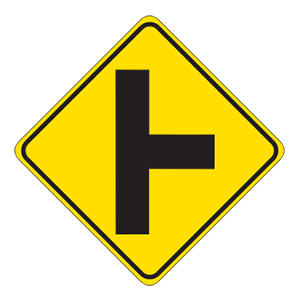
This sign means:
Side road.
Low clearance.
Merging traffic.
Prepare to stop.
Q.8.
You may park or stop along the shoulder of the freeway:
As long as you turn on your four-way (emergency) flashers.
If no part of your vehicle is on the road.
If you need to look at a map for directions.
Only if you have an emergency.
Q.9.
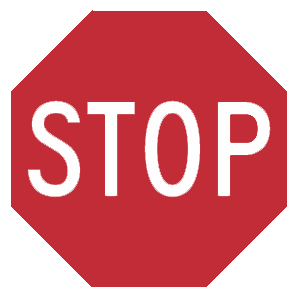
This road sign means:
Slow down or stop.
Stop, if necessary.
You must come to a complete stop.
Drive with caution and be ready to stop.
Q.10.
On slippery roads, you should:
Slow down.
Drive more quickly.
Drive the speed limit, with caution.
Not drive more quickly than 20 mph.
Q.11.
To reduce the effects of headlight glare at night, you should look:
Straight ahead.
Over your shoulder.
At the center of the road
To the right edge of the road.
Q.12.
You are approaching an intersection when the traffic light changes from green to solid yellow. You should:
Consider it the same as a caution sign and continue through the intersection.
Stop immediately.
Stop before entering the intersection, unless you are too close to stop safely.
Speed up to get through the intersection before the red light appears.
Q.13.
The amount of space you need to cross traffic depends on the:
Road conditions, weather conditions, and oncoming traffic.
Presence of a stop sign.
Use of your turn signals.
Cars behind you.
Q.14.
At a four-way stop:
The driver to arrive first has the right-of-way.
The driver to arrive last has the right-of-way.
One driver should continue driving without stopping.
One driver should wave the other drivers ahead.
Q.15.
At dusk or on overcast days, you should:
Drive using your four-way flashers.
Drive using your parking lights.
Not turn on any vehicle lights.
Turn on your headlights.
Q.16.
If you need to slow down while driving on a slippery road, the first thing you should do is:
Firmly apply your brakes.
Take your foot off the gas pedal.
Apply your parking brake.
Pump your brakes.
Q.17.
You need to use extra caution when driving near a pedestrian using a white cane because:
He or she is deaf.
He or she is a police officer.
He or she is blind.
He or she has poor balance.
Q.18.
Drivers who eat and drink while driving:
Make no driving errors.
Have trouble driving slowly.
Are better drivers because they are not hungry.
Have trouble controlling their vehicles.
Q.19.
In Idaho, you may pass another vehicle in an intersection:
Under no circumstances.
If a dashed yellow line is marked through the intersection.
If a dashed yellow line and a solid yellow line are marked through the intersection.
If there are no pavement markings in the intersection.
Q.20.
Stress can affect your driving by:
Lowing your ability to focus on driving.
Decreasing your chances of an accident.
Causing you to fall asleep at the wheel.
Making you more aware of others around you.
Q.21.
If one of your tires blows out as you are driving, you should:
Brake hard immediately.
Try to steer straight while gradually slowing by removing your foot from the gas pedal.
Maintain your current speed and steer straight.
Swerve back and forth to alert traffic behind you.
Q.22.
A speed restriction sign:
May be ignored in rainy, snowy, or icy conditions.
Has a triangular shape.
Is blue with black lettering.
Shows a recommended speed for a curve or turn.
Q.23.
You may pass another vehicle if the line dividing your lane from the lane you wish to enter is a ____ line.
Broken white
Double solid yellow
Solid yellow
Solid white
Q.24.
When you want to make a right turn, your car must be:
Near the center of the street.
Close to the left side of the street.
Close to the right side of the street.
Past the center of the intersection when you begin to turn.
Q.25.
A single broken yellow line down the center of a two-lane road indicates:
Lanes are moving in opposite directions and drivers are not permitted to pass.
Lanes are moving in opposite directions and drivers are permitted to pass when it is safe to do so.
Lanes are moving in the same direction and drivers are not permitted to pass.
Lanes are moving in the same direction and drivers are permitted to pass when it is safe to do so.
Q.26.
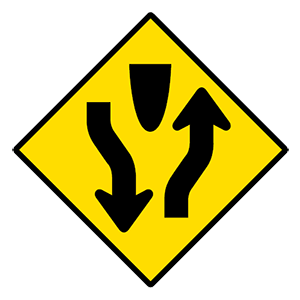
This road sign means:
Keep right.
Keep left.
Pass with caution.
No passing.
Q.27.
To drive safely at night, you should:
Increase your following distance.
Not drive if you are tired.
Make sure your headlights are working properly.
All of the above.
Q.28.
When two vehicles enter an intersection from different highways at the same time, which vehicle must yield the right-of-way?
Either one
The vehicle on the left
The vehicle on the right
Neither
Q.29.
While driving, your wheels slip off the edge of the road. You should:
Jerk the steering wheel to force the vehicle back onto the pavement.
Speed up and steer back onto the pavement gradually.
Slam on your brakes and stop.
Slow down by gently using the brakes. Turn the steering wheel to return to the pavement at a safe speed.
Q.30.
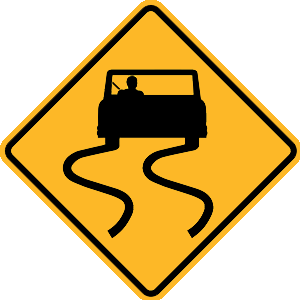
This sign means:
Don't drink if you are going to drive.
Slippery when wet.
Road curves ahead.
You are approaching a hill.
Q.31.
Allow room for vehicles merging onto the freeway by:
Abruptly slowing down to allow them access.
Always driving in the far left lane.
Safely merging out of the right lane to allow them access.
Honking your horn to make them aware of your presence.
Q.32.
This road sign means:
Turn right after making a complete stop.
Right turns are not permitted.
Left turns are permitted.
None of the above.
Q.33.
When stopped for a traffic violation or at an equipment check, the driver must produce:
Proof of insurance.
Their license.
Proof of registration.
All of the above.
Q.34.
A stop sign is shaped like a(n):
Rectangle.
Square.
Circle.
Octagon.
Q.35.
You are driving on the roadway and hear a siren behind you. You should:
Stop where you are.
Pull over to the right and stop.
Speed up to get out of the way.
Slow down.
Q.36.
If two drivers arrive at the same time to a four-way intersection controlled by stop signs:
The driver on the right has the right-of-way.
The driver on the left has the right-of-way.
One driver may continue driving without stopping.
One driver should honk to indicate that they are giving up the right-of-way.
Q.37.
Drinking alcohol and driving is:
A minor traffic safety problem.
A serious traffic safety problem.
Safe if you have only had a few drinks.
Only dangerous to the driver who drinks.
Q.38.
When making a turn, you must ____ your speed.
Increase
Maintain
Vary
Reduce
Q.39.
Your vehicle's stopping distance increases when stopping:
On a wet or icy road.
On paved highways.
When driving at night.
All of the above.
Q.40.
This sign means:
Slow down if an emergency vehicle is approaching.
Look both ways as you cross the intersection.
Always come to a full stop at the intersection.
Slow down and be prepared to stop if necessary.
Support mcqgeeks.com by disabling your adblocker.
×
Please disable the adBlock and continue.
Thank you.
Reload page