MCQGeeks
CBSE
JEE
NTSE
NEET
English
UK Quiz
Quiz
Driving Test
Practice
Games
Driving Test
Idaho
Idaho Car Driving Permit Test-17
Answers
Q.1.
You must yield for emergency vehicles:
Under no circumstances.
When you see a flashing red or blue light or hear a siren.
Only when other vehicles yield.
None of the above.
Q.2.
You want to turn left at an intersection. The light is green but oncoming traffic is heavy. You should:
Use the next intersection.
Wait at the crosswalk for traffic to clear.
Wait in the center of the intersection for traffic to clear.
Take the right-of-way since you have a green light.
Q.3.
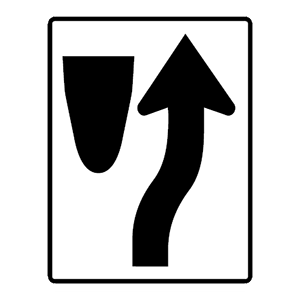
This road sign means:
Side road.
Keep to the side indicated by the arrow.
You may drive in the left lane.
You have the right-of-way.
Q.4.
When driving in Idaho, you must:
Always drive at the maximum posted speed limit.
Drive at a speed that is reasonable and prudent at all times.
Drive 10 mph below the posted speed limit at all times.
Always drive at the same speed as the vehicles around you.
Q.5.
When merging onto a freeway, it is usually best to:
Proceed slowly while waiting for an opening.
Accelerate to a speed that is faster than the speed of traffic.
Turn on your hazard lights until safely on the freeway.
Accelerate to the speed of freeway traffic.
Q.6.
You should honk your horn when you:
Are traveling through an intersection.
Are passing a bicyclist.
See a child who is about to run into the street.
Are parallel parking.
Q.7.
Which of the following must you obey over the other three?
A steady red light
A police officer
A stop sign
A flashing red light
Q.8.
When a stop is required at an intersection and no markings appear to indicate a stop line or crosswalk, a driver:
Is not required to stop.
Is required to slow down to make sure crossing traffic is clear.
Should stop only at a place where they can see at least 200 feet on either side, even if they have to enter the intersecting roadway.
Should stop where they have a clear view of approaching traffic before they enter the intersecting roadway.
Q.9.
You have the right-of-way when turning left on which of the following traffic signals?
A solid green light
A flashing yellow light
A green arrow pointing left
A flashing red light
Q.10.
A person's ability to drive can be impaired by:
Alcohol.
Any medication.
A lack of sleep.
All of the above.
Q.11.
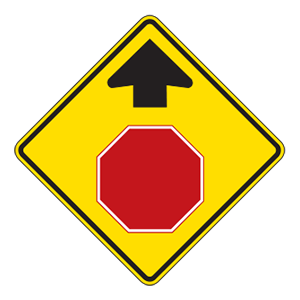
This sign means:
Stop ahead.
Buggy warning.
Limited parking.
Do not block intersection.
Q.12.
To turn left from multilane, one-way streets and highways, you should start from:
The middle of the intersection.
The right lane.
The left lane.
Any lane.
Q.13.
You are driving up a hill and are approaching a heavy truck from the rear. You should know that:
The truck may be traveling at a speed slower than the posted speed limit.
You may not be able to safely pass the truck.
You may not be able to legally pass the truck.
All of the above.
Q.14.
If you want to get off the freeway but you have missed your exit, you should:
Go to the next exit.
Make a U-turn through the median.
Pull onto the shoulder and back your car to the exit.
Flag down a police officer for an escort back to your exit.
Q.15.
Certain highway signs require drivers to obey an indicated instruction. Such signs are known as:
Regulatory signs.
Warning signs.
Information signs.
Guide signs.
Q.16.
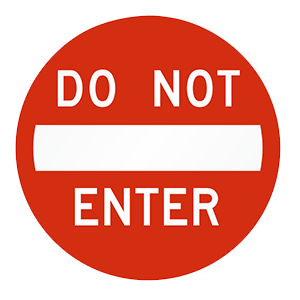
This road sign means:
You are about to enter a one-way street from the wrong direction.
U-turns are prohibited.
You may proceed if the way is clear.
Come to a complete stop before proceeding.
Q.17.
A leaking exhaust system can:
Cause excessive oil use.
Require your vehicle to have a tune-up sooner than normal.
Make you drowsy while driving.
Set grass fires on country roads.
Q.18.
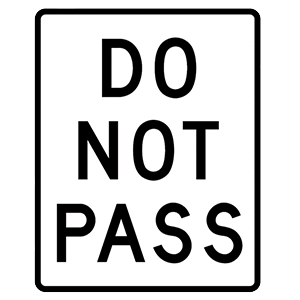
If you see this sign, you:
Must not pass another vehicle.
May pass a slow-moving vehicle if you can do so quickly.
May pass if you know the road ahead.
May pass, but only at night.
Q.19.
If involved in an accident, a driver should:
Stop their vehicle at or near the scene.
Not stand or walk in traffic lanes.
Turn off the ignitions of wrecked vehicles.
All of the above.
Q.20.
Regulatory signs:
Are placed in every location where there is a present danger.
Indicate what a driver must or must not do.
Are diamond-shaped and yellow or green.
May warn drivers that they are approaching a school zone.
Q.21.
State and local authorities:
Must post the same speed limit for all roads that are similar to one another.
May adjust statewide speed limits by posting speed limit signs.
Do not have the authority to post varying speed limits.
Must never post a speed limit lower than 35 miles per hour.
Q.22.
You are entering a crowded freeway. What should you do to merge into traffic?
Use your side and rearview mirrors and check your blind spots.
Use the acceleration lane to adjust your speed to match the speed of freeway traffic.
Yield to traffic already on the freeway.
All of the above.
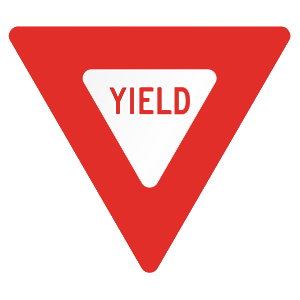
Q.23.
This is a ____ sign.
Stop
Wrong way
Yield
Do not enter
Q.24.
A traffic light displaying a green arrow and a red light means that:
You may only drive straight ahead.
You may drive only in the direction of the green arrow.
You must wait for a solid green light to proceed in any direction.
Vehicles moving in any direction must stop.
Q.25.
When you see this sign, you must:
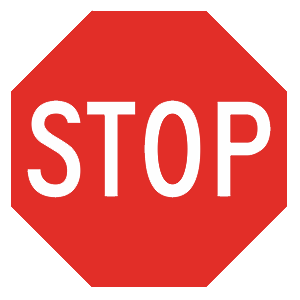
Stop completely and check for pedestrians and cross traffic.
Slow down without coming to a complete stop.
Stop completely and wait for a green light.
Slow down and check for traffic.
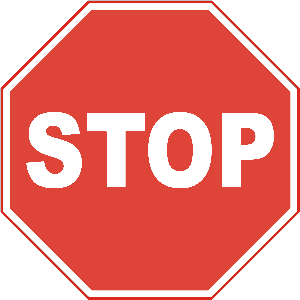
Q.26.
What does this road sign mean?
Slow down and prepare to stop if cars are approaching you.
Come to a full stop and go when it is safe to do so.
Proceed carefully through the intersection, not always stopping.
Stop only for traffic on an intersecting road.
Q.27.
Always signal when:
Changing lanes.
Pulling into or out of a parking space.
Pulling into traffic from an alley or parking area.
All of the above.
Q.28.
Which of the following is true about driving on a wet roadway?
As you drive faster, your tires become less effective.
Water does not affect cars with good tires.
Deep water is less dangerous than shallow water.
As you decrease your speed, the roadway becomes more slippery.
Q.29.
To be safe when crossing a railroad, you should:
Look both ways, but only when the red light is flashing.
Listen, look both ways, and then proceed if it is safe to do so.
Cross especially quickly when a train is approaching.
Quickly pass under any lowering gates.
Q.30.
You are driving when your power steering stops working. You should:
Honk your horn and turn off the ignition.
Turn on your hazard lights and brace yourself.
Work hard to steer, reduce your speed, drive to a safe area, and stop.
Slam on your brakes.
Q.31.
If your car starts to skid, turn your steering wheel:
To keep the front wheels straight.
In the direction you want the vehicle to go.
In the opposite direction of the skid.
In any direction. It doesn't matter.
Q.32.
Regulatory signs are usually ____ and should always be obeyed.
White
Blue
Green
Orange
Q.33.
You must yield to other drivers:
Only where a yield sign is present.
Only when you want to yield.
When they are working in construction zones.
When their car is bigger than yours.
Q.34.
Your body gets rid of approximately:
Three alcoholic drinks an hour.
One alcoholic drink an hour.
Two alcoholic drinks an hour.
None of the above.
Q.35.
When approaching a flashing red traffic light, drivers should:
Drive through the intersection if there is no crossing traffic.
Continue driving, as they have the right-of-way.
Stop if a police officer is nearby.
Treat the light like a stop sign.
Q.36.
You are driving in the left lane and want to move into the right lane. You should:
Check your mirrors, signal, and look over your left shoulder for other vehicles before changing lanes.
Check your mirrors, signal, and look over your right shoulder for other vehicles before changing lanes.
Check your mirrors, signal, and look over both shoulders for other vehicles before changing lanes.
Check your mirrors, signal, and change lanes.
Q.37.
Passing is prohibited:
When you are approaching a school bus that has stopped to load passengers.
On hills where your vision is restricted.
Within 100 feet of an intersection.
All of the above.
Q.38.
On the freeway, you see a "Merging traffic“ sign. You should:
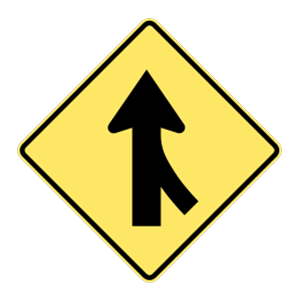
Honk at incoming traffic.
Always remain at your present speed.
Speed up to avoid congesting traffic.
Move to another lane, if safe, to let traffic enter.
Q.39.
When driving in fog:
Use your parking lights.
Use your low beams.
Use your high beams.
It makes no difference which lights you use.
Q.40.
When passing another vehicle on a road with two lanes traveling in opposite directions, you should:
Return to the driving lane when there's enough room between you and the vehicle you passed.
Remain in the left lane if you intend to turn left.
Return to the right side of the roadway immediately.
Drive in either lane.
Support mcqgeeks.com by disabling your adblocker.
×
Please disable the adBlock and continue.
Thank you.
Reload page