MCQGeeks
CBSE
JEE
NTSE
NEET
English
UK Quiz
Quiz
Driving Test
Practice
Games
Driving Test
Idaho
Idaho Car Driving Permit Test-4
Answers
Q.1.
If you drink alcohol socially, what helps ensure safe driving?
Drink coffee before driving.
Ride home with a friend who has not been drinking.
Take a cold shower before driving.
Stop drinking one half hour before driving.
Q.2.
Road rage and aggressive driving may be reduced by:
Allowing extra travel time.
Obeying posted speed limits.
Using proper turn signals.
All of the above.
Q.3.
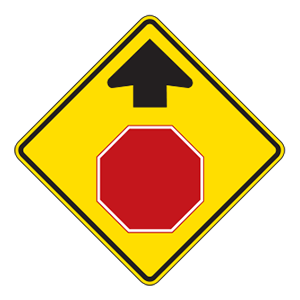
This sign means:
Stop ahead.
Buggy warning.
Limited parking.
Do not block intersection.
Q.4.
When exiting a highway, you should slow down:
On the main road, just before the exit lane.
Once you see a toll booth.
Once you have moved into the exit lane.
When you first see the exit sign.
Q.5.
You may drive across a dashed white line:
At any time.
Only during daylight hours.
When it is safe to change lanes.
Only when passing a motorcycle.
Q.6.
Emergency vehicles:
Have the right-of-way when using sirens, horns, and/or flashing lights.
May use a loudspeaker to give instructions.
May follow each other.
All of the above.
Q.7.
When you hear the siren or see the flashing lights of an approaching emergency vehicle, you must:
Slow down until it passes you.
Drive to the right side of the road and stop.
Motion for the emergency vehicle to pass you.
Merge into the right lane and continue driving.
Q.8.
When you approach a railroad crossing without flashing warning signals or crossing gates, you should:
Cross the tracks immediately and as quickly as possible.
Always stop before crossing the tracks.
Prepare to yield to any train at the crossing.
Speed up to beat any oncoming train.
Q.9.
To enter a freeway:
Signal, yield to existing traffic, and enter at the same speed that traffic is moving.
Signal and enter the freeway. Freeway traffic must yield.
Drive slowly so you can check traffic.
Always come to a complete stop first.
Q.10.
When approaching a steady green traffic light, drivers should:
Continue driving, unless there are vehicles or pedestrians already in the intersection.
Stop if a police officer is nearby.
Treat the intersection like a four-way stop.
Come to a complete stop before proceeding.
Q.11.
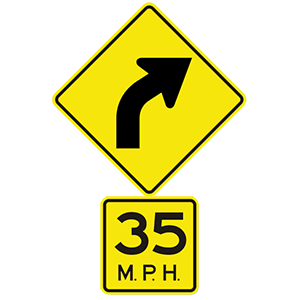
This road sign means:
The road ahead curves right. Slow down to the safe speed indicated.
Divided highway begins. Slow down to the safe speed indicated.
Merge. Slow down to the safe speed indicated.
Winding road ahead. Slow down to the safe speed indicated.
Q.12.
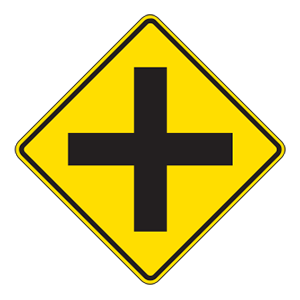
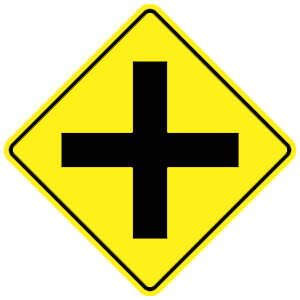
This sign means:
Crossroad ahead.
Flagger ahead.
Lane ends.
Turn right or go straight.
Q.13.
When driving on roads that may be slippery:
Always drive at the maximum speed limit.
Use cruise control to maintain a steady speed.
Reduce your following distance.
Do not make any sudden changes in speed or direction.
Q.14.
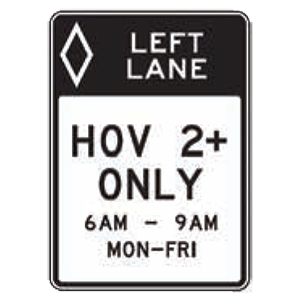
This road sign means:
The left lane is reserved for vehicles with a specific number of occupants.
Specific turning movements are allowed from specific lanes.
Do not enter.
Drivers in both lanes are responsible for merging smoothly.
Q.15.
You are waiting to turn left at a multilane intersection and opposing traffic is blocking your view. You should:
Accelerate rapidly when the first lane you need to cross is clear.
Wait until you can see all the lanes you need to cross before going ahead with your turn.
Wait for an oncoming driver to wave you across the intersection.
Edge your car into each lane of opposing traffic as soon as it clears.
Q.16.
If a crossing guard is directing traffic in a school zone, you must:
Follow the directions given by the crossing guard.
Copy what surrounding traffic is doing, despite the crossing guard's instructions.
Assume the guard is not supposed to be directing traffic.
Follow rules that would be in place if no children were present.
Q.17.
What should you do if your vehicle’s right wheels leave the pavement?
Stop quickly.
Immediately pull all the way off of the road and get back on when it is safe.
Accelerate and steer back on the road quickly.
Take your foot off the accelerator, slow down, then ease back onto the road when it is safe to do so.
Q.18.
If you miss your exit on an interstate expressway:
Stop and make a U-turn.
Get off at the next exit and come back to the exit you missed.
Roll down your window and ask the driver next to you for help.
Back up on the highway.
Q.19.
When you hear a fire engine siren behind you, you must:
Slow down until it passes you.
Drive with your flashers on.
Pull over to the side of the road and stop.
Speed up and take the nearest exit.
Q.20.
Signs indicating areas of public recreation are:
Orange.
Red.
Green.
Brown.
Q.21.
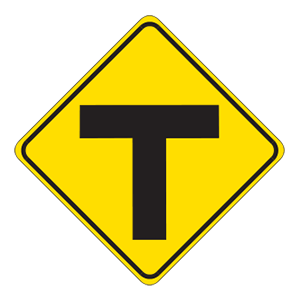
This sign means:
T intersection.
Lane shifting.
Side road.
Do not block intersection.
Q.22.
This sign means:
Slow down if an emergency vehicle is approaching.
Look both ways as you cross the intersection.
Always come to a full stop at the intersection.
Slow down and be prepared to stop if necessary.
Q.23.
When passing other vehicles:
Check your mirrors and blind spots.
Honk your horn at least three times.
Re-enter your lane within 10 feet of the passed vehicle.
There is no need to signal.
Q.24.
When you see an emergency vehicle with flashing lights, you must:
Slow down and keep moving in your lane.
Keep driving in your lane.
Pull to the right curb and stop.
Stop exactly where you are.
Q.25.
Distracted drivers are at a greater risk of a crash when they are using which of the following?
CD player
Radio
Cell phone
All of the above
Q.26.
On a two-lane street, your vehicle is being followed by a fire engine that is not using its emergency signals. You should:
Continue to drive in a normal manner.
Stop as quickly as you can.
Speed up to get out of its way.
Slow down, move as far to the right as possible, and stop.
Q.27.
This sign means:
All traffic must turn.
Turn right at the intersection.
Parking area ahead.
Crossroad ahead. Watch for traffic.
Q.28.
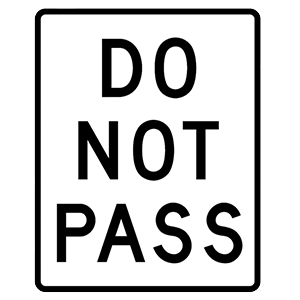
If you see this sign, you:
Must not pass another vehicle.
May pass a slow-moving vehicle if you can do so quickly.
May pass if you know the road ahead.
May pass, but only at night.
Q.29.
To be safe when crossing a railroad, you should:
Look both ways, but only when the red light is flashing.
Listen, look both ways, and then proceed if it is safe to do so.
Cross especially quickly when a train is approaching.
Quickly pass under any lowering gates.
Q.30.
You come to an intersection displaying a flashing red light. You should:
Come to a full stop and go when it is safe to do so.
Stop only if other cars are also approaching the intersection.
Stop only if other cars are already within the intersection.
Slow down and be prepared to stop, if necessary.
Q.31.
When changing lanes, you should:
Rely on your mirrors.
Begin signaling as you move into the next lane.
Signal at least 500 feet before your lane change when driving on residential streets.
Always check your blind spot.
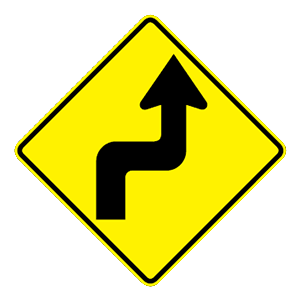
Q.32.
This road sign means:
The road ahead turns sharply right, then left.
The road ahead turns sharply left, then right.
The road ahead curves to the left.
Construction ahead.
Q.33.
This green arrow on a lane use control signal means:
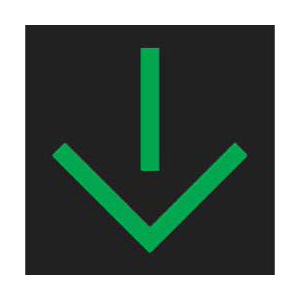
You may use this lane.
No traffic is allowed in this lane.
You have the right-of-way.
You must merge into this lane.
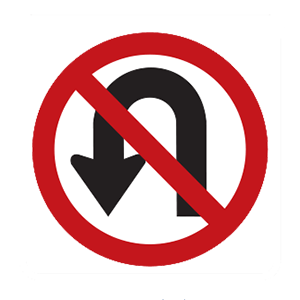
Q.34.
This sign means:
No U-turn.
Two-way left turn.
Minimum speed limit.
No parking.
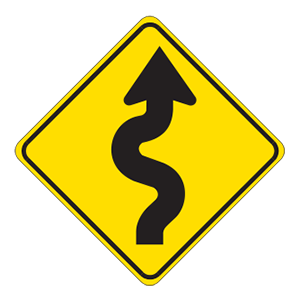
Q.35.
This sign means:
Winding road.
No parking.
Right lane closed.
Multiple turns.
Q.36.
When you see other drivers around you acting or reacting in anger:
Don’t make eye contact.
Don't react with hand gestures.
Distance yourself from the situation.
All of these.
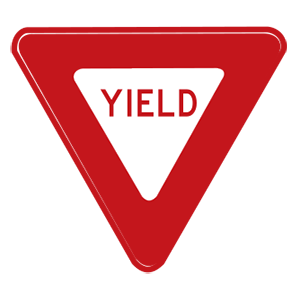
Q.37.
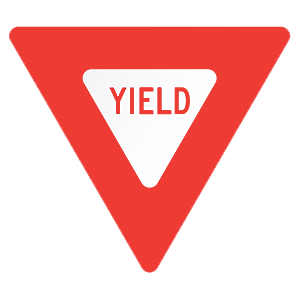
This sign means:
Yield.
Crossroad ahead.
Keep right.
Yield ahead.
Q.38.
When passing a large vehicle, the driver of a small vehicle must be prepared for:
Loud noises.
Excess air pollution.
Wind gusts produced by the large vehicle.
Falling vehicle parts.
Q.39.
A yellow and black diamond-shaped sign:
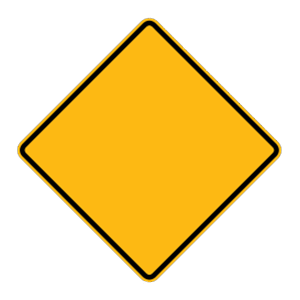
Warns you about conditions on or near the road.
Helps direct you to cities and towns ahead.
Tells you about traffic laws and regulations.
Tells you about road construction ahead.
Q.40.
If an aggressive driver cuts you off, you should:
Call the police immediately.
Stay calm and move out of the aggressive driver's way.
Flash your vehicle's lights to let the aggressive driver know he is wrong.
Use a driving action of your own to get back at the aggressive driver.
Support mcqgeeks.com by disabling your adblocker.
×
Please disable the adBlock and continue.
Thank you.
Reload page