MCQGeeks
CBSE
JEE
NTSE
NEET
English
UK Quiz
Quiz
Driving Test
Practice
Games
Driving Test
Idaho
Idaho Motorcycle Driving Permit Test-10
Answers
Q.1.
Which of the following is not a benefit of maintaining a cushion of space between your motorcycle and other vehicles?
You have more time to react to the movements of other drivers.
You have space to maneuver.
You have limited escape route options.
Q.2.
The key to making a quick turn is to:
Shift your weight quickly.
Turn the handlebars quickly.
Get your motorcycle to lean quickly.
Q.3.
When you are being passed on the left, you should:
Speed up.
Ride in the right portion of the lane.
Ride in the center portion of the lane.
Q.4.
Passengers should:
Hold onto the rider's hips, waist, or belt.
Never hold onto the rider.
Not lean into any turn.
Q.5.
When selecting a jacket that will be used as protective apparel, a motorcycle rider should look for a jacket that is:
Black, or another dark color.
Warm.
Made of leather or synthetic materials.
Q.6.
__________ can be a cause of collisions involving motorcycles.
Tailgating
Inappropriately sounding a horn
Communicating with other drivers
Q.7.
When passing a row of parked vehicles, a motorcycle rider has an advantage over an automobile driver because:
The motorcycle can accelerate more quickly than a car.
The motorcyclist can ride in the left part of the lane to avoid people and cars to their right.
Motorcycles have a shorter stopping distance than cars do.
Q.8.
You should pick a lane position that:
Best increases your visibility and allows for a safe cushion of space.
You like, without regard to others.
Gets you close to other vehicles.
Q.9.
If you are riding behind another vehicle at night, you can determine if there are bumps on the road ahead by:
Listening for the other vehicle scraping against the pavement.
Noticing the other vehicle’s taillights bouncing up and down.
Looking at the rear bumper of the vehicle ahead and trying to determine if it is bouncing.
Q.10.
Mirrors on motorcycles:
Have blind spots, just like cars.
Do not have blind spots.
Are not required.
Q.11.
When passing a vehicle, you:
May exceed the speed limit by 10 mph.
Must not exceed the speed limit.
Are required to ride faster than the speed limit.
Q.12.
Before riding, a motorcycle operator should check the clutch. A properly working clutch should feel:
Loose and rough.
Tight and smooth.
Loose and smooth.
Q.13.
Hearing protection:
Is not needed when the rider is wearing a helmet.
Is only recommended for long trips.
Should be used on all rides.
Q.14.
What does a flashing red traffic light mean?
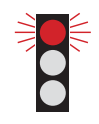
Come to a complete stop and proceed when it is safe to do so.
Only stop to yield to other traffic.
Vehicles will be entering the roadway.
Q.15.
A rider's boots or shoes should:
Be below their ankles.
Cover their ankles.
Be made of a soft, pliable material.
Q.16.
The risk of a head or neck injury is reduced:
By wearing a helmet.
By riding more slowly.
By reading the owner’s manual.
Q.17.
Which of the following is not a potential problem?
An upcoming change in road surface characteristics
Surrounding traffic
Conditions that do not appear to change as you approach
Q.18.
You are most likely to get into a collision:
At an intersection.
When riding in a group.
Traveling on the expressway.
Q.19.
Which of the following factors may affect the blood alcohol content (BAC) of a person?
The amount of alcohol consumed
The drinker's height
The temperature outside
Q.20.
Which brake is more powerful on a motorcycle?
The front brake
The rear brake
Both brakes are equally powerful.
Q.21.
As you consume more alcohol, your ability to safely ride:
Increases.
Stays the same.
Decreases.
Q.22.
The safest part of the lane:
Is always the left portion of the lane.
Is always the right portion of the lane.
Changes depending on the situation.
Q.23.
Footrests:
May be shared by the driver and passenger
Are required for the driver and passenger
Are not required
Q.24.
Where should you position your motorcycle when entering a curve?
The outside of the curve
The inside of the curve
Wherever traffic and road conditions require
Q.25.
To swerve correctly, you should:
Shift your weight quickly.
Turn the handlebars quickly.
Press the handgrip in the direction of the turn.
Support mcqgeeks.com by disabling your adblocker.
×
Please disable the adBlock and continue.
Thank you.
Reload page