MCQGeeks
CBSE
JEE
NTSE
NEET
English
UK Quiz
Quiz
Driving Test
Practice
Games
Driving Test
Idaho
Idaho Motorcycle Driving Permit Test-6
Answers
Q.1.
When cars are merging from an entrance ramp:
A motorcyclist should assume the entering drivers see them.
A motorcyclist should never assume the entering drivers see them.
A motorcyclist should stop.
Q.2.
As a rider, you can lessen your chances of being involved in an accident by:
Not looking ahead for hazards.
Refraining from using turn signals, as doing so could distract other drivers.
Being visible to other drivers.
Q.3.
The best way to avoid fatigue when riding your motorcycle on a long trip is to:
Take frequent breaks to rest.
Ride as fast as possible.
Take artificial stimulants.
Q.4.
A flat front tire is especially dangerous because:
The front tire affects your steering, which also affects your balance.
The front tire being flat will disable the front brake.
The front tire being flat will prevent you from accelerating.
Q.5.
One problem with a motorcyclist riding directly next to another vehicle is that:
The other vehicle may block the motorcyclist's escape route.
The motorcyclist can be easily seen by other drivers.
The motorcyclist may not be able to read signs on the side of the road.
Q.6.
Your lane position should do all of the following, except:
Provide you with an escape route.
Help you receive wind blasts.
Communicate your intentions to other drivers.
Q.7.
When riding in the rain, you should:
Ride down the center of your lane.
Ride on the right side of your lane.
Ride in tire tracks left by other cars.
Q.8.
Usually a good way to handle tailgaters is to:
Get off the roadway.
Change lanes and let them pass.
Ride faster.
Q.9.
Which of the following is not a factor in determining a person's blood alcohol content (BAC)?
The amount of alcohol consumed
How quickly the alcohol is consumed
How often the person consumes alcohol
Q.10.
In general, which position within a lane is the best to ride in?
The left position
The right position
There is no single best lane position.
Q.11.
To reduce the chances of a collision, a motorcyclist should:
Stare straight in front of their motorcycle.
Be unwilling to move to avoid a potential hazard.
Scan their path of travel, looking at least 10 to 15 seconds ahead of their motorcycle.
Q.12.
When riding on a slippery surface, you should:
Avoid making sudden moves, as doing so could cause a skid.
Travel on the shoulder to be out of the way of traffic.
Use only the rear brake because the front brake is ineffective on slippery surfaces.
Q.13.
Under normal riding conditions, one of the best ways to help others see your motorcycle is:
To flash your lights.
To keep your high beam headlight turned on.
To ensure that your motorcycle is painted a dark color.
Q.14.
When crossing angled railroad tracks, it is usually best to:
Use the shoulder of the road to slow down before crossing the tracks.
Walk your motorcycle across the tracks.
Continue straight within your lane to cross the tracks.
Q.15.
Pick a lane position that:
Helps you avoid road hazards.
Hides you from other road users.
Places you directly next to another vehicle.
Q.16.
For motorcycle operators, eye protection is:
Required.
Not required, but recommended.
Not recommended.
Q.17.
A motorized scooter can:
Only be operated during the day.
Be operated without a driver license.
Be operated with any class of driver license.
Q.18.
To properly control a motorcycle, you should:
Allow your feet to hang off the footrests.
Sit so your arms hold up your body.
Keep your knees against the gas tank.
Q.19.
Experienced riders use the acronym "SIPDE" as a way to stay aware of conditions around them. What does the "D" stand for in "SIPDE?"
Drive
Donor
Decide
Q.20.
You should pick a lane position that:
Best increases your visibility and allows for a safe cushion of space.
You like, without regard to others.
Gets you close to other vehicles.
Q.21.
If you must stop quickly, you should:
Use the front brake only.
Use the front brake first.
Use the front brake at the same time as the rear brake.
Q.22.
Of the following, which is not a reason to keep a cushion of space between your motorcycle and the vehicle in front of you?
It allows you more time to respond to hazards.
It prevents you from finding an escape route.
It provides space to maneuver your motorcycle.
Q.23.
Most motorcycle/automobile accidents occur:
At intersections.
On the open road.
In parking lots.
Q.24.
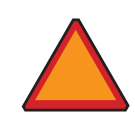
What does this sign mean?
Yield
Slow-moving vehicle
Railroad crossing
Q.25.
The center portion of a lane contains an oily strip. This strip:
Should be avoided at all times.
Usually provides adequate traction for riding, unless it is raining.
Should only be traveled upon if you are sharing the lane with another vehicle.
Support mcqgeeks.com by disabling your adblocker.
×
Please disable the adBlock and continue.
Thank you.
Reload page