MCQGeeks
CBSE
JEE
NTSE
NEET
English
UK Quiz
Quiz
Driving Test
Practice
Games
Driving Test
Idaho
Idaho Motorcycle Driving Permit Test-8
Answers
Q.1.
When preparing to ride with a passenger, instruct the passenger to:
Get onto the motorcycle before you.
Sit as far back as possible.
Hold firmly onto your waist, hips, or belt.
Q.2.
Motorcycles may pass on the right:
If there is at least eight feet of unobstructed pavement.
By riding on the shoulder of the road.
By riding on the grass, if it is level.
Q.3.
Unlike other beverages, alcohol:
Is absorbed into the bloodstream right away.
Needs to be digested.
Doesn’t affect humans.
Q.4.
If your motorcycle starts to weave while riding over uneven metal bridge gratings, you should:
Downshift immediately to a lower gear.
Proceed in a zigzag pattern until you cross the bridge.
Relax and steer straight.
Q.5.
If you borrow a motorcycle, you should:
Assume all controls are in the same location as they are on your motorcycle.
Immediately take it out on the highway.
Get familiar with it in a controlled area.
Q.6.
Blind spots on motorcycles:
Are nothing to worry about.
Should be consistently checked by riders.
Don't exist if the motorcycle has a rearview mirror.
Q.7.
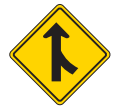
What does this sign mean?
Two-way traffic
Right lane ends
Merge
Q.8.
If a motorcycle rider takes a turn too fast, they may:
Have increased control of their motorcycle.
Experience a more stable ride.
Unintentionally leave the road.
Q.9.
How do convex mirrors differ from regular mirrors?
They provide a more narrow view of the road.
They provide a wider view of the road.
They provide a better view of the road.
Q.10.
If a motorcycle is towing a trailer, the motorcyclist's following distance should:
Increase.
Decrease.
Be the same as it normally would be.
Q.11.
When riding at night:
Only ride in the left portion of the lane to better see around other vehicles ahead.
Ride closely to the vehicle in front of you to most effectively use their headlights.
Reduce your speed to increase your chances of avoiding an unexpected hazard.
Q.12.
The best footwear for motorcyclists are:
Sneakers.
Sturdy boots.
Sandals.
Q.13.
There is the greatest potential for conflict between a motorcycle and other traffic:
On the highway.
At intersections.
On rural roads.
Q.14.
Under normal conditions, a motorcyclist should maintain a following distance of at least:
Two seconds.
Three seconds.
Four seconds.
Q.15.
Before starting a turn, a motorcyclist should change gears to:
Prevent a change in power in the middle of the turn.
Be able to keep both hands on the handle grips during the turn.
Prevent the motorcycle from slowing down.
Q.16.
A plastic, shatter-resistant face shield:
Protects your face, but not your eyes.
Protects your eyes, but not your whole face.
Helps protect your whole face.
Q.17.
Mirrors on motorcycles:
Have blind spots, just like cars.
Do not have blind spots because a motorcycle is usually smaller than a car
Are not required.
Q.18.
When stopping your motorcycle while carrying a passenger, you should:
Ride a little faster than you normally would.
Start slowing earlier than you normally would.
Merge into smaller gaps of traffic than you normally would.
Q.19.
Which lane position is usually best for minimizing the risk of other vehicles sharing your lane?
The left portion of the lane
The center portion of the lane
The right portion of the lane
Q.20.
If possible, do not ride directly next to another vehicle because:
Another driver may want to use your lane to pass.
You may be in the vehicle’s blind spot.
You may have access to escape routes.
Q.21.
If traveling with a load, the load should be:
Secured as low as possible.
Secured as high as possible.
Attached to a sissy bar.
Q.22.
The oily strip down the center of a lane:
Should only be traveled upon if you are sharing the lane with another vehicle.
Usually provides adequate traction for riding, unless it is raining.
Should be avoided at all times.
Q.23.
When riding, you should wear:
Bright clothing.
Dark clothing.
Clothes that are uncomfortable.
Q.24.
To swerve correctly, you should:
Shift your weight quickly.
Turn the handlebars quickly.
Press the handgrip in the direction of the turn.
Q.25.
If bright sunlight makes it difficult for drivers to see a motorcycle's mechanical turn signals, the rider should:
Continue to use the mechanical turn signals.
Honk their horn to inform other drivers of any upcoming turns.
Use hand signals.
Support mcqgeeks.com by disabling your adblocker.
×
Please disable the adBlock and continue.
Thank you.
Reload page