MCQGeeks
CBSE
JEE
NTSE
NEET
English
UK Quiz
Quiz
Driving Test
Practice
Games
Driving Test
Indiana
Indiana Car Driving Permit Test-12
Answers
Q.1.
If two drivers arrive at the same time to a four-way intersection controlled by stop signs:
The driver on the right has the right-of-way.
The driver on the left has the right-of-way.
One driver may continue driving without stopping.
One driver should honk to indicate that they are giving up the right-of-way.
Q.2.
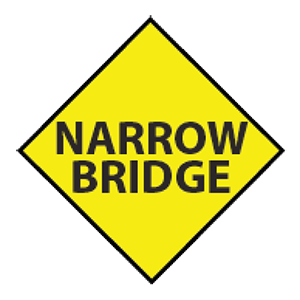
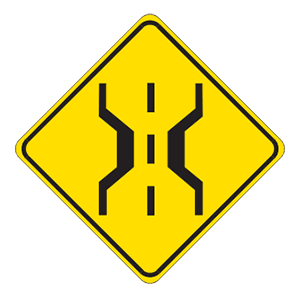
This sign means:
Trucks are permitted on an upcoming narrow bridge.
The bridge ahead is open to one-way traffic only.
The bridge ahead is wide enough for only one car at a time.
The bridge ahead may be too narrow to meet or pass a truck.
Q.3.
Lanes of traffic moving in the same direction are divided by ____ lines.
Yellow
White
Red
Black
Q.4.
Which of the following about winter driving is not true?
Winter is the most difficult driving season.
Checking your vehicle's antifreeze and windshield washer fluid levels is especially important during the winter.
Using cruise control in winter weather is a safe thing to do.
It is best to use snow tires on your vehicle.
Q.5.
Which of the following statements is true?
A sudden change in weather calls for a change in driving.
You should slow down when driving in rain and fog.
Be particularly aware of vehicles coming up behind you in inclement weather.
All of the above.
Q.6.
A person walking with a white cane or guide dog is likely to be:
A deaf person.
A person involved with a traffic study.
A blind person.
None of the above.
Q.7.
A speed restriction sign:
May be ignored in rainy, snowy, or icy conditions.
Has a triangular shape.
Is blue with black lettering.
Shows a recommended speed for a curve or turn.
Q.8.
What is the only way to reduce your blood alcohol concentration (BAC)?
Drink coffee.
Exercise.
Allow your body time to get rid of the alcohol.
Take a cold shower.
Q.9.
What are the colors of signs that tell you the distance to the next exit on a highway?
Yellow with black letters
Black with white letters
Red with white letters
Green with white letters
Q.10.
When approached by an emergency vehicle that is using its siren and/or flashing lights, a driver must immediately:
Pull to the right and stop.
Pull to the right and slow down.
Pull to the right and turn on their vehicle's four-way flashers.
Stop and let the emergency vehicle pass.
Q.11.
Round signs indicate:
No passing zones.
School zones.
Upcoming railroad crossings.
Hospitals.
Q.12.
Compared to driving during the day, driving at night is:
Less dangerous.
No more or less dangerous.
More dangerous.
Easier on your eyes.
Q.13.
This sign means:
Two-way traffic.
Lane shifting.
Low clearance.
Added lane.
Q.14.
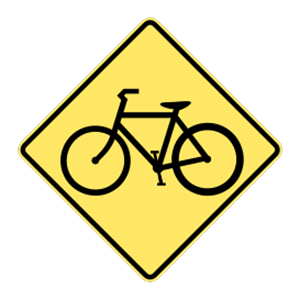
This sign means:
Watch for bicycles.
Bicycles not allowed.
Bicycle repair shop ahead.
Bicycles have the right-of-way.
Q.15.
Which of the following is true about driving on a wet roadway?
As you drive faster, your tires become less effective.
Water does not affect cars with good tires.
Deep water is less dangerous than shallow water.
As you decrease your speed, the roadway becomes more slippery.
Q.16.
A solid yellow line on your side of the centerline means:
Slow down.
Pass with caution.
Do not pass.
Keep right on hills.
Q.17.
When the road is marked with a solid yellow line and a broken yellow line, with the broken line next to your lane, you may pass:
Only in an emergency.
If you are on an expressway.
If traffic is clear.
Only at an intersection.
Q.18.
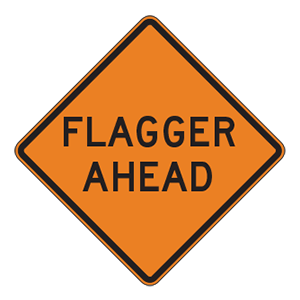
This sign means:
Flagger ahead.
Do not block intersection.
Side road.
Right lane closed.
Q.19.
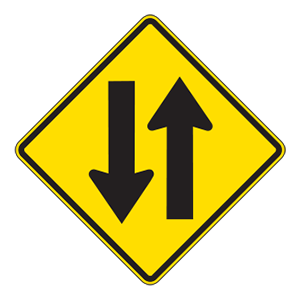
This sign means:
One-way traffic.
Two-way left turn.
Two-way traffic.
Minimum speed limit.
Q.20.
The “No zone” is:
A term used to describe blind spots around a truck or bus.
A special speed zone.
A roadway with restrictions on vehicle stereo volume.
The television show that replaced The Twilight Zone.
Q.21.
If you leave your vehicle unattended, you must:
Turn off the engine.
Lock the ignition and remove the key.
Set the parking brake.
All of the above.
Q.22.
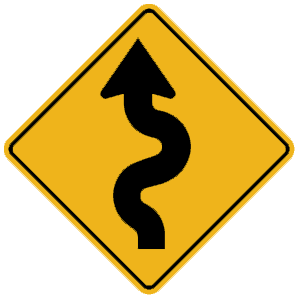
This sign tells you that:
No turns are allowed on this road.
The road narrows ahead.
There are a series of curves ahead.
The road may be slippery when wet.
Q.23.
You are making a left turn from a two-way street onto a one-way street. When you have completed the turn, your car should be:
In the right lane of the street.
In the center of the street.
In the left lane of the street.
In the lane with the least traffic.
Q.24.
You may avoid the risks of alcohol-related crashes by:
Deciding before you start drinking that you are not going to drive.
Simply saying, "No thanks, I'm driving," if someone offers you a drink.
Calling a taxi.
Doing any of the above.
Q.25.
A flashing yellow light at an intersection means that you should:
Slow down and proceed with care.
Continue normally through the intersection.
Stop and proceed when a green light appears.
Stop and proceed when the way is clear.
Q.26.
____ greatly increase stopping distances and severity of crashes.
High speeds
Slow speeds
Night drives
Uphill inclines
Q.27.
If your turn signals fail, you should use ____ to indicate that you are turning.
Your horn
Your headlights
Hand signals
Your emergency flashers
Q.28.
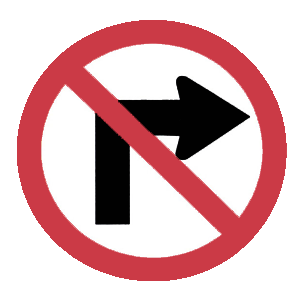
This road sign means:
No left turn.
No U-turns.
No exit.
No right turn.
Q.29.
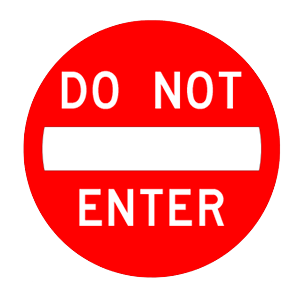
This sign means:
Heavy traffic ahead.
Do not enter.
Railroad crossing.
Yield.
Q.30.
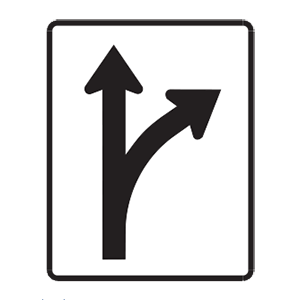
This sign means:
Turn right or continue straight.
Left on arrow only.
Do not enter.
Two-way left turn.
Q.31.
When driving on slick roads, you should:
Take turns more slowly than usual.
Change lanes quickly.
Accelerate quickly.
Brake hard.
Q.32.
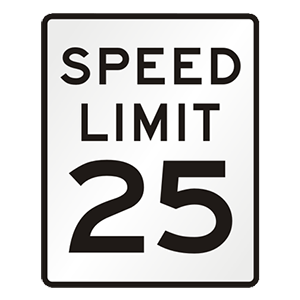
The posted speed limit shows:
Only a recommended driving speed.
The exact speed at which you must travel to avoid a ticket.
The maximum safe driving speed under ideal road and weather conditions.
The maximum safe driving speed under all road conditions.
Q.33.
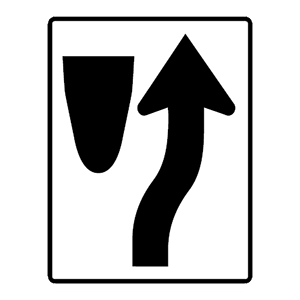
This road sign means:
Side road.
Keep to the side indicated by the arrow.
You may drive in the left lane.
You have the right-of-way.
Q.34.
You should be cautious when passing a bicycle because:
You are moving faster than the bicycle.
The bicycle always has the right-of-way.
Oncoming traffic may not see you pull out to pass the bicycle.
The cyclist may have to swerve into traffic to avoid an object on the road.
Q.35.
You are driving on a divided multilane highway and see or hear the signal of an approaching emergency vehicle. You should:
Disregard the signal if there are other lanes available for the emergency vehicle.
Stop as quickly as you can.
Slow down, move your vehicle to provide a clear path for the emergency vehicle, and stop.
Increase your speed to get out of the way of the emergency vehicle.
Q.36.
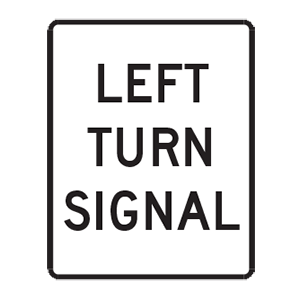
This sign means:
Left turn signal.
Added lane.
Turn right or go through.
Multiple turns.
Q.37.
Your body gets rid of approximately:
Three alcoholic drinks an hour.
One alcoholic drink an hour.
Two alcoholic drinks an hour.
None of the above.
Q.38.
Double solid yellow lines painted down the middle of the road mean:
Railroad crossing ahead.
Pedestrian crossing ahead.
Passing is not permitted from either direction.
Passing is permitted from either direction.
Q.39.
A load extending more than ____ beyond the rear of a vehicle must be marked by a red flag during the day.
One foot
Two feet
Three feet
Four feet
Q.40.
Increasing your vehicle’s speed:
Increases your field of vision.
Decreases your field of vision.
Makes it easier to see cross traffic.
Has no effect on your field of vision.
Q.41.
To safely pass a bicycle, you should:
Honk at the bicyclist to let them know you're trying to pass.
Drive in the bicycle lane until you get a chance to pass.
Slow down and give them as much space as possible.
Rush ahead to pull in front of the bicyclist.
Q.42.
A diamond-shaped sign is a:
Road hazard sign.
Interstate route sign.
School crossing sign.
Speed limit sign.
Q.43.
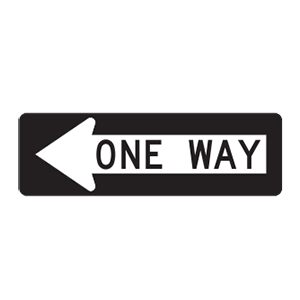
This sign means:
Narrow bridge.
One-way.
No parking anytime.
No turn on red.
Q.44.
When changing lanes, you can check your blind spots by:
Using the inside rearview mirror.
Using the outside rearview mirror.
Using both inside and outside rearview mirrors.
Turning your head and looking over your shoulder.
Q.45.
Alcohol:
Slows reflexes and reaction time.
Puts you to sleep.
Wakes you up.
Improves your judgment.
Q.46.
When turning or changing lanes, you must:
Always signal your intentions, even when no visible traffic is present.
Signal only if there is visible traffic.
Signal only when driving at night.
Signal only when driving in heavy traffic at night.
Q.47.
Which of the following lights indicates that you should slow down and proceed with caution at an intersection?
A flashing yellow light
A flashing red light
A solid yellow light
A solid red light
Q.48.
Overpercent of all fatal collisions have been recorded as having ____ as the primary cause.
Driver action
Malfunctioning traffic signals
Unsafe road conditions
Defective vehicles
Q.49.
What is the first thing you should adjust, if needed, when you get into a car to drive?
Your seat belt
The steering wheel
Your rearview mirror
Your seat
Q.50.
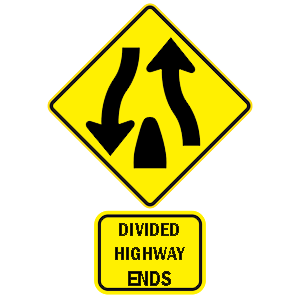
This sign means:
One-way traffic.
Divided highway ends.
Two-way traffic.
Keep left.
Support mcqgeeks.com by disabling your adblocker.
×
Please disable the adBlock and continue.
Thank you.
Reload page