MCQGeeks
CBSE
JEE
NTSE
NEET
English
UK Quiz
Quiz
Driving Test
Practice
Games
Driving Test
Iowa
Iowa Car Driving Permit Test-1
Answers
Q.1.
You want to back out of your driveway. You see children playing nearby. Before you start to move your car, you should:
Rev your engine to warn the children that you are moving.
Sound your horn so the children will hear you.
Walk to the back of the car to be sure the way is clear.
Tell the children to stay away from the driveway.
Q.2.
Which of the following statements is true?
A sudden change in weather calls for a change in driving.
You should slow down when driving in rain and fog.
Be particularly aware of vehicles coming up behind you in inclement weather.
All of the above.
Q.3.
What are the colors of warning signs indicating upcoming hazards?
Black letters or symbols on a white background
Black letters or symbols on a yellow background
White letters or symbols on a blue background
White letters or symbols on a green background
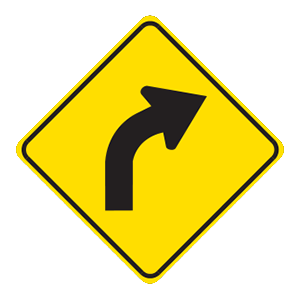
Q.4.
This sign means:
Do not drink and drive.
Slippery when wet.
Road curves ahead.
Q.5.
A red arrow pointing to the right on a traffic light means you may:
Turn in that direction after slowing and checking for traffic.
Not turn in that direction until the light turns green.
Turn in that direction after you come to a complete stop.
Q.6.
Roads with double solid yellow line markings down the center indicate that passing is:
Allowed from both directions.
Allowed only from your direction of travel.
Not allowed from either direction.
Q.7.
Which of the following is most likely to be slippery in cold weather after snow or rain?
A hilly, open road
A residential road
A road in a shaded area
Q.8.
When approaching a police car, tow truck, or utility vehicle that is parked along the road while displaying its flashing lights, what should you do?
Stop abruptly.
Continue as usual.
Change lanes and slow to a reasonable and safe speed as you pass.
Q.9.
A broken yellow line beside a solid yellow line indicates that:
Passing is permitted from the lane next to the solid yellow line.
Passing is not permitted from either direction.
Passing is permitted from the lane next to the broken yellow line.
Q.10.
To enter a freeway:
Signal, yield to existing traffic, and enter at the same speed that traffic is moving.
Signal and enter the freeway. Freeway traffic must yield.
Drive slowly so you can check traffic.
Always come to a complete stop first.
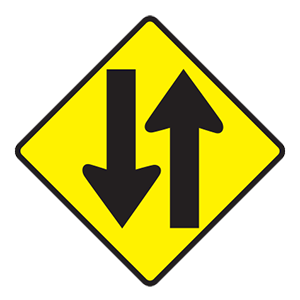
Q.11.
This sign means:
You can travel in either direction in this lane.
There is two-way traffic.
You are approaching a divided highway.
Q.12.
This sign means:
Curve ahead.
Roadwork ahead.
Merging traffic.
No left turn.
Q.13.
What does an orange-colored sign indicate?
The start of a no passing zone.
A railroad crossing is ahead.
A school zone is ahead.
The presence of construction work.
Q.14.
Motorcycles, scooters, and mopeds are not easy to see; therefore, you should:
Slow down when driving.
Make constant visual checks.
Share a lane with a motorcycle.
Q.15.
A flashing red traffic signal at an intersection has the same requirements as:
A slow sign.
A yield sign.
A stop sign.
An intersection sign.
Q.16.
When driving past a vehicle that has just stopped in a parked position on the side of the road, you should:
Assume that the driver will open the car door as you approach.
Speed up.
Slam on your brakes.
Assume that the driver will wait for you to pass before opening the door.
Q.17.
When approaching a school bus stopped with its stop arm extended, drivers should:
Come to a complete stop and wait to proceed.
Honk their horn before passing the bus on its left.
Continue driving when they think most kids are probably done exiting the bus.
Pass the bus before its door opens.
Q.18.
You come to an intersection with a flashing red light. You must:
Slow down and drive carefully through the intersection.
Turn either right or left, since the road is blocked ahead.
Stop at the intersection and wait for a flashing green light.
Stop at the intersection, then proceed as traffic allows.
Q.19.
If you experience a tire blowout:
Take your foot of the gas.
Do not immediately use your brakes.
Gradually slow down and pull off the side of the road.
All of the above.
Q.20.
When making a turn, you must ____ your speed.
Increase
Maintain
Vary
Reduce
Q.21.
What should you do when you see this sign?
Look for a train station ahead.
Signal before going any further.
Slow down and yield for trains.
Stop.
Q.22.
Headlights are required when visibility is less than:
100 feet.
300 feet.
500 feet.
Q.23.
A leaky exhaust system in your vehicle is dangerous because it can cause:
A loss of hearing.
Pollution.
Carbon monoxide poisoning.
Poor engine performance.
Q.24.
This road sign means:
Sharp turn to the right.
Double curve.
Winding road.
Pavement ends.
Q.25.
“Highway hypnosis” is a driving condition that can result from:
Staring at the roadway for long periods of time.
Frequent rest stops.
Too much sleep the night before your trip.
Short trips on expressways.
Q.26.
If you drink alcohol socially, what helps ensure safe driving?
Drink coffee before driving.
Ride home with a friend who has not been drinking.
Take a cold shower before driving.
Stop drinking one half hour before driving.
Q.27.
This sign shows one type of:
Intersection.
Road curve.
Right turn.
Q.28.
Drivers turning left must yield to:
Overtaking cars.
Oncoming cars.
No one.
Q.29.
What does a single dashed yellow line separating traffic mean?
Drivers may pass if it is safe to do so.
Both lanes travel in the same direction.
Drivers may not pass.
Drivers may pass, even if it could be dangerous.
Q.30.
To prevent yourself from becoming an aggressive driver:
Relax and concentrate on driving.
Drive above the posted speed limit.
Tailgate the driver in front of you.
Q.31.
A broken yellow line beside a solid yellow line indicates that passing is:
Permitted from the side next to the solid yellow line.
Not permitted from either direction.
Permitted from the side next to the broken yellow line.
Q.32.
In traffic moving attomph, you are least likely to have an accident if you:
Drive a few miles per hour faster than most other vehicles.
Stay within that speed range.
Drive a few miles per hour slower than most other vehicles.
Q.33.
A steady green traffic light at an intersection means:
Increase your speed.
Adjust your mirrors.
You may continue through the intersection at a safe and reasonable speed, if it is clear to do so.
Q.34.
This sign means:
Divided highway.
Railroad warning.
No passing zone.
Q.35.
If your car becomes disabled while on the highway, you should:
Stop in the right lane.
Park with all four wheels off the traveled highway, if possible.
Stop where you are.
Support mcqgeeks.com by disabling your adblocker.
×
Please disable the adBlock and continue.
Thank you.
Reload page