MCQGeeks
CBSE
JEE
NTSE
NEET
English
UK Quiz
Quiz
Driving Test
Practice
Games
Driving Test
Iowa
Iowa Car Driving Permit Test-12
Answers
Q.1.
This sign means:
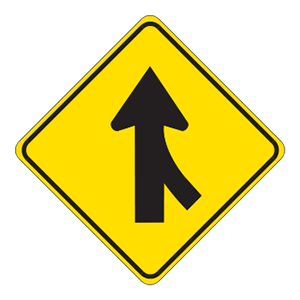
Merging traffic.
Multiple turns.
Lane shifting.
Do not block intersection.
Q.2.
What do speed limit signs indicate?
Potential driving speeds for the area
The maximum or minimum speed that is legally allowed to be driven
The speed drivers should drive in heavy traffic
The speed drivers should drive under poor conditions
Q.3.
You have the right-of-way when turning left on which of the following traffic signals?
A solid green light
A flashing yellow light
A green arrow pointing left
A flashing red light
Q.4.
Cell phones can be a serious source of driver distractions.
True
False
Q.5.
Roads become very slippery:
When it has been raining for an hour or more.
The day after it rains.
For the first 10 to 15 minutes of a rainstorm.
Right after the rain has stopped.
Q.6.
If the gates at a railroad crossing are down and red lights are flashing, you should:
Stop and proceed only when the gates are raised and the lights have stopped flashing.
Drive around the gates after stopping.
Drive side by side with the train.
Q.7.
To check your blind spot when changing lanes to the left, you should glance:
Over your right shoulder.
At your side mirror.
Over your left shoulder.
At your rearview mirror.
Q.8.
Yellow lines separate:
Traffic lanes on one-way streets.
Traffic moving in opposite directions on two-way roads.
All carpool lanes from regular traffic lanes.
Q.9.
Which of the following statements is true?
Signal at least 100 feet before changing lanes to pass and ensure there is no oncoming traffic.
Use your mirrors and look over your left shoulder to check your blind spot when passing to the left.
When passing, wait until you can see both headlights of the passed car in your rearview mirror before returning to your original lane.
All of the above.
Q.10.
Blind spots are:
Spots in your vision when you become fatigued.
Areas of the road that cannot be seen in a vehicle's mirrors.
Traffic control devices.
Q.11.
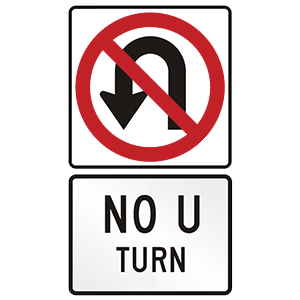
This road sign means:
Do not enter.
No parking.
No U-turn.
Q.12.
If you want to pass a pedestrian who is walking along the roadway and an oncoming vehicle is approaching, you should:
Slow down and let the oncoming vehicle pass before you pass the pedestrian.
Keep driving at a steady speed. The oncoming vehicle must stop for you.
Honk your horn to get the pedestrian to move over.
Q.13.
At an intersection with a yield sign, you should:
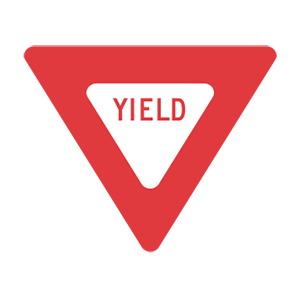
Always stop before entering the intersection.
Yield just to the traffic on the right.
Yield just to the traffic on the left.
Slow down and yield the right-of-way to other traffic.
Q.14.
On slippery roads, you should:
Slow down.
Drive more quickly.
Drive the speed limit, with caution.
Not drive more quickly than 20 mph.
Q.15.
A driver should:
Stare directly in front of their car.
Only focus on the middle of the road.
Watch beside, ahead, and to the rear of their car.
Q.16.
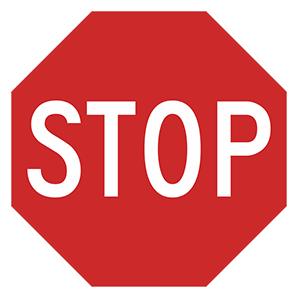
This road sign means:
Slow down or stop.
Stop if necessary.
You must come to a complete stop.
Q.17.
You should be cautious when passing a bicycle because:
You are moving faster than the bicycle.
The bicycle always has the right-of-way.
Oncoming traffic may not see you pull out to pass the bicycle.
The cyclist may have to swerve into traffic to avoid an object on the road.
Q.18.
If the rear of your vehicle is skidding to the left, you should:
Not turn your steering wheel.
Turn your steering wheel to the left to correct the skid.
Turn your steering wheel to the right to correct the skid.
Q.19.
If you are turning onto a street with more than one lane traveling in your direction, you should:
Turn into the lane closest to your previous lane.
Turn into the lane marked with an arrow.
Turn into the middle lane.
Turn into any lane.
Q.20.
At dawn or dusk and in rain or snow, it can be hard to see and be seen. A good way to let other drivers know you are there is to turn:
Up the instrumental panel lights.
On your parking lights.
On your headlights.
Q.21.
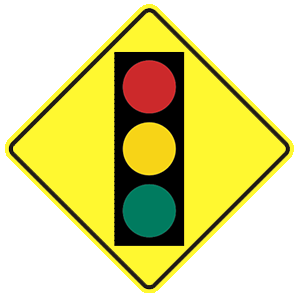
This sign means:
Emergency vehicles ahead.
Uncontrolled intersection ahead.
Four-way stop ahead.
Traffic signal ahead.
Q.22.
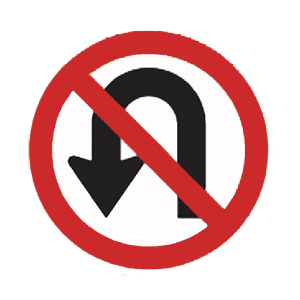
This sign means:
No turns.
No outlet.
No U-turns.
Q.23.
This yellow sign means:
One lane ahead.
Merging traffic ahead.
Lane ends ahead.
Q.24.
Your body gets rid of approximately:
Three alcoholic drinks an hour.
One alcoholic drink an hour.
Two alcoholic drinks an hour.
None of the above.
Q.25.
This sign means:
Railroad ahead.
No passing zone.
School zone.
Q.26.
An orange-colored sign like this means:
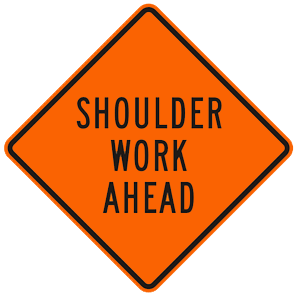
There is roadwork ahead.
You must change lanes ahead.
There is a detour ahead.
Q.27.
Which of these statements is true about large trucks?
They take longer to stop than passenger vehicles.
They all have air brakes that allow them to stop quickly.
They are more maneuverable than passenger vehicles.
Q.28.
Backing your vehicle is:
Always dangerous.
Dangerous if you have a helper.
Only dangerous in large vehicles.
Q.29.
If oncoming headlights are blinding you while you are driving at night, you should:
Look toward the right edge of the road.
Switch your lights to high beams.
Turn your lights on and off.
Q.30.
The best way to deal with tailgaters is to:
Speed up to increase the distance between you and the tailgater.
Slam on your brakes to get the other driver to back off.
Change lanes or gradually slow down to encourage them to pass.
Ignore them.
Q.31.
If your car starts to skid, turn your steering wheel:
To keep the front wheels straight.
In the direction you want the vehicle to go.
In the opposite direction of the skid.
In any direction. It doesn't matter.
Q.32.
When driving on an interstate:
Stop on the shoulder of the road if you are tired.
You should always use cruise control.
Signal, check mirrors, and check blind spots before changing lanes.
You should change lanes often.
Q.33.
Excessive speed:
Saves time so you can get to your destination more quickly.
Helps you maneuver around obstacles.
Increases the likelihood of serious bodily injury and death.
Q.34.
When should you yield your legal right-of-way?
Often, even at controlled intersections.
Whenever it helps prevent collisions.
Never. It confuses other drivers.
Q.35.
The driver's left arm and hand are extended downward. This hand signal means that the driver plans to:
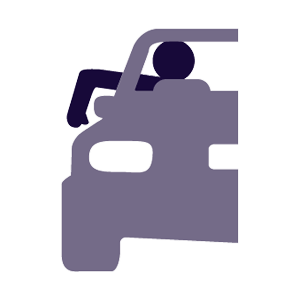
Turn left.
Turn right.
Stop.
Start up.
Support mcqgeeks.com by disabling your adblocker.
×
Please disable the adBlock and continue.
Thank you.
Reload page