MCQGeeks
CBSE
JEE
NTSE
NEET
English
UK Quiz
Quiz
Driving Test
Practice
Games
Driving Test
Iowa
Iowa Car Driving Permit Test-13
Answers
Q.1.
This sign means:
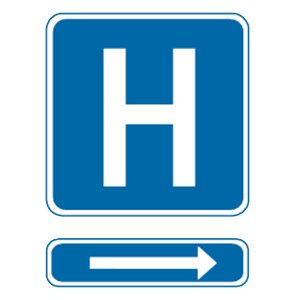
Highway changes ahead and to the right.
Hiking trails ahead and to the right.
Hotel ahead and to the right.
Hospital ahead and to the right.
Q.2.
When driving in fog:
Use your parking lights.
Use your low beams.
Use your high beams.
It makes no difference which lights you use.
Q.3.
When the road is marked with a solid yellow line and a broken yellow line, with the broken line next to your lane, you may pass:
Only in an emergency.
If you are on an expressway.
If traffic is clear.
Only at an intersection.
Q.4.
When you are merging onto the freeway, you should be driving:
At or near the speed of traffic on the freeway.
Five to 10 mph slower than the speed of traffic on the freeway.
The posted speed limit for freeway traffic.
Q.5.
When changing lanes, you should:
Rely on your mirrors.
Begin signaling as you move into the next lane.
Signal at least 500 feet before your lane change when driving on residential streets.
Always check your blind spot.
Q.6.
A regulatory sign containing a red circle with a slash through the middle indicates:
That drivers should come to a complete stop.
That an action is forbidden.
That some drivers should yield to other drivers.
That drivers should drive under the speed limit.
Q.7.
To avoid panic stops:
Watch for hazards well ahead of you on the roadway.
Drive with your window partly down.
Accelerate heavily.
Q.8.
As alcohol builds up in your blood, it:
Slows down your reactions.
Makes you feel less confident.
Begins to metabolize itself more quickly.
Decreases the number of driving errors.
Q.9.
The effect that lack of sleep has on your safe driving ability is the same as:
The effect that alcohol has.
The effect that amphetamines have.
The effect that anger has.
The effect that driving with teenagers has.
Q.10.
Downward-facing triangular signs:
Indicate school zones.
Tell drivers to yield.
Indicate construction zones.
Indicate railroad crossings.
Q.11.
When driving on the highway, consistently looking far ahead of your vehicle:
Helps you keep up with traffic.
Reduces the need for last-minute braking or turning.
Allows you to spot upcoming police officers.
Q.12.
You are driving on the freeway. The vehicle in front of you is a large truck. You should drive:
Closely behind the truck in bad weather because the driver can see farther ahead than you can.
Farther behind the truck than you would when following a passenger vehicle.
No more than one car length behind the truck so the driver can see you.
Q.13.
You approach an emergency vehicle that is stopped with its lights flashing. You must:
Slow down. If possible, change lanes so you will not drive next to the stopped emergency vehicle.
Drive to the right side of the road and stop.
Stay in your lane and continue to drive at the same speed.
Accelerate to quickly pass the stopped vehicle.
Q.14.
Always signal when:
Changing lanes.
Pulling into or out of a parking space.
Pulling into traffic from a parking area or alley.
All of the above.
Q.15.
You are driving when your power steering stops working. You should:
Honk your horn and turn off the ignition.
Turn on your hazard lights and brace yourself.
Work hard to steer, reduce your speed, drive to a safe area, and stop.
Slam on your brakes.
Q.16.
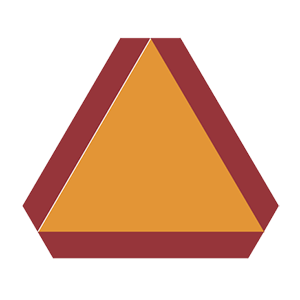
This sign means:
Slow-moving vehicle.
Road construction/maintenance area.
Traffic signal ahead.
Q.17.
When two vehicles enter an intersection from different highways at the same time, which vehicle must yield the right-of-way?
Either one
The vehicle on the left
The vehicle on the right
Neither
Q.18.
An intersection has no traffic signs or signals. You arrive at the same time as a vehicle to your right. You should:
Speed up and get through the intersection.
Slow down and yield to the vehicle on your right.
Drive into the intersection and make the other vehicle stop.
Honk your horn and drive through the intersection.
Q.19.
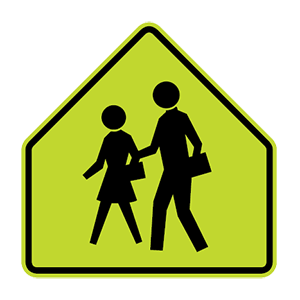
This yellow warning sign means:
You are approaching a school or school crosswalk.
Slow down, drive with caution, and watch for children.
Both of the above.
Q.20.
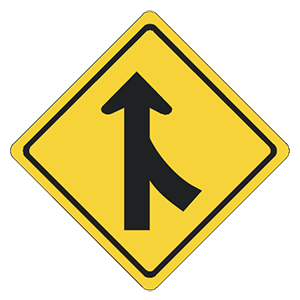
This sign means:
Merge.
Winding road ahead.
Reserved parking for persons with disabilities.
Q.21.
It is illegal for a personyears of age or older to drive with a minimum blood alcohol concentration (BAC) of:
0.05 percent.
0.08 percent.
0.02 percent.
Q.22.
Do not pass:
On a hill or curve.
When school bus lights are flashing.
When approaching an intersection.
All of the above.
Q.23.
Which of the following is true regarding seat belts and child restraints in vehicles?
You should never place an infant or small child in the front seat of a vehicle with airbags.
An airbag can be dangerous to an infant or small child, even in a low-speed collision.
You should always make sure all your passengers are using a seat belt or child restraint.
All of the above.
Q.24.
Roads freeze quickly when they are:
Flat.
Curvy.
In the sun.
Shaded.
Q.25.
A seat belt should be adjusted so that it:
Is loose.
Is buckled snugly across your hip bones and lower abdomen.
Is hidden beneath the seat.
Keeps the seat belt buzzer or light from operating.
Q.26.
If your vehicle begins to skid, you should:
Ease up on the gas pedal.
Brake as hard as possible.
Turn off the ignition.
Q.27.
When driving in fog, it is best to drive with:
High beam headlights.
Low beam headlights.
Four-way flashers.
Q.28.
It is unlawful for a car to try to share a lane with a motorcycle.
TRUE
FALSE
Q.29.
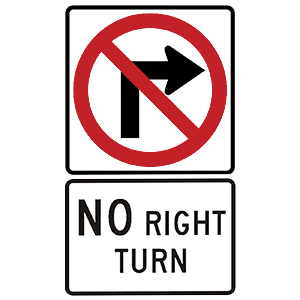
This sign means:
No U-turn.
No left turn.
No right turn.
Q.30.
This road sign means:
Do not pass.
Do not enter.
No turn on red.
Keep right.
Q.31.
If two vehicles arrive to an uncontrolled intersection at the same time:
The largest vehicle has the right-of-way.
The car on the left has the right-of-way.
The car on the left shall yield to the car on the right.
The car on the right shall yield to the car on the left.
Q.32.
This sign means:
No right turn.
Keep right.
No U-turn.
Left lane must turn left.
Q.33.
This road sign means:
Bicycle crossing.
Stop only if other cars are approaching.
Yield the right-of-way to pedestrians.
Q.34.
Construction zone signs are generally:
Square or rectangular with white and red coloring.
Round or octagonal with black and yellow coloring.
Diamond-shaped or rectangular with orange and black coloring.
Q.35.
If you parallel park facing downward on a hill:
Turn your wheels sharply toward the side of the road.
Turn your wheels away from the side of the road.
Keep your wheels straight.
Support mcqgeeks.com by disabling your adblocker.
×
Please disable the adBlock and continue.
Thank you.
Reload page