MCQGeeks
CBSE
JEE
NTSE
NEET
English
UK Quiz
Quiz
Driving Test
Practice
Games
Driving Test
Iowa
Iowa Car Driving Permit Test-16
Answers
Q.1.
This sign means:
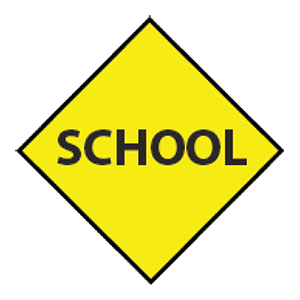
You must drive slowly and sound your horn.
A bus stop is ahead.
You are entering a school's parking lot.
A school zone is ahead.
Q.2.
Which of the following statements is correct?
Use your left foot to brake.
Use your right foot for both braking and accelerating your vehicle.
You should always brake abruptly to ensure stopping.
Q.3.
Increase your following distance when:
Driving behind a large vehicle that blocks your vision.
Exiting an expressway.
Following a motorcycle.
All of the above.
Q.4.
If a traffic light shows both a red light and a green arrow, a driver may not turn in the direction of the arrow until the red light has changed.
True
False
Q.5.
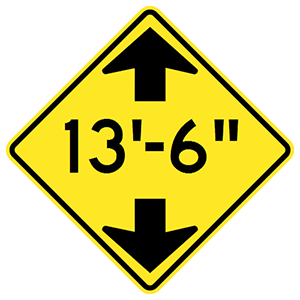
This road sign means:
Divided highway begins.
A steep grade is ahead.
The overpass ahead has a low clearance.
Two lanes of traffic moving in opposite directions are about to merge.
Q.6.
When driving under snowy or icy conditions:
It is safe to use your cruise control.
Make speed and directional changes more gradually than you would otherwise.
Drive as you would under normal conditions.
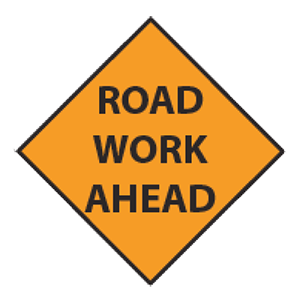
Q.7.
This sign means:
There is a detour ahead.
You must stop for flaggers.
The road ahead is closed to traffic.
The highway ahead is undergoing maintenance.
Q.8.
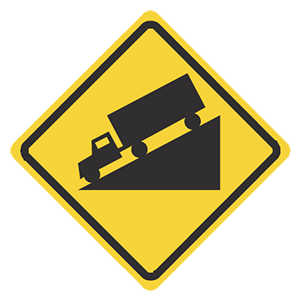
This sign means:
Upcoming downgrade or hill.
Road construction area.
Upcoming narrowing of roadway.
Q.9.
This sign is used to warn drivers:
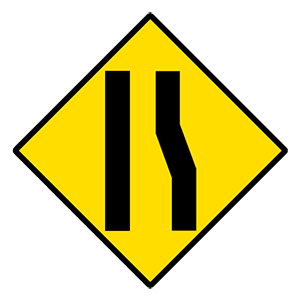
That the right lane ends and traffic should merge left.
That the road curves ahead.
About upcoming intersections.
About road construction.
Q.10.
Blind spots are:
Spots in your vision when you become fatigued.
Areas of the road that cannot be seen in a vehicle's mirrors.
Traffic control devices.
Q.11.
What might happen when alcohol is combined with another drug?
The effects of the alcohol and the drug may both be increased.
Nothing will happen.
The effects of the alcohol and the drug may both be reduced.
The effects of only the alcohol may be reduced.
Q.12.
You need to use extra caution when driving near a pedestrian using a white cane because:
He or she is deaf.
He or she is a police officer.
He or she is blind.
He or she has poor balance.
Q.13.
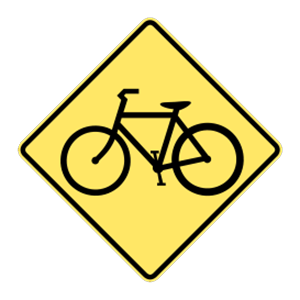
This sign means:
Watch for bicycles.
Bicycles not allowed.
Bicycle repair shop ahead.
Bicycles have the right-of-way.
Q.14.
If you can see that the roadway up ahead is covered by heavy smoke, you should:
Turn on your four-way flashers and continue.
Reduce your speed, move as far to the right as possible, and stop off the roadway.
Turn on your high beam headlights and continue.
Q.15.
When changing lanes, you should never:
Look over your shoulder to check your blind spot.
Change lanes abruptly or spontaneously.
Check for other vehicles moving into the same lane.
Q.16.
When you see this sign, you must:
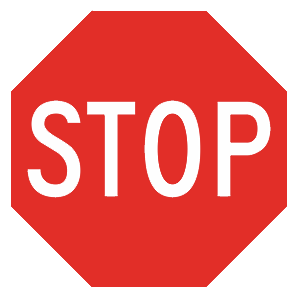
Stop completely and check for pedestrians and cross traffic.
Slow down without coming to a complete stop.
Stop completely and wait for a green light.
Slow down and check for traffic.
Q.17.
When changing lanes on a highway, you should:
Signal a lane change.
Check your rearview and outside mirrors.
Check your blind spot by glancing over your shoulder.
All of the above.
Q.18.
Continuous hard braking on ice and snow often:
Helps you stop faster.
Locks the front wheels of a vehicle, causing a loss of steering.
Keeps the brakes from freezing.
Q.19.
An octagonal sign is always a:
Speed limit sign.
Stop sign.
Hospital sign.
Railroad warning sign.
Q.20.
If you are driving near a motorcycle, you must:
Allow the motorcycle to use a complete lane.
Drive on the shoulder beside the motorcycle.
Allow the motorcycle to use only half of a lane.
Pass using the same lane as the motorcycle.
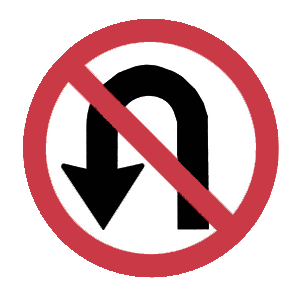
Q.21.
This road sign means:
Do not enter.
No parking.
No U-turn.
No left turn.
Q.22.
If driving in fog, a driver should turn on the high beam headlights to increase their field of vision.
True
False
Q.23.
You must show proof of insurance to law enforcement:
Only if you are involved in a collision.
If you are involved in a collision or stopped for a citation.
Only if you are stopped and cited.
Q.24.
To be able to turn quickly, your hands must be:
On opposite sides of the steering wheel.
Next to each other on the top of the steering wheel.
On the top and bottom of the steering wheel.
Q.25.
A driver can legally pass on the right side of another vehicle:
If the vehicle is waiting to turn left and there is an available passing lane.
Even if it means driving off the pavement.
On a narrow bridge.
At any time.
Q.26.
Signaling your intentions before turning, changing lanes, or driving away from a curb:
Is necessary only if other traffic is present.
Is a good driving habit and is required by law.
Is necessary only during the maneuver, not before.
Is not necessary if the maneuver is done slowly.
Q.27.
The posted maximum speed limit is the fastest you can drive in an area.
True
False
Q.28.
It is unlawful in Iowa for any driver to read, write, or send a text message while driving.
True
False
Q.29.
It is important to be alert to motorcycles because:
They are more difficult to see than cars.
They rarely use their headlights.
Motorcyclists are less skilled drivers than other motorists.
All of the above.
Q.30.
This white sign means you should not pass other vehicles:
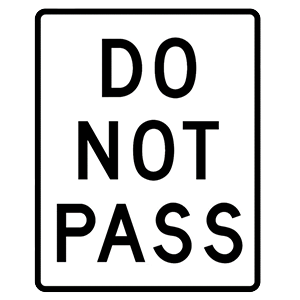
Until after you pass the sign.
Unless it seems safe to do so.
For any reason.
Q.31.
You should signal continuously while turning because it:
Is illegal to turn off your signal before completing a turn.
Lets other drivers know what your intentions are.
Is always unsafe to turn off a signal before completing a turn.
Q.32.
Just like alcohol and other drugs, drowsiness can:
Help you to be a better driver.
Make you feel better.
Impair your judgment.
Q.33.
You may drive around the gates at a railroad crossing:
When the train has passed.
Under no circumstances.
When the lights have stopped flashing.
When other drivers drive around the gates.
Q.34.
Which of the following driving skills are affected by the use of alcohol and/or drugs?
Alertness and concentration.
Reaction time and coordination.
All of the above.
Q.35.
Driving under the influence of any medication which impairs your driving is permitted:
Under no circumstances.
If you don't feel drowsy.
If it is prescribed by a physician.
Support mcqgeeks.com by disabling your adblocker.
×
Please disable the adBlock and continue.
Thank you.
Reload page