MCQGeeks
CBSE
JEE
NTSE
NEET
English
UK Quiz
Quiz
Driving Test
Practice
Games
Driving Test
Iowa
Iowa Car Driving Permit Test-22
Answers
Q.1.
When you approach an octagonal sign, you must:

Slow.
Stop.
Turn.
Q.2.
The sign with this shape and color is a ____ sign.
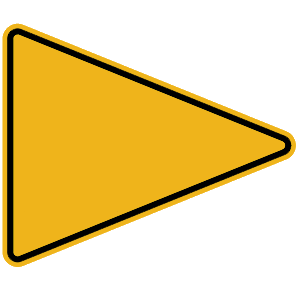
No passing zone
Wrong way
Railroad crossing
Stop
Q.3.
A red traffic signal light means that you must:
Stop at the stop line.
Stop before entering any crosswalk.
Stop before entering the intersection.
All of the above.
Q.4.
When you need to change lanes, it is important to:
Signal your intentions ahead of the lane change.
Check your blind spot.
Make sure the lane is clear before entering.
All of the above.
Q.5.
Before turning left, it is important to:
Sound your horn.
Yield to oncoming vehicles.
Swing to the right side of your lane.
Wait until oncoming traffic has a red light.
Q.6.
If you approach a traffic light with a red signal and a police officer directs you to go through the intersection without stopping, you should:
Stop until the light turns green.
Go through the intersection without stopping.
Come to a complete stop before proceeding.
Q.7.
To help avoid skidding on slippery surfaces, you should:
Shift to a lower gear after starting down a steep hill.
Speed up to enter curves and slow down to exit them.
Slow down before entering curves and intersections.
Q.8.
When making a right turn on a green light, you must:
Maintain your normal driving speed.
Stop and look for nearby police cars.
Yield to pedestrians.
Increase your normal driving speed.
Q.9.
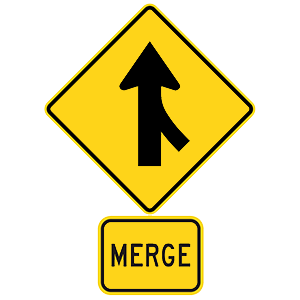
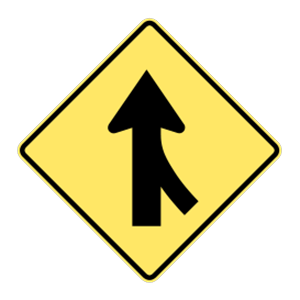
This road sign means:
Cars in the right lane must slow down.
No left turn.
Merge.
Q.10.
On the freeway, you see a "Merging traffic“ sign. You should:
Honk at incoming traffic.
Always remain at your present speed.
Speed up to avoid congesting traffic.
Move to another lane, if safe, to let traffic enter.
Q.11.
When entering a street from a driveway, you:
Must drive slowly to allow approaching vehicles and pedestrians time to get out of your way.
Must honk your horn so approaching vehicles and pedestrians know to give you room.
Must stop and proceed only when there are no pedestrians or vehicles approaching.
Can disregard any pedestrians if there is no sidewalk.
Q.12.
If weather or light conditions require you to have your lights on while driving:
Use your parking lights.
Use your high beams.
Use your low beams.
Q.13.
To check your blind spot before changing lanes:
Look into the left side mirror.
Look into the right side mirror.
Look into the rearview mirror.
Look over your shoulder in the direction you plan to move.
Q.14.
Work zone signs mean:
It is summer.
You must immediately stop and back up.
Less than ideal conditions are present for driving.
You should drive faster to get out of the work zone.
Q.15.
When driving on an interstate, to avoid traffic merging from on-ramps to your right, the best thing to do is to:
Change lanes to the left.
Slow down.
Maintain your speed and position.
Q.16.
When driving in work zones, you should:
Follow the driver in front of you closely.
Pass the driver in front of you as soon as you can.
Avoid tailgating and keep a safe following distance.
Q.17.
Highways and roads freeze before ramps and bridges.
True
False
Q.18.
If two drivers arrive at the same time to a four-way intersection controlled by stop signs:
The driver on the right has the right-of-way.
The driver on the left has the right-of-way.
One driver may continue driving without stopping.
One driver should honk to indicate that they are giving up the right-of-way.
Q.19.
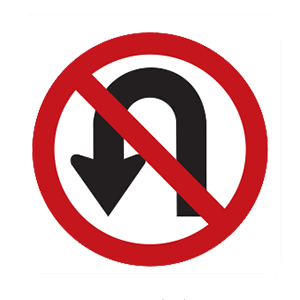
This sign means:
No U-turn.
Two-way left turn.
Minimum speed limit.
No parking.
Q.20.
In inclement weather, you should:
Steer off the road.
Drive in a low gear.
Steer and brake smoothly.
Q.21.
You may drive around or under a gate that is being lowered or raised at a railroad crossing:
As long as an approaching train is not too close.
If your vehicle can do so without damaging the gate.
If you first look carefully in both directions.
Under no circumstances.
Q.22.
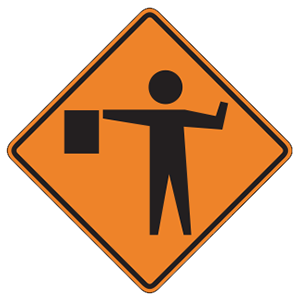
This sign means:
Pedestrians ahead.
End of construction zone.
School crossing ahead.
Flagger ahead.
Q.23.
Regulatory signs are:
Green.
Yellow.
White.
Q.24.
You enter a designated turn lane to make a left turn at an upcoming intersection. There is oncoming traffic. You should:
Move to the left of the center lane.
Signal before you arrive at the intersection.
Turn your front wheels to the left to be prepared to turn.
Q.25.
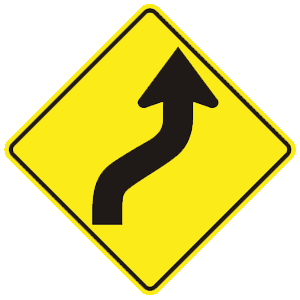
This sign means:
The highway ahead curves only to the right.
The highway ahead turns sharply to the right.
The highway ahead curves to the right and then to the left.
The highway ahead curves to the left and then to the right.
Q.26.
When passing another vehicle, you should return to your original lane when:
You can see both headlights of the passed vehicle in your rearview mirror.
You have cleared the front bumper of the passed vehicle.
You are 50 feet in front of the passed vehicle.
Q.27.
To see vehicles in your blind spots, you should check:
The inside rearview mirror.
The outside rearview mirror.
Over your shoulders.
Q.28.
A broken yellow line alongside a solid yellow line means:
Passing on the left is permitted from either direction.
Passing is permitted from the lane next to the broken line.
Passing is permitted from the lane next to the solid line.
Passing is not allowed from either direction.
Q.29.
Water on the road can cause a vehicle to hydroplane. Your car may hydroplane at speeds as low as:
45 miles per hour.
35 miles per hour.
40 miles per hour.
Q.30.
What should you do if your vehicle’s right wheels leave the pavement?
Stop quickly.
Immediately pull all the way off of the road and get back on when it is safe.
Accelerate and steer back on the road quickly.
Take your foot off the accelerator, slow down, then ease back onto the road when it is safe to do so.
Q.31.
Streets and highways are most slippery:
When it has been raining hard for several hours.
When they are clean and dry.
Just after it starts to rain.
Q.32.
You should not make sudden stops in front of large trucks and buses because:
Small vehicle drivers cannot adequately see large trucks and buses in their rearview mirrors.
Large trucks and buses, due to their size and weight, require longer distances to stop than smaller passenger vehicles.
Large trucks and buses travel at a higher speeds than small vehicles.
Q.33.
When used on roadways, bicycles are considered:
Hazards.
Vehicles.
Dangerous.
Q.34.
If a child is about to run into the street, you should:
Start to prepare to slow down.
Flash your headlights.
Sound a sharp blast of your horn.
Q.35.
To change lanes you should:
Check your mirrors and signal, then change lanes.
Signal, check your mirrors, check your blind spot in the direction you plan to move, then change lanes.
Signal, check your mirrors, and change lanes.
Signal and change lanes.
Support mcqgeeks.com by disabling your adblocker.
×
Please disable the adBlock and continue.
Thank you.
Reload page