MCQGeeks
CBSE
JEE
NTSE
NEET
English
UK Quiz
Quiz
Driving Test
Practice
Games
Driving Test
Iowa
Iowa Car Driving Permit Test-23
Answers
Q.1.
You are driving when it begins to rain. You should:
Drive faster than surrounding traffic.
Drive at the maximum posted speed limit.
Slow down.
Drive closely behind the vehicle in front of you.
Q.2.
Make room for cars that are entering the freeway by:
Slowing down.
Merging into a different lane.
Maintaining your speed and position.
Q.3.
If you find that the roadway ahead of you is flooded, you should:
Slam on the brakes.
Not drive through the flooded area. Turn around and find another route.
Drive only in the center of the roadway.
Q.4.
You may avoid the risks of alcohol-related crashes by:
Deciding before you start drinking that you are not going to drive.
Simply saying, "No thanks, I'm driving," if someone offers you a drink.
Calling a taxi.
Doing any of the above.
Q.5.
You must stop at an intersection when you see a:
Flashing red light.
Steady yellow light.
Yellow arrow.
Flashing yellow light.
Q.6.
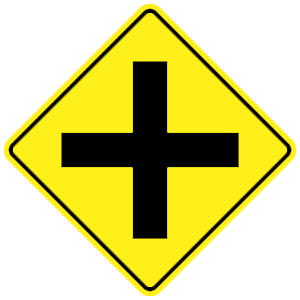
This road sign means:
Increase your speed.
Railroad crossing ahead.
Intersection ahead.
Four-way stop ahead.
Q.7.
You are approaching an intersection at the posted speed limit when the signal turns yellow. You should:
Slow down and proceed through the intersection without caution.
Speed up to cross the intersection before the light turns red.
Stop before entering the intersection, if you can do so safely.
Q.8.
At intersections, crosswalks, and railroad crossings, you should always:
Stop, listen, and proceed cautiously.
Look to the sides of your vehicle to see what is coming.
Slowly pass vehicles that seem to be stopped for no reason.
Q.9.
If you are about to be hit from the rear, you should consider each of the following, except for:
Applying your brakes.
Letting go of the steering wheel.
Pressing your head firmly against the head restraint.
Q.10.
To help prevent crashes, you should:
Communicate with other road users.
Ignore other drivers on the road.
Drive only on side streets and back roads.
Avoid driving during rush hour.
Q.11.
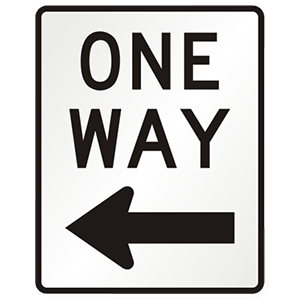
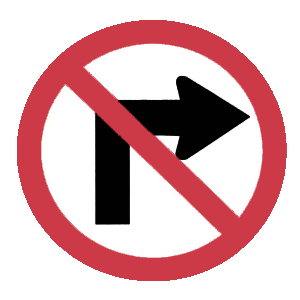
This road sign means:
No right turn.
Drive only in the direction of the arrow.
Curve ahead.
Q.12.
A broken yellow centerline means that:
Passing is not permitted.
Passing on the right is permitted when the way ahead is clear.
Passing on the left is permitted when the way ahead is clear.
Q.13.
Is it legal cross a double solid yellow centerline to pass?
Yes.
No.
If there is no oncoming traffic.
If the vehicle ahead of you is driving under the speed limit.
Q.14.
Which of the following must you obey over the other three?
A steady red light
A police officer
A stop sign
A flashing red light
Q.15.
Double solid yellow lines painted down the middle of the road mean:
Railroad crossing ahead.
Pedestrian crossing ahead.
Passing is not permitted from either direction.
Passing is permitted from either direction.
Q.16.
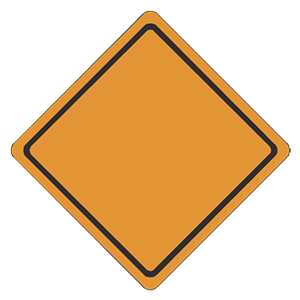
This sign means:
Do not enter.
Stop ahead.
Roadwork or maintenance is present.
Q.17.
A double solid yellow line down the center of a two-lane road indicates:
Lanes are moving in opposite directions and drivers are not permitted to pass.
Lanes are moving in opposite directions and drivers are permitted to pass when it is safe to do so.
Lanes are moving in the same direction and drivers are not permitted to pass.
Lanes are moving in the same direction and drivers are permitted to pass when it is safe to do so.
Q.18.
Drinking coffee after drinking alcohol:
Decreases blood alcohol concentration.
Cancels the effect of the alcohol.
Has no effect on blood alcohol concentration.
Increases blood alcohol concentration.
Q.19.
You are driving at night and another vehicle is approaching from the opposite direction. Your headlights:
Should be on their high beam setting.
Should be on their low beam setting.
Should be off. Use your parking lights.
May be on either their high or low beam setting.
Q.20.
This green arrow on a lane use control signal means:
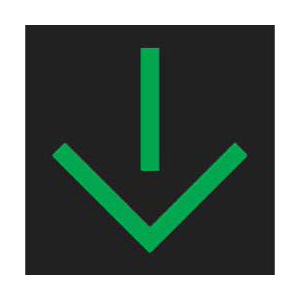
You may use this lane.
No traffic is allowed in this lane.
You have the right-of-way.
You must merge into this lane.
Q.21.
At a school crossing sign, you should:
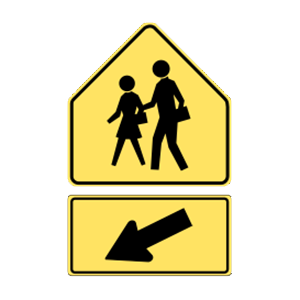
Always stop, whether there’s a stop sign or not.
Watch for children and be ready to stop.
Always sound your horn when you see children.
Be ready to help children crossing the street.
Q.22.
Never drive a vehicle through, around, or under any railroad gate or barrier.
True
False
Q.23.
Because there is often slow-moving traffic on county highways, you should:
Stay in the left lane and drive above the speed limit.
Be ready to adjust your speed to the speed of traffic.
Pass slow-moving vehicles when in a curve.
Q.24.
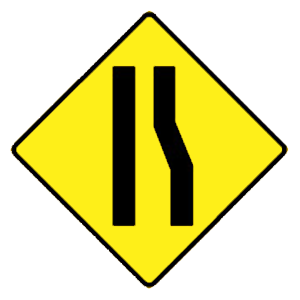
This road sign means:
Road widens ahead.
Lane reduction; the right lane ends soon.
Highway entrance ramp ahead.
Lane reduction; the left lane ends soon.
Q.25.
According to the Iowa Implied Consent Law:
An arrested driver may be asked to submit to a chemical test to determine the alcohol content of their blood.
Refusal to submit to chemical testing will result in a driver's driving privileges being withdrawn.
Both of the above.
Q.26.
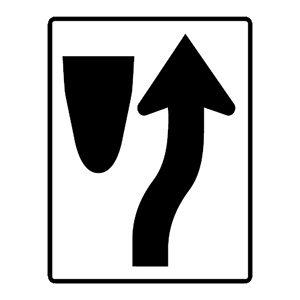
This road sign means:
Side road.
Keep to the side indicated by the arrow.
You may drive in the left lane.
You have the right-of-way.
Q.27.
Emergency vehicles:
Have the right-of-way when using sirens, horns, and/or flashing lights.
May use a loudspeaker to give instructions.
May follow each other.
All of the above.
Q.28.
This road sign means:
No left turn.
No U-turns.
No exit.
No right turn.
Q.29.
This sign indicates that the road ahead:
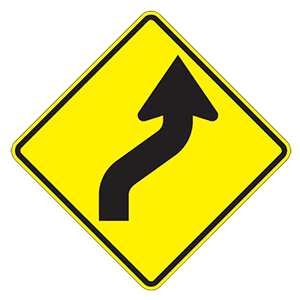
Turns sharply right, then left.
Curves right, then left.
Curves right.
Q.30.
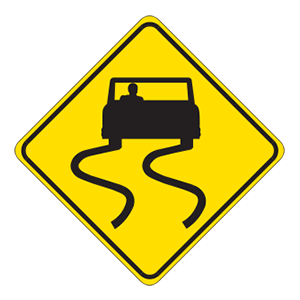
This sign means:
Slippery when wet.
Tow-away zone.
Steep downgrade.
Roadwork ahead.
Q.31.
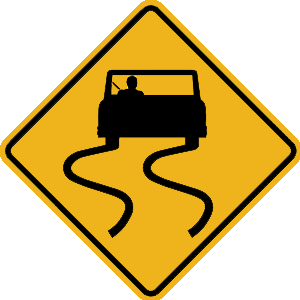
This sign means:
A left curve is ahead.
A series of curves is ahead.
An S-curve is ahead.
The road will be slippery when wet.
Q.32.
A steady red arrow displayed on a traffic light means:
Drivers cannot turn in the indicated direction.
Drivers may turn in the indicated direction after coming to a complete stop.
Drivers may turn in the indicated direction.
Q.33.
A broken yellow centerline indicates that:
Passing is not permitted.
Passing on the right is permitted when the way ahead is clear.
Passing on the left is permitted when the way ahead is clear.
Q.34.
When approaching a railroad crossing, you should:
Slow down.
Look for a train.
Be ready to stop.
All of the above.
Q.35.
Which of the following are factors commonly contributing to traffic crashes?
Exceeding the posted speed limit and driving too fast for conditions or circumstances.
Getting adequate rest and staying alert.
Scanning the environment and staying focused on the driving task.
Support mcqgeeks.com by disabling your adblocker.
×
Please disable the adBlock and continue.
Thank you.
Reload page