MCQGeeks
CBSE
JEE
NTSE
NEET
English
UK Quiz
Quiz
Driving Test
Practice
Games
Driving Test
Kansas
Kansas Car Driving Permit Test-1
Answers
Q.1.
At an intersection with stop signs on all corners, yield the right-of-way to any driver:
On your left.
Who arrived before you.
Across from your vehicle.
Q.2.
Sudden wind gusts on highways:
Generally affect only the movement of large vehicles.
Only cause visibility problems.
Can cause problems for all vehicles.
Q.3.
If you want to pass a pedestrian who is walking along the roadway and an oncoming vehicle is approaching, you should:
Slow down and let the oncoming vehicle pass before you pass the pedestrian.
Keep driving at a steady speed. The oncoming vehicle must stop for you.
Honk your horn to get the pedestrian to move over.
Q.4.
What is the purpose of rumble strips?
They alert drivers to potential tire problems.
They test a vehicle's shock absorbers.
Through vibration and sound, they alert inattentive drivers to the fact that their vehicles have left the travel lane.
Q.5.
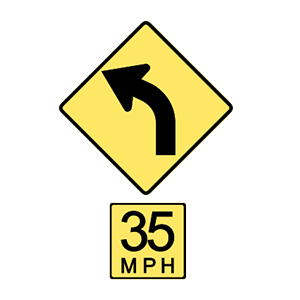
This sign means:
There is a 35 mph speed zone after the curve ahead.
Drive no slower than 35 mph around the upcoming curve.
Approach the upcoming curve at a speed of 35 mph or slower.
Q.6.
You have allowed the wheels of your vehicle to run off the edge of the pavement. What should you do first?
Turn the front wheels slightly to the left to edge the car back onto the pavement.
Hold the steering wheel firmly, release the gas pedal, and gently apply the brakes.
Apply the brakes and turn the front wheels sharply to the left.
Q.7.
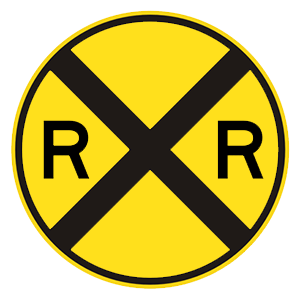
When you see this sign, you:
Are approaching a railroad crossing and should prepare to stop.
Will always stop at the upcoming railroad crossing.
Should stop and wait for a signal before crossing the railroad tracks.
Q.8.
It is very foggy. You should slow down and:
Turn on your emergency flashers.
Turn your lights to their high beam setting.
Turn your lights to their low beam setting.
Q.9.
Where is it safe to pass another vehicle?
Within an intersection where there are no oncoming vehicles
Wherever signs and/or pavement markings permit passing
Within a curve where there are no oncoming vehicles
Q.10.
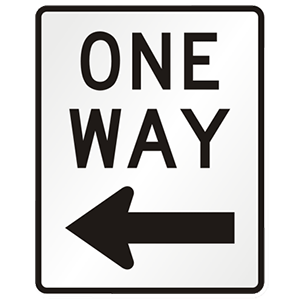
This road sign means:
No right turn.
Drive only in the direction of the arrow.
Curve ahead.
Q.11.
Regulatory signs are:
Green.
Yellow.
White.
Q.12.
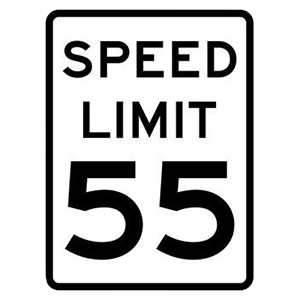
This road sign means:
You must travel through the intersection at the posted speed limit.
The maximum speed limit under ideal conditions is 55 mph.
You must not travel below the speed indicated.
Q.13.
An orange and red triangular sign on a vehicle always means:
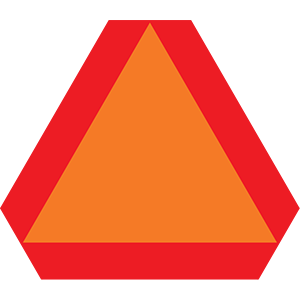
The vehicle has the right-of-way.
Slow-moving vehicle.
Shoulder work ahead.
Q.14.
When driving on the highway, consistently looking far ahead of your vehicle:
Helps you keep up with traffic.
Reduces the need for last-minute braking or turning.
Allows you to spot upcoming police officers.
Q.15.
"No passing zone" signs tell drivers:
To speed up slightly.
That it is not safe to pass.
To maintain a steady speed.
Q.16.
Which of the following driving skills are affected by the use of alcohol and/or drugs?
Alertness and concentration.
Reaction time and coordination.
All of the above.
Q.17.
Motorcycle operators have the right to:
Use a complete traffic lane.
Use half of a traffic lane.
Use the shoulder of a roadway.
Q.18.
To pass on a two-lane road, you should:
Sound your horn as you pass.
Flash your headlights as you pass.
Judge the distance to any oncoming vehicles.
Q.19.
Alcohol is:
A stimulant.
An antihistamine.
A depressant.
Q.20.
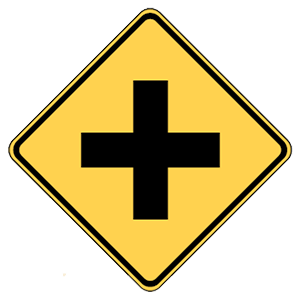
This road sign means:
Hospital.
Upcoming intersection.
Railroad crossing.
Q.21.
The amount of alcohol in the blood is referred to as:
Implied consent (IC).
Blood alcohol concentration (BAC).
Rate of alcohol consumption (RAC).
Q.22.
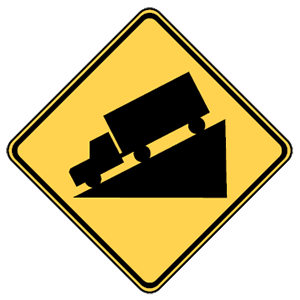
This road sign means:
Intersection ahead.
Merging traffic.
Steep hill ahead.
Q.23.
What is a potential effect of taking a prescription drug while drinking alcohol?
There will likely be no effect.
It will make you more alert.
It can make you unfit to drive.
Q.24.
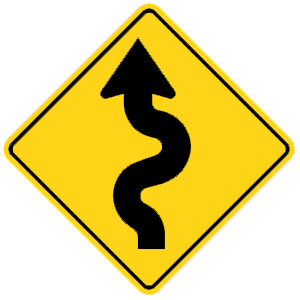
This road sign means:
Sharp turn to the right ahead.
Upcoming sharp left and right turns.
Winding road ahead.
Q.25.
You should signal continuously while turning because it:
Is illegal to turn off your signal before completing a turn.
Lets other drivers know what your intentions are.
Is always unsafe to turn off a signal before completing a turn.
Support mcqgeeks.com by disabling your adblocker.
×
Please disable the adBlock and continue.
Thank you.
Reload page