MCQGeeks
CBSE
JEE
NTSE
NEET
English
UK Quiz
Quiz
Driving Test
Practice
Games
Driving Test
Kansas
Kansas Car Driving Permit Test-13
Answers
Q.1.
You can help keep the driver behind you a safe distance away from your vehicle by:
Driving 10 mph faster than the car behind you.
Driving 10 mph slower than the car behind you.
Maintaining a steady speed.
Q.2.
Increase your following distance when driving behind a large vehicle:
To better see around the sides of the vehicle.
Because other drivers tend to pull behind large vehicles before trying to pass them.
Because following too closely will get you caught in the vehicle's slipstream.
Q.3.
A blood alcohol concentration of 0.percent:
Won't have any effect on your driving.
Won't put other drivers at risk.
Will double your chances of having an accident.
Q.4.
If you are driving and you see animals standing near the roadway:
Speed up to scare them away.
Slow down and proceed with caution.
Quickly swerve into the next lane.
Q.5.
If you see orange construction signs and cones on a freeway, you must:
Slow down because the lane ends ahead.
Be prepared for workers and equipment ahead.
Change lanes and maintain your current speed.
Q.6.
As you approach the top of a hill, you should:
Speed up slightly.
Prepare to stop, if needed.
Maintain a steady speed.
Q.7.
When passing another vehicle, you should return to your original lane when:
You can see both headlights of the passed vehicle in your rearview mirror.
You have cleared the front bumper of the passed vehicle.
You are 50 feet in front of the passed vehicle.
Q.8.
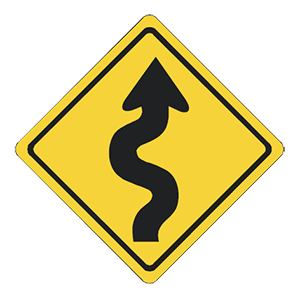
This sign means:
Winding road ahead.
Do not enter.
Pedestrian crossing.
Q.9.
If you parallel park facing downward on a hill:
Turn your wheels sharply toward the side of the road.
Turn your wheels away from the side of the road.
Keep your wheels straight.
Q.10.
If you are driving near a large commercial vehicle, you should:
Follow the large vehicle closely to reduce wind drag on your vehicle.
Avoid driving beside it for long stretches of time.
Drive on its right side when on curves and hills.
Q.11.
Should you always drive more slowly than other traffic?
No, you can block traffic when you drive too slowly.
Yes, it is a good defensive driving technique.
Yes, it is always safer than driving faster than other traffic.
Q.12.
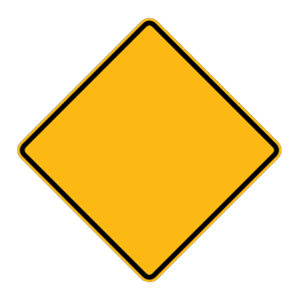
A sign with this shape means:
Railroad crossing.
Warning.
Signal ahead.
Q.13.
If you approach a flashing red traffic light, you:
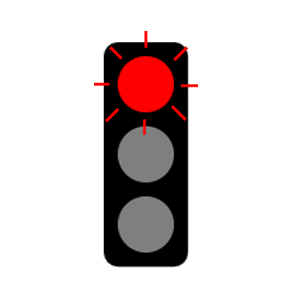
Are traveling in the wrong direction.
Must treat the intersection as if it is controlled by a stop sign.
May not proceed until it changes to green.
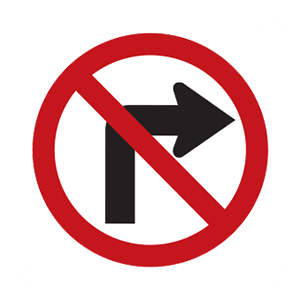
Q.14.
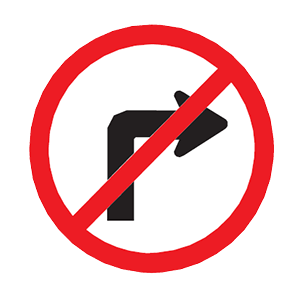
This sign means:
No right turn.
You must turn right.
Watch for traffic on your right.
Q.15.
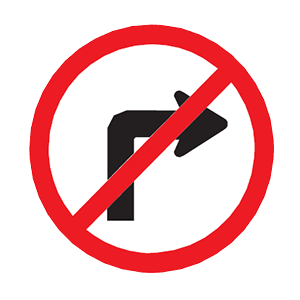
This sign means:
No right turn.
Right turn on red light permitted with caution.
All traffic must turn right at next intersection.
Q.16.
In a vehicle equipped with airbags, the safest place for children ageand under to ride is in:
The front seat.
The back seat.
The bed of a pick-up truck.
Q.17.
You must yield the right-of-way to an emergency vehicle that is using its siren and flashing lights by:
Driving as closely to the right edge of the road as possible and stopping.
Moving into the right lane and driving slowly until it has passed.
Stopping immediately, even if you are within an intersection.
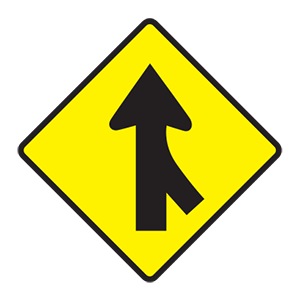
Q.18.
This sign means:
You should stop for other traffic.
Traffic is entering from another road and you should allow additional space for drivers to merge safely into the flow of traffic.
Traffic is entering from another road and you should keep right.
Q.19.
When driving at night, you should:
Always use your high beams.
Look directly at the headlights of an oncoming vehicle.
Increase your following distance.
Q.20.
On a multilane road, a dashed yellow line next to a solid yellow line means:
Passing is prohibited from both directions.
Passing is permitted from both directions.
Passing is permitted only from the direction next to the dashed line.
Q.21.
This road sign means:
No right turn.
No U-turns.
No left turn.
Q.22.
You may pass a vehicle when:
You are on a hill or curve.
You are on a road with a solid line next to your lane.
You are on a road with a broken line next to your lane.
Q.23.
When driving in fog or mist, never put your headlights on the high beam setting because:
The light will reflect back into your eyes.
Approaching vehicles might not see you.
Vehicles behind you may follow too closely.
Q.24.
The traditional mirror setting:
May be appropriate for large vehicles when towing or backing in tight areas.
Does not show the edge of the vehicle.
Is appropriate for all vehicles in all situations.
Q.25.
Which of the following describes the thinking of defensive drivers?
They know other drivers will do the right thing.
They consider what other drivers might do and are prepared to react.
They expect no breaks and give none.
Support mcqgeeks.com by disabling your adblocker.
×
Please disable the adBlock and continue.
Thank you.
Reload page