MCQGeeks
CBSE
JEE
NTSE
NEET
English
UK Quiz
Quiz
Driving Test
Practice
Games
Driving Test
Kansas
Kansas Car Driving Permit Test-23
Answers
Q.1.
You are required to stop your vehicle:
At any intersection where a police officer orders you to stop.
Where there is a red traffic light.
Both of the above.
Q.2.
If the roadway is wet or icy, you should:
Reduce your speed.
Drive at the posted speed.
Speed up.
Q.3.
The best thing to do if you become tired while driving is to:
Stop to rest or change drivers.
Drink coffee.
Open a window.
Q.4.
Hydroplaning occurs when tires ride on a thin film of water instead of on the road. To prevent hydroplaning in wet weather, you should:
Put on your cruise control to maintain a constant speed.
Slow down.
Move to the shoulder of the road as soon as it starts to rain.
Q.5.
Motorcycle operators have the right to:
Use a complete traffic lane.
Use half of a traffic lane.
Use the shoulder of a roadway.
Q.6.
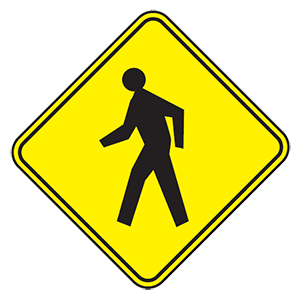
This sign means:
School crossing.
School zone.
Pedestrian crossing.
Q.7.
If your vehicle starts to lose traction because of water on the road, you should:
Drive at a constant speed to gain better traction.
Apply the brakes firmly to prevent your vehicle from sliding.
Slow down gradually and not apply the brakes.
Q.8.
If you drive more slowly than the flow of traffic, you will most likely:
Interfere with traffic and receive a ticket.
Improve traffic flow.
Demonstrate defensive driving techniques.
Q.9.
When a pedestrian guided by a dog or carrying a white cane is crossing the street:
You must always yield the right-of-way.
You must tell them where to cross the street.
You only have to yield the right-of-way if you are at a corner.
Q.10.
When driving in a construction zone:
Slightly increase your speed.
Expect the unexpected.
Expect construction workers to yield to motorists.
Q.11.
Tailgating other drivers (driving too closely to their rear bumper):
Can frustrate other drivers and make them angry.
Cannot result in a traffic citation.
Reduces collisions by preventing being "cut off."
Q.12.
If you are being followed too closely on a two-lane road:
Reduce your speed slowly to encourage the tailgater to drive around you.
Speed up to increase the distance between you and the other car.
Apply your brakes to slow down, then resume your original speed.
Q.13.
This sign means:
No left turn can be made here.
A left turn can be made only after stopping.
All traffic must turn right at the next intersection.
Q.14.
Drivers turning left must yield to:
Oncoming vehicles traveling straight or turning right.
Passing cars.
No one in particular.
Q.15.
What should a driver do when approaching a traffic control signal that is not in operation?
Come to a full stop and yield the right-of-way before entering the intersection.
If the intersection is clear, the driver does not need to stop.
Drive quickly through the intersection to get out of the way of other vehicles.
Q.16.
Where is it safe to pass another vehicle?
Within an intersection where there are no oncoming vehicles
Wherever signs and/or pavement markings permit passing
Within a curve where there are no oncoming vehicles
Q.17.
When changing lanes:
Check your side mirror and look over your shoulder to make sure the lane is clear.
Check the inside rearview mirror.
Slow down.
Q.18.
While driving on a roadway with a single broken white centerline:
You must stay within your lane.
You may cross the centerline to change lanes.
You may change lanes only from the left lane.
Q.19.
You are entering a freeway. Check traffic on the freeway by:
Using your rearview and side mirrors.
Using your rearview mirror.
Using your side mirror and looking over your shoulder.
Q.20.
Broken yellow lines are used on streets and highways to:
Indicate no passing zones.
Separate lanes of traffic moving in the same direction.
Separate lanes of traffic moving in opposite directions.
Q.21.
Before returning to your original lane after passing another vehicle, you should:
Beep your horn.
See both headlights of the passed vehicle in your rearview mirror.
Flash your headlights.
Q.22.
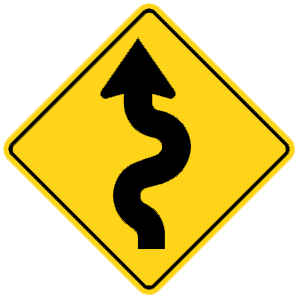
This sign tells you that:
No turns are allowed on the road.
The road narrows ahead.
There is a series of curves ahead.
Q.23.
On a green arrow, you must:
Yield to any vehicle, bicycle, or pedestrian in the intersection.
Yield to pedestrians only in the intersection.
Wait four seconds before proceeding.
Q.24.
When a school bus is stopped ahead on your side of the road with its red lights flashing, you must:
Slow to a speed no faster than 10 mph.
Stop until the lights stop flashing.
Change lanes and pass cautiously.
Q.25.
When turning left from a two-way street onto a one-way street, you should:
Turn into any lane.
Turn into first lane.
Turn into second lane.
Support mcqgeeks.com by disabling your adblocker.
×
Please disable the adBlock and continue.
Thank you.
Reload page