MCQGeeks
CBSE
JEE
NTSE
NEET
English
UK Quiz
Quiz
Driving Test
Practice
Games
Driving Test
Kansas
Kansas Motorcycle Driving Permit Test-16
Answers
Q.1.
Which lane position is usually best for minimizing the risk of other vehicles sharing your lane?
The left portion of the lane
The center portion of the lane
The right portion of the lane
Q.2.
If a dog is chasing your motorcycle, you should:
Swerve around the dog.
Slow down, let the dog approach, and accelerate away from the animal.
Park and wait for the dog to lose interest.
Q.3.
Who is required to wear a helmet on a moving motorcycle?
Only passengers
All motorcycle riders and passengers
No one
Q.4.
To be effective, eye or face shield protection must:
Fasten securely.
Restrict your vision to the sides so you can focus on the road ahead.
Not allow eyeglasses or sunglasses to be worn.
Q.5.
Which of the following is an example of a potentially slippery surface?
A gravel road
A paved driveway
Dry pavement
Q.6.
A sign that your rear tire has suddenly gone flat is that:
The back of your motorcycle is swaying from side to side.
You heard a loud noise.
A discharge of air can be seen.
Q.7.
Unlike other substances, alcohol:
Is very quickly absorbed into the bloodstream.
Needs to be digested to enter the bloodstream.
Can improve your riding ability.
Q.8.
When riding, you should wear boots or shoes that:
Cover your ankles.
Have long heels.
Have long and loose laces.
Q.9.
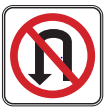
What does this sign mean?
No right turn
No left turn
No U-turn
Q.10.
When wearing a jacket for protection, the jacket should:
Be loose-fitting and flap in the wind while riding.
Fit snugly.
Be uncomfortable.
Q.11.
How many alcoholic drinks need to be consumed before the drinker's riding ability is affected?
One
Two
Three
Q.12.
When entering a curve, you should always position your motorcycle:
On the left side of the lane.
In a position that allows you to most effectively see and be seen.
In the center of the lane.
Q.13.
When riding at night:
Ride on the shoulder of the road.
Decrease your following distance.
Increase your following distance.
Q.14.
When entering a curve, you should position your motorcycle:
In the outside of the curve.
In the inside of the curve.
Where you can most safely handle road and traffic conditions.
Q.15.
To execute a turn safely, a motorcycle rider should always:
Lean in the direction of the curve.
Slow down in the turn.
Turn by using only the handle bars.
Q.16.
Since most crashes happen in daylight, you:
Do not need to wear brightly-colored clothing during the day.
Should wear brightly-colored clothing during the day.
Should wear dark clothing during the day.
Q.17.
When taking a curve while riding in a group, you should be in:
A single-file formation.
Pairs.
A staggered formation.
Q.18.
When riding a motorcycle, it is important to:
Focus only on what is in front of you.
Focus only on what is behind you.
Know what’s happening both in front of and behind you.
Q.19.
When preparing to pass a vehicle on the left, you should ride in which portion of the lane?
Right
Center
Left
Q.20.
Whichever style of helmet you choose, you will get the most protection by ensuring that your helmet:
Fits snugly.
Is clean.
Looks cool.
Q.21.
If your front wheel locks while you are stopping, you should:
Continue to apply the front brake.
Release the front brake and only use the rear brake.
Immediately release the front brake, then re-apply the brake firmly.
Q.22.
Which of the following is not recommended as protective apparel for motorcycle users?
Long pants
Gloves
A baseball cap
Q.23.
When riding in the rain, you should:
Ride down the center of your lane.
Ride on the right side of your lane.
Ride in tire tracks left by other cars.
Q.24.
When riding behind a car, traveling in the left third of the lane allows the driver to see you in their side mirror. What is a downside to this?
Most people don’t use their side mirrors as often as they use their rearview mirror.
The wind may prevent the use of a side mirror.
Side mirrors should not be used by motorists.
Q.25.
The human body removes alcohol at a rate of:
About one drink per hour.
About two drinks per hour.
About three drinks per hour.
Support mcqgeeks.com by disabling your adblocker.
×
Please disable the adBlock and continue.
Thank you.
Reload page