MCQGeeks
CBSE
JEE
NTSE
NEET
English
UK Quiz
Quiz
Driving Test
Practice
Games
Driving Test
Kentucky
Kentucky Car Driving Permit Test-20
Answers
Q.1.
If you approach a flashing red traffic light, you:
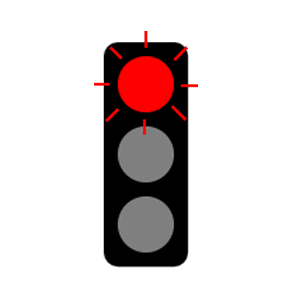
Are traveling in the wrong direction.
Must treat the intersection as if it is controlled by a stop sign.
May not proceed until it changes to green.
Q.2.
Slowing down just to look at collisions or anything else out-of-the-ordinary:
Causes traffic congestion.
Prevents rear-end collisions.
Improves traffic flow by preventing collisions.
Q.3.
As your speed increases, it is important to:
Turn on your headlights.
Look well ahead of your vehicle.
Change lanes frequently.
Q.4.
It is very foggy. You should slow down and:
Turn on your emergency flashers.
Turn your lights to their high beam setting.
Turn your lights to their low beam setting.
Q.5.
When should drivers yield the right-of-way to pedestrians in a crosswalk?
Only if the pedestrians first wave to the driver.
Only if the pedestrians are not texting while walking.
At all times.
Q.6.
A driver should:
Assume all drivers automatically obey the right-of-way rules.
Assume most drivers obey the right-of-way rules.
Always be prepared to yield the right-of-way.
Q.7.
If your car's suspension is bad, it can cause:
Vehicle control problems.
Squealing brakes.
Slack in the steering.
Q.8.
If you encounter an aggressive driver, you should:
Challenge them.
Get out of their way.
Speed up.
Q.9.
What does a traffic signal with a yellow left arrow indicate?
Drivers should prepare to yield to oncoming traffic.
The protected left turn is about to end.
Both of the above.
Q.10.
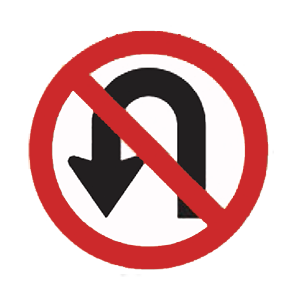
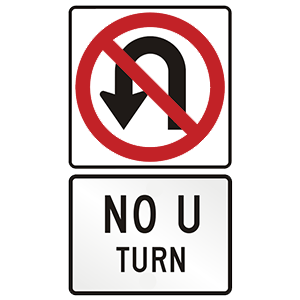
This sign means:
No turns.
No outlet.
No U-turns.
Q.11.
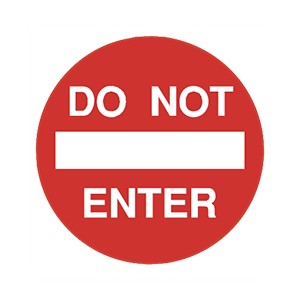
This sign means:
Do not enter.
Yield the right-of-way.
Reserved parking for persons with disabilities.
Q.12.
Excessive speed:
Does not increase the chance of a crash.
Increases your ability to react to a hazard.
Often leads to high-risk decision-making.
Q.13.
When changing lanes, you can check your blind spot by:
Using the inside rearview mirror.
Turning your head and looking over your shoulder.
Using your side mirror.
Q.14.
Which of the following are factors commonly contributing to traffic crashes?
Exceeding the posted speed limit and driving too fast for conditions or circumstances.
Getting adequate rest and staying alert.
Scanning the environment and staying focused on the driving task.
Q.15.
When may you legally drive around or under a railroad crossing gate?
Never.
When you can see clearly in both directions.
When the warning lights are not flashing.
Q.16.
When entering traffic after being parked at a curb, you:
Should drive more slowly than other traffic for 200 feet.
Should wait for a large enough gap to get up to the speed of traffic.
Should wait for the first two vehicles to pass, then drive into the lane.
Q.17.
This sign indicates that the road ahead:
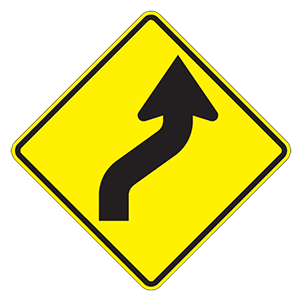
Turns sharply right, then left.
Curves right, then left.
Curves right.
Q.18.
If you have an argument with another person and you are angry, you should:
Loudly play the radio while driving so you won’t think about your argument.
Take a few minutes to cool off before driving.
Drive on the interstate to let off steam.
Q.19.
A broken yellow centerline indicates that:
Passing is not permitted.
Passing on the right is permitted when the way ahead is clear.
Passing on the left is permitted when the way ahead is clear.
Q.20.
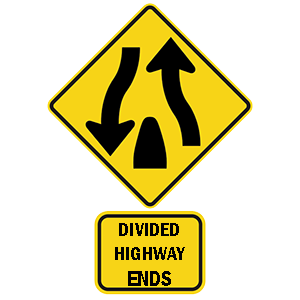
This sign means:
Curves ahead.
Divided highway starts.
Divided highway ends.
Q.21.
At dawn or dusk and in rain or snow, it can be hard to see and be seen. A good way to let other drivers know you are there is to turn:
Up the instrumental panel lights.
On your parking lights.
On your headlights.
Q.22.
If you are driving and you see animals standing near the roadway:
Speed up to scare them away.
Slow down and proceed with caution.
Quickly swerve into the next lane.
Q.23.
To improve visibility lowered by rain or fog, drivers should use their:
Low beam headlights.
High beam headlights.
Parking lights.
Q.24.
To see objects in their blind spot when changing lanes, drivers should check:
Only the left outside mirror.
Over their left or right shoulder.
Only the inside rearview mirror.
Q.25.
The best way to avoid a dangerous situation while driving is to:
Know what is happening around your vehicle.
Turn off the radio.
Always keep your eyes focused ahead of your car.
Q.26.
Under normal weather, road, and traffic conditions, maintain a minimum following distance of:
One second.
Two seconds.
Three seconds.
Q.27.
If it feels like your tires have lost contact with the surface of the road, you should:
Slow down by shifting into a lower gear.
Ease your foot off the gas pedal.
Slow down by pumping the brakes quickly and firmly.
Q.28.
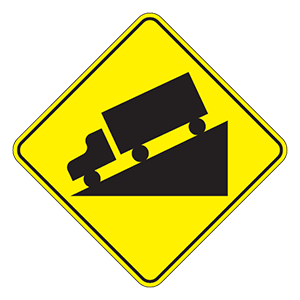
This sign means:
Trucks entering.
Truck exit only.
Steep downgrade ahead.
Q.29.
At an intersection with a yield sign, you:
Must yield the right-of-way to cross traffic that is close enough to cause conflict.
Must yield to vehicles only on your right.
Should slow down but never stop.
Q.30.
You see pedestrians near the road. You should:
Sound your horn and maintain your speed.
Speed up to clear the area quickly.
Slow down and pass with caution.
Q.31.
When you see this yellow sign, you should:
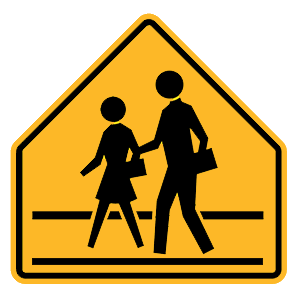
Always stop at the crosswalk.
Stop at the crosswalk until a crossing guards signals for you to go.
Be prepared to stop if children are in the crosswalk.
Q.32.
This sign means:
No U-turn.
No turning.
No left turn.
Q.33.
If you see a pedestrian using a guide dog or carrying a white cane:
The pedestrian must yield the right-of-way.
You must yield the right-of-way.
Honk your horn to let them know you are there.
Q.34.
What is the only effective way to remove alcohol from the body?
Drink strong coffee.
Wait.
Take a cold shower.
Q.35.
If your wheels drop off the roadway or pavement edge, you should:
Wait until it is safe to do so, then gradually re-enter the roadway.
Turn back onto the roadway immediately.
Stop.
Q.36.
What message will be found on a red octagon-shaped sign?

Do not enter.
One-way.
Stop.
Q.37.
Hydroplaning occurs when tires ride on a thin film of water instead of on the road. To prevent hydroplaning in wet weather, you should:
Put on your cruise control to maintain a constant speed.
Slow down.
Move to the shoulder of the road as soon as it starts to rain.
Q.38.
When crossing a sidewalk to enter traffic from an alley or driveway, drivers should:
Stop only if pedestrians are on the sidewalk.
Stop before driving onto the sidewalk or sidewalk area.
Expect pedestrians on the sidewalk to yield the right-of-way.
Q.39.
You exit the freeway on a ramp that curves downhill. You should:
Slow to a safe speed before the curve.
Slow to the posted speed limit for the freeway.
Wait until you have entered the curve to begin braking.
Q.40.
What is a potential effect of taking a prescription drug while drinking alcohol?
There will likely be no effect.
It will make you more alert.
It can make you unfit to drive.
Support mcqgeeks.com by disabling your adblocker.
×
Please disable the adBlock and continue.
Thank you.
Reload page