MCQGeeks
CBSE
JEE
NTSE
NEET
English
UK Quiz
Quiz
Driving Test
Practice
Games
Driving Test
Kentucky
Kentucky Car Driving Permit Test-3
Answers
Q.1.
You should always travel:
At the speed of vehicles surrounding you.
At the speed limit.
At a speed appropriate for road and weather conditions.
Q.2.
When stopped at a red traffic light with a green arrow, you may proceed in the direction of the arrow if you:
First come to a complete stop.
Wait until the light changes.
Are in the proper lane and the intersection is clear.
Q.3.
You are involved in a minor collision at an intersection. There are no injuries and there is very little vehicle damage. You should:
Leave your vehicle in the traffic lane until law enforcement arrives.
Move your vehicle out of the traffic lane, if possible.
Not move your vehicle for any reason.
Q.4.
A large truck is ahead of you and is turning right onto a street with two lanes in each direction. The truck:
May complete its turn in either of the two lanes.
May have to swing wide to complete the right turn.
Must stay in the right lane at all times while turning.
Q.5.
When you want to change lanes, you should never:
Move into another lane while within an intersection.
Check your blind spot by looking over your shoulder.
Check for other drivers moving into the same lane.
Q.6.
You must obey instructions from school crossing guards:
At all times.
Only during school hours.
Unless you do not see any children present.
Q.7.
A steady green traffic light at an intersection means:
Increase your speed.
Adjust your mirrors.
You may continue through the intersection at a safe and reasonable speed, if it is clear to do so.
Q.8.
If a tire suddenly blows out while you are driving, you should:
Grip the steering wheel firmly, slow down, and exit the traffic lane.
Pump the brakes rapidly.
Brake hard and steer toward the right edge of the roadway.
Q.9.
Changing from one lane to another is best done:
Quickly and often.
When a car is in your blind spot.
Gradually and carefully.
Q.10.
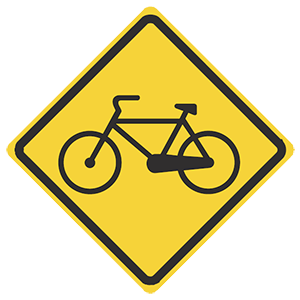
This sign means:
Watch for bicycles.
Bicycles not allowed.
Bicycle repair shop ahead.
Q.11.
A driver should:
Stare directly in front of their car.
Only focus on the middle of the road.
Watch beside, ahead, and to the rear of their car.
Q.12.
Unless otherwise posted, the speed limit on interstate highways is:
55 mph.
65 mph.
75 mph.
Q.13.
If you are driving on the interstate and pass your exit, you should:
Quickly cut across traffic and make your turn.
Make a U-turn to go back to the exit.
Continue driving and use the next exit.
Q.14.
Which of these statements is true about drugs and driving?
Any prescription drug is safe to use if you don't feel drowsy.
Even over-the-counter drugs can impair your driving.
Only illegal drugs can impair your driving.
Q.15.
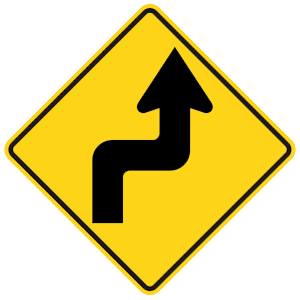
This road sign means:
Sharp right turn ahead.
A road joins from the right.
The road ahead turns sharply right then sharply left.
Q.16.
What is the only medically proven method of removing alcohol or other drug combinations from your system?
Breathe in some fresh air.
Give your body time.
Drink coffee.
Q.17.
If a vehicle is equipped with airbags:
Seat belts should still be worn.
Seat belts do not need to be worn.
Seat belts should be worn behind the back.
Q.18.
When driving on the highway, consistently looking far ahead of your vehicle:
Helps you keep up with traffic.
Reduces the need for last-minute braking or turning.
Allows you to spot upcoming police officers.
Q.19.
When changing lanes:
Rely on the rearview mirror.
Look over your shoulder in the direction you plan to move.
Rely on the left side mirror.
Q.20.
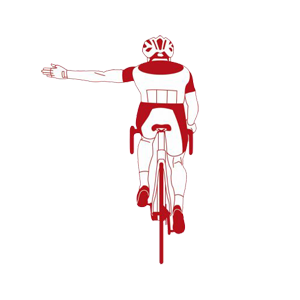
This bicyclist is signaling:
A left turn.
An upcoming stop.
A right turn.
Q.21.
You have allowed the wheels of your vehicle to run off the edge of the pavement. What should you do first?
Turn the front wheels slightly to the left to edge the car back onto the pavement.
Hold the steering wheel firmly, release the gas pedal, and gently apply the brakes.
Apply the brakes and turn the front wheels sharply to the left.
Q.22.
It is illegal for a personyears of age or older to drive with a minimum blood alcohol concentration (BAC) of:
0.05 percent.
0.08 percent.
0.02 percent.
Q.23.
When changing lanes, you should never:
Look over your shoulder to check your blind spot.
Change lanes abruptly or spontaneously.
Check for other vehicles moving into the same lane.
Q.24.
If you are about to be hit from the rear, you should consider each of the following, except for:
Applying your brakes.
Letting go of the steering wheel.
Pressing your head firmly against the head restraint.
Q.25.
It is necessary to use your low beams any time you are:
On a lighted street.
On a freeway.
In fog.
Q.26.
If you see a pedestrian using a guide dog or carrying a white cane:
The pedestrian must yield the right-of-way.
You must yield the right-of-way.
Honk your horn to let them know you are there.
Q.27.
Stopping distances and severity of crashes:
Decrease as vehicle speed increases.
Are not affected by vehicle speed.
Increase as vehicle speed increases.
Q.28.
A distraction when driving is:
Anything that causes evasive action while driving.
Anything that takes your attention away from driving.
Anything that causes you to pay more attention to driving.
Q.29.
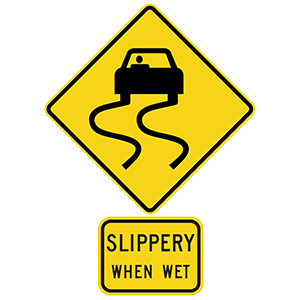
This road sign means:
When pavement is wet, reduce your speed.
The road ahead winds in a series of turns or curves.
Traffic increases ahead.
Q.30.
When merging onto the freeway, you should be driving:
At or near the speed of the freeway traffic.
At the legal speed limit.
More slowly than the freeway traffic.
Q.31.
Which of the following is most likely to be slippery in cold weather after snow or rain?
A hilly, open road
A residential road
A road in a shaded area
Q.32.
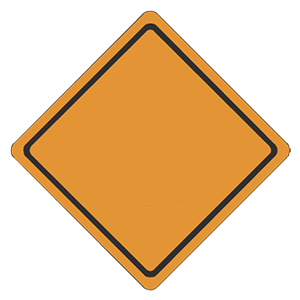
This sign means:
Road construction/maintenance area.
Side road.
Railroad ahead.
Q.33.
This yellow warning sign means:
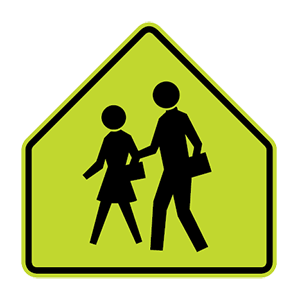
You are approaching a school or school crosswalk.
Slow down, drive with caution, and watch for children.
Both of the above.
Q.34.
If you parallel park facing downward on a hill:
Turn your wheels sharply toward the side of the road.
Turn your wheels away from the side of the road.
Keep your wheels straight.
Q.35.
There is no crosswalk and you see a pedestrian crossing your lane ahead. You should:
Make eye contact with and then pass the pedestrian.
Slow down as you pass the pedestrian.
Stop and let the pedestrian finish crossing the street.
Q.36.
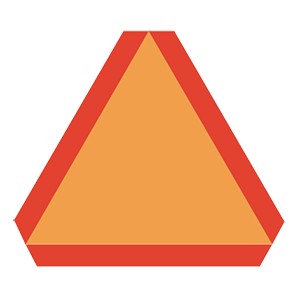
This symbol is used for:
Dangerous intersections.
Slow-moving vehicles.
Yield signs.
Q.37.
When driving behind another vehicle at night, you should:
Keep your headlights on the low beam setting.
Use your high beam headlights until you are within 10 feet of the vehicle ahead.
Use your high beam headlights.
Q.38.
This sign is a warning that you are approaching:
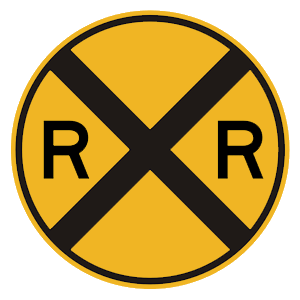
An intersection.
A crosswalk.
A railroad crossing.
Q.39.
You exit the freeway on a ramp that curves downhill. You should:
Slow to a safe speed before the curve.
Slow to the posted speed limit for the freeway.
Wait until you have entered the curve to begin braking.
Q.40.
A solid yellow line on your side of the centerline means:
Reduce your speed.
Traffic light ahead.
Do not pass.
Support mcqgeeks.com by disabling your adblocker.
×
Please disable the adBlock and continue.
Thank you.
Reload page