Q.1.
To provide the best protection, a helmet should:
Q.2.
A plastic, shatter-resistant face shield:
Q.3.
When riding with a passenger, you should:
Q.4.
When adjusting your rearview mirror, be sure you can:
Q.5.
To get the best protection, be sure that your helmet:
Q.6.
To increase your line of sight when preparing to pass another vehicle on its left, you should:
Q.7.
Which of the following does not offer protection to a motorcycle rider?
Q.8.
When riding at night, you should travel:
Q.9.
If a tire goes flat while you are riding and you must stop, you should:
Q.10.
An integrated braking system:
Q.11.
To stop quickly, it is best to:
Q.12.
When you ride a motorcycle, you should:
Q.13.
If you cannot avoid a slippery road, you should:
Q.14.
Switching to a lower gear is also known as:
Q.15.
Motorcycle riders:
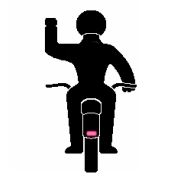
Q.16.
When an operator's left arm is bent at the elbow and pointing upward, it means the operator:
Q.17.
When checking tire pressure:
Q.18.
Smoothly downshifting on motorcycles:
Q.19.
Which of the following will help you ride safely on slippery surfaces?
Q.20.
Slippery surfaces can make it difficult to control a motorcycle. Which of the following would be considered a slippery surface?
Q.21.
To lean the motorcycle for a turn, you should:
Q.22.
When riding a motorcycle and trying to turn, you should:
Q.23.
A three-wheeled motorcycle:
Q.24.
When riding in a group while passing another vehicle, it is best to:
Q.25.
Usually, a minimum following distance of _____ should be maintained.
Q.26.
You should do a pre-ride inspection:
Q.27.
When going through a curve, you should:
Q.28.
Small vehicles can appear ______ and seem to be traveling ______ than they actually are.
Q.29.
A linked braking system:
Q.30.
Keep an expanded cushion of space between your motorcycle and the vehicle in front of you: