MCQGeeks
CBSE
JEE
NTSE
NEET
English
UK Quiz
Quiz
Driving Test
Practice
Games
Driving Test
Kentucky
Kentucky Motorcycle Driving Permit Test-6
Answers
Q.1.
Motorcyclists riding in a group should avoid pairing up because:
A merging driver may not see both riders.
Reflections from both helmets may make it difficult for the riders to see.
Riding in pairs does not allow riders the necessary space to maneuver.
It is too difficult for riders on the left side of a pairing to exit a highway.
Q.2.
Mirror checks:
Are unimportant.
Should only be done on long trips.
Should be part of your normal scanning routine.
Are not helpful since you can’t do anything about what is behind you.
Q.3.
A motorcyclist's cushion of space:
Should always stay the same.
Should vary according to riding conditions.
Is not necessary in most situations.
Should be avoided to keep traffic moving safely.
Q.4.
All of the following will lessen your chances of being involved in an accident, except:
Remaining alert.
Identifying hazards and prioritizing risks.
Riding without a headlight.
Maintaining a space cushion.
Q.5.
Where is the throttle usually located?
Near the left footrest
Near the right footrest
On the left handle grip
On the right handle grip
Q.6.
When braking, you should use:
The front brake only.
The rear brake only.
Both front and rear brakes.
Either the front or rear brake, but not both.
Q.7.
A plastic, shatter-resistant face shield protects the wearer from:
Insects.
Headlight glare.
Noise.
Sunshine.
Q.8.
Before every ride, it is important to check all of the following, except:
The spokes.
The tire tread.
The lights.
The seat fabric.
Q.9.
If your motorcycle begins to wobble, you should:
Accelerate out of the wobble.
Use the brakes gradually.
Grip the handlebars firmly and close the throttle gradually.
Downshift.
Q.10.
When a vehicle attempts to pass you from behind, you should:
Move to the center portion of the lane.
Move to the left portion of the lane.
Move to the right portion of the lane.
Not be concerned about which portion of the lane you are using.
Q.11.
Why should a load be placed low on a motorcycle?
If a load is too high, it raises the center of gravity.
If a load is too high, it may interfere with the turn signals.
It may be difficult to see over a load that is placed too high.
Others can't see your load if it is low.
Q.12.
Riding directly alongside another vehicle is discouraged because:
You may have a difficult time getting to a highway exit.
You may be in the other vehicle’s blind spot.
You may block the driver's view.
It prevents other drivers from passing both of you.
Q.13.
When riding in a group while passing another vehicle, it is best to:
Allow one rider to fully pass the other vehicle before another rider begins to pass.
Allow several members of the group to pass the other vehicle at once.
Have the last rider in the group wave to the driver being passed to signal that no other motorcycles are approaching.
Pass in a staggered formation.
Q.14.
What does this hand signal mean?
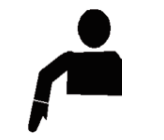
Slow or stop
Left turn
Right turn
Backing up
Q.15.
Riding in cold weather for long periods of time could result in all of the following, except:
Fatigue.
Hypothermia.
Severe chills.
Hot flashes.
Q.16.
Face shields and goggles:
Will likely never need to be replaced.
Will develop scratches and become brittle, requiring regular replacement.
Should be made of breakable materials so they can break away in the event of a crash.
Should not allow air to pass through.
Q.17.
To increase your visibility, you should:
Turn off your headlight during the day.
Wear dark clothes.
Keep your headlight on at all times.
Ride in the right portion of the lane.
Q.18.
Which of the following is not a safe step in preventing fatigue while riding?
Protecting yourself from the elements
Taking artificial stimulants
Limiting the distance ridden in one day
Taking frequent breaks
Q.19.
When riding with a passenger, you should:
Maintain your usual space cushion.
Brake later than usual.
Ride a little more slowly than usual.
Ride a little faster than usual.
Q.20.
To lessen your chances of being involved in a crash, you should:
Be visible to other drivers.
Keep your intentions unknown from other drivers.
Always stay within a foot of another vehicle.
Ride on the shoulder.
Q.21.
In any crash, you have a better chance of avoiding serious injury if you do all of the following, except:
Wear an approved helmet.
Wear face or eye protection.
Wear protective clothing.
Have a windshield.
Q.22.
An integrated braking system:
Applies partial rear braking when the front brake is applied.
Applies partial front braking when the rear brake is applied.
Applies even braking for both the front and rear brakes when either is applied.
Learns and remembers the approximate braking force used by the rider.
Q.23.
A properly-fitted motorcycle:
Allows the rider to touch the ground with their feet while seated.
Has a seat even with the rider's waist.
Has a seat that is 10 inches above the rider's waist.
Has a seat that is 10 inches below the rider's waist.
Q.24.
If your friend has been drinking alcohol, it is a good idea to do any of the following, except:
Arrange for a safe ride home for your friend.
Occupy your friend with activities to distract them from drinking.
Keep your friend from leaving until they are sober.
Allow your friend to ride their motorcycle.
Q.25.
When approaching an object or uneven surface that you cannot avoid, you should:
Make sure the motorcycle is leaning to one side.
Speed up.
Swerve quickly.
Rise slightly off the seat to allow your legs to absorb the shock.
Q.26.
To stop quickly, you should:
Use only the rear brake.
Use only the front brake.
Use both brakes.
Use the rear brake firmly while gradually increasing the braking pressure of the front brake.
Q.27.
To effectively provide protection for a motorcycle rider, pants should:
Be made of a soft material.
Be made of a heavy material.
Fit loosely enough that they flap in the wind.
Be short and expose some parts of the legs.
Q.28.
If you are riding in traffic when a small animal enters your lane, you should:
Do whatever you can, including swerving into other lanes, to avoid hitting the animal.
Switch lanes as quickly as possible.
Stay in your lane.
Flash your lights to try to scare the animal.
Q.29.
If road conditions require a longer stopping distance than normal, you should:
Decrease your usual following distance.
Increase your usual following distance.
Travel on the shoulder.
Ask someone else to operate your motorcycle.
Q.30.
To stop quickly, you should:
Rely only on the front brake.
Rely only on the rear brake.
Use the front brake and then the rear brake.
Use both brakes at the same time.
Support mcqgeeks.com by disabling your adblocker.
×
Please disable the adBlock and continue.
Thank you.
Reload page