MCQGeeks
CBSE
JEE
NTSE
NEET
English
UK Quiz
Quiz
Driving Test
Practice
Games
Driving Test
Louisiana
Louisiana Car Driving Permit Test-19
Answers
Q.1.
This sign means:
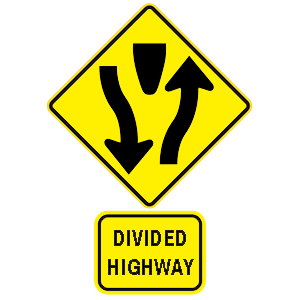
One-way traffic.
Divided highway ahead.
Two-way traffic.
Keep left.
Q.2.
To turn left from multilane, one-way streets and highways, you should start from:
The middle of the intersection.
The right lane.
The left lane.
Any lane.
Q.3.
What does alcohol do to your driving skills and judgement?
It helps driving skills but harms your judgement.
It harms both driving skills and judgement.
It has no effect on either driving skills or judgement.
It has no effect on judgement but it harms driving skills.
Q.4.
If a driver sees an animal on the roadway:
No special action is required.
The driver should honk their horn.
The driver should pass the animal as closely as possible.
The driver should be very cautious.
Q.5.
When approaching an uncontrolled intersection, a driver should:
Maintain their speed and proceed.
Stop at the intersection, check in all directions, and proceed.
Yield to all other drivers.
Be prepared to yield.
Q.6.
If you leave your vehicle unattended, you must:
Turn off the engine.
Lock the ignition and remove the key.
Set the parking brake.
All of the above.
Q.7.
If traffic signals at an intersection are not functioning due to a power outage:
Park your vehicle as far off the road as possible and wait for power to be restored.
Use hand signals to indicate your intentions to other drivers.
Turn on your hazard lights and proceed through the intersection without stopping.
Treat the intersection as a four-way stop.
Q.8.
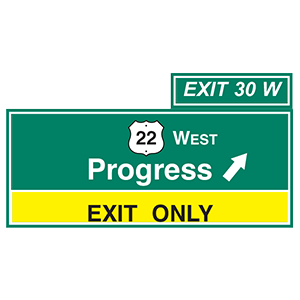
If you see this sign above your lane, you:
May not exit the freeway.
May either continue through the interchange or exit the freeway from your current lane.
May stay in your lane and continue through the interchange.
Must exit the freeway, if you stay in your current lane.
Q.9.
When sharing the road with a truck, it is important to remember that trucks generally:
Require longer distances to stop than smaller vehicles do.
Require less time to pass on a downgrade than smaller vehicles do.
Require a smaller turning radius than smaller vehicles do.
Require less time to pass on an incline than smaller vehicles do.
Q.10.
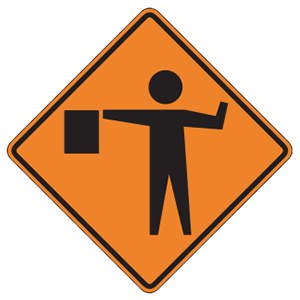
This sign means:
Pedestrians ahead.
End of construction zone.
School crossing ahead.
Flagger ahead.
Q.11.
When parking near a crosswalk, drivers may park no closer than ____ to the crosswalk.
20 feet
10 feet
Five feet
One foot
Q.12.
A solid white line down the center of a two-lane road indicates:
Lanes are moving in opposite directions and drivers are not permitted to pass.
Lanes are moving in opposite directions and drivers are permitted to pass when it is safe to do so.
Lanes are moving in the same direction and drivers are not permitted to pass.
Lanes are moving in the same direction and drivers are permitted to pass when it is safe to do so.
Q.13.
You should honk your horn when you:
Are traveling through an intersection.
Are passing a bicyclist.
See a child who is about to run into the street.
Are parallel parking.
Q.14.
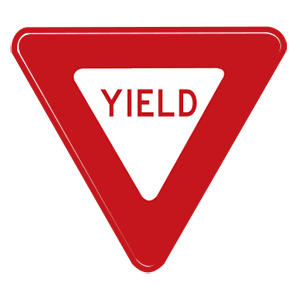
This sign means:
Yield.
Crossroad ahead.
Keep right.
Yield ahead.
Q.15.
You are driving when it begins to rain. You should:
Drive faster than surrounding traffic.
Drive at the maximum posted speed limit.
Slow down.
Drive closely behind the vehicle in front of you.
Q.16.
After stopping for a school bus that is unloading children:
Do not proceed until the children wave to you.
Watch for children walking along the side of the road.
Accelerate quickly.
Turn on your emergency flashers.
Q.17.
Which of the following commonly causes traffic accidents?
Inattentive driving
Excessive speed under the driving conditions
Following other vehicles too closely
All of the above
Q.18.
When you want to change lanes, you should:
Maintain a safe following distance.
Decrease your following distance.
Come to a complete stop before changing lanes.
Swerve in and out of traffic as quickly as possible.
Q.19.
When stopped at an intersection, drivers should look:
Only to their left.
Only to their right.
To their left, to their right, and to their left again.
Straight ahead.
Q.20.
At a four-way stop:
The driver to arrive first has the right-of-way.
The driver to arrive last has the right-of-way.
One driver should continue driving without stopping.
One driver should wave the other drivers ahead.
Q.21.
A broken yellow line alongside a solid yellow line means:
Passing on the left is permitted from either direction.
Passing is permitted from the lane next to the broken line.
Passing is permitted from the lane next to the solid line.
Passing is not allowed from either direction.
Q.22.
What is the appropriate action to take when approaching a railroad crossing that does not have signals to direct traffic?
Always bring the car to a complete stop.
Slow down and be prepared to stop.
All railroad crossings have signals so you will never encounter this situation.
Increase your speed to get across the tracks quickly.
Q.23.
If another driver cuts you off in traffic, you should:
Pull next to the driver and yell at them.
Let it go.
Flash your high beams at the driver.
Get back at the other driver by cutting them off.
Q.24.
When approaching a school bus stopped with its stop arm extended, drivers should:
Come to a complete stop and wait to proceed.
Honk their horn before passing the bus on its left.
Continue driving when they think most kids are probably done exiting the bus.
Pass the bus before its door opens.
Q.25.
If a transit vehicle is signaling to re-enter the main roadway following a stop, you must:
Honk to let them know you’re there.
Move to the left lane.
Yield.
Speed up to pass.
Q.26.
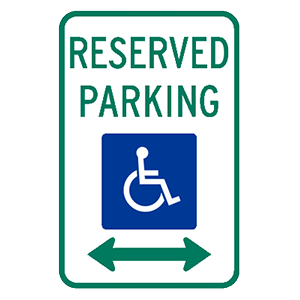
This road sign means:
Parking spaces are reserved for people with disabled parking permits.
A circular intersection is ahead.
Traffic in the lane must turn in the direction of the arrow.
Lanes are reserved for buses and vehicles with a driver and one or more passengers.
Q.27.
How do you check your blind spots?
By looking in your side mirrors.
By turning your head and looking over your shoulders.
By looking in your rearview mirror.
By staring straight ahead.
Q.28.
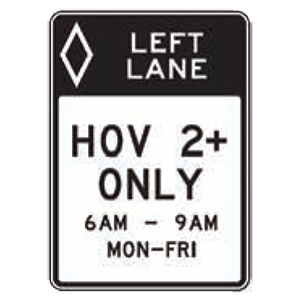
This road sign means:
The left lane is reserved for vehicles with a specific number of occupants.
Specific turning movements are allowed from specific lanes.
Do not enter.
Drivers in both lanes are responsible for merging smoothly.
Q.29.
When you park uphill on a street with a curb:
Keep the front wheel straight and set the parking brake.
Turn the front wheels away from the curb.
Turn the front wheels toward the curb.
Turn the back wheels into the curb.
Q.30.
A red and white triangular sign at an intersection means:
Slow down if an emergency vehicle is approaching.
Look both ways as you cross the intersection.
Always come to a full stop at the intersection.
Slow down and be prepared to stop if necessary.
Q.31.
To help prevent crashes, you should:
Communicate with other road users.
Ignore other drivers on the road.
Drive only on side streets and back roads.
Avoid driving during rush hour.
Q.32.
What does a flashing yellow traffic light mean?
Merging traffic
Proceed with caution.
Pedestrian crossing
Come to a full stop.
Q.33.
Double solid yellow lines painted down the middle of the road mean:
Railroad crossing ahead.
Pedestrian crossing ahead.
Passing is not permitted from either direction.
Passing is permitted from either direction.
Q.34.
Your body gets rid of approximately:
Three alcoholic drinks an hour.
One alcoholic drink an hour.
Two alcoholic drinks an hour.
None of the above.
Q.35.
The effect that lack of sleep has on your safe driving ability is the same as:
The effect that alcohol has.
The effect that amphetamines have.
The effect that anger has.
The effect that driving with teenagers has.
Q.36.
When you see this sign, it means:
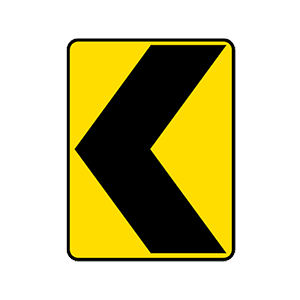
There is an object on the roadway.
Traffic is coming from the right.
The road is curving sharply to the left.
There is a merge point ahead.
Q.37.
____ of crashes occur withinmiles of home.
75 percent
50 percent
25 percent
15 percent
Q.38.
If you want to get off the freeway but you have missed your exit, you should:
Go to the next exit.
Make a U-turn through the median.
Pull onto the shoulder and back your car to the exit.
Flag down a police officer for an escort back to your exit.
Q.39.
The most common color of warning signs is:
Red.
Yellow.
Green.
Blue.
Q.40.
Stop lines are solid white lines painted across traffic lanes:
In curves and on hills.
Next to churches and schools.
At intersections and pedestrian crosswalks.
On freeway on-ramps.
Support mcqgeeks.com by disabling your adblocker.
×
Please disable the adBlock and continue.
Thank you.
Reload page