MCQGeeks
CBSE
JEE
NTSE
NEET
English
UK Quiz
Quiz
Driving Test
Practice
Games
Driving Test
Louisiana
Louisiana Car Driving Permit Test-20
Answers
Q.1.
When changing lanes, you can check your blind spots by:
Using the inside rearview mirror.
Using the outside rearview mirror.
Using both inside and outside rearview mirrors.
Turning your head and looking over your shoulder.
Q.2.
A leaky exhaust system in your vehicle is dangerous because it can cause:
A loss of hearing.
Pollution.
Carbon monoxide poisoning.
Poor engine performance.
Q.3.
If two drivers arrive at the same time to an open intersection:
The driver on the right has the right-of-way.
The driver on the left has the right-of-way.
One driver may continue driving without stopping.
One driver should honk to indicate that they are giving up the right-of-way.
Q.4.
What happens if you drink alcohol while taking prescription or over-the-counter medicine?
The medicine reduces the effect of the alcohol.
The alcohol will help the medicine cure a cold.
The combination could multiply the effects of the alcohol or medicine.
There is no effect because they are different substances.
Q.5.
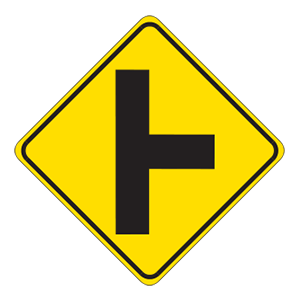
This sign means:
Side road.
Low clearance.
Merging traffic.
Prepare to stop.
Q.6.
If you’re going to turn left onto a one-way street, you should complete the turn into:
The right lane.
The lane closest to your previous lane.
Either lane.
Neither lane.
Q.7.
Drivers should use hand-over-hand steering:
When turning the wheel during normal driving activity.
When avoiding a hazard at a high speed.
When turning the wheel at low speeds.
When backing, activating signals, turning on the radio, or activating windshield wipers.
Q.8.
When approaching a steady red traffic light, drivers should:
Drive through the intersection if there is no crossing traffic.
Continue driving, as they have the right-of-way.
Stop only if a police officer is nearby.
Come to a complete stop.
Q.9.
When encountering an aggressive driver, you should:
Avoid eye contact, slow down, and let them pass.
Cut them off to slow them down.
Retaliate by tailgating them.
Make sure they know you disapprove of their behavior.
Q.10.
A flashing red light on a traffic signal means:
The same thing as a stop sign.
The traffic signal is broken.
You do not have to come to a complete stop.
Driving conditions are dangerous.
Q.11.
When traffic lights are horizontal instead of vertical, the red light is:
On the right.
In the middle.
On the left.
On a separate traffic signal.
Q.12.
If you are following a motorcycle, your following distance should be at least:
Four seconds.
Three seconds.
Two seconds.
One second.
Q.13.
It is important to slow down:
On narrow or winding roads.
At intersections or railroad crossings.
When the road is wet or slippery.
All of the above.
Q.14.
Which of the following can be hazardous when driving during the spring?
An increased number of potholes
Drowsiness caused by allergy medication
Rain and mist on the roadways
All of the above
Q.15.
It is illegal for a personyears of age or older to drive with a minimum blood alcohol concentration (BAC) of:
0.05 percent.
0.08 percent.
0.02 percent.
0.1 percent.
Q.16.
You need to use extra caution when driving near a pedestrian using a white cane because:
He or she is deaf.
He or she is a police officer.
He or she is blind.
He or she has poor balance.
Q.17.
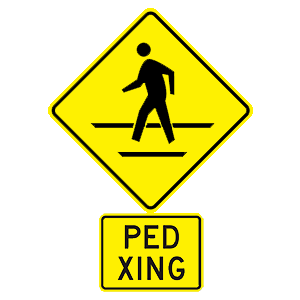
This sign means:
School ahead.
School crossing.
Pedestrian crossing.
Construction workers on or near the roadway.
Q.18.
Drivers should use evasive action steering:
When turning the wheel during normal driving activity.
When avoiding a hazard at a high speed.
When turning the wheel at low speeds.
When backing, activating signals, turning on the radio, or activating windshield wipers.
Q.19.
A person's ability to drive can be impaired by:
Alcohol.
Any medication.
A lack of sleep.
All of the above.
Q.20.
You come to an intersection displaying a flashing red light. You should:
Come to a full stop and go when it is safe to do so.
Stop only if other cars are also approaching the intersection.
Stop only if other cars are already within the intersection.
Slow down and be prepared to stop, if necessary.
Q.21.
If an aggressive driver cuts you off, you should:
Call the police immediately.
Stay calm and move out of the aggressive driver's way.
Flash your vehicle's lights to let the aggressive driver know he is wrong.
Use a driving action of your own to get back at the aggressive driver.
Q.22.
When driving down a long or steep hill, you should:
Check your mirrors for speeding traffic behind you.
Assume all traffic is maintaining a consistent speed.
Watch over your shoulder for traffic behind you.
Hold down your brake pedal to control traffic speeds.
Q.23.
A good rule to remember for passing is:
Pass on the right whenever possible.
Drive with the flow of traffic and pass only as needed.
Try to get to the front of any slow-moving traffic so that you can see better.
Always flash your lights and sound your horn to alert other drivers to your intentions.
Q.24.
If one of your tires blows out as you are driving, you should:
Brake hard immediately.
Try to steer straight while gradually slowing by removing your foot from the gas pedal.
Maintain your current speed and steer straight.
Swerve back and forth to alert traffic behind you.
Q.25.
Two solid yellow lines on the pavement mean:
Passing is allowed for drivers from both directions.
Passing is not allowed.
Passing is allowed if you are at the top a hill.
Passing is allowed during daylight only.
Q.26.
A telltale sign of a drunk driver is:
They are weaving between lanes.
They are driving more slowly than the normal traffic flow.
They are making quick and sudden stops.
All of the above.
Q.27.
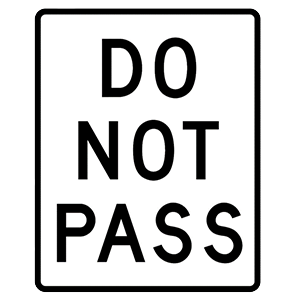
If you see this sign, you:
Must not pass another vehicle.
May pass a slow-moving vehicle if you can do so quickly.
May pass if you know the road ahead.
May pass, but only at night.
Q.28.
If a crossing guard is directing traffic in a school zone, you must:
Follow the directions given by the crossing guard.
Copy what surrounding traffic is doing, despite the crossing guard's instructions.
Assume the guard is not supposed to be directing traffic.
Follow rules that would be in place if no children were present.
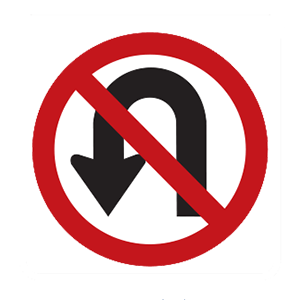
Q.29.
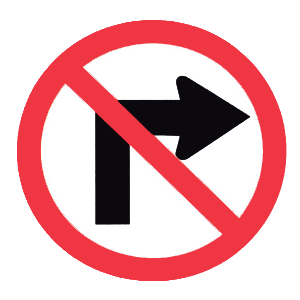
This sign means:
No U-turn.
No left turn.
No right turn.
No turning.
Q.30.
A red arrow displayed on a traffic light means that:
A driver must proceed slowly through the intersection.
A driver must stop and then proceed when the way is clear.
A driver must stop and then proceed when the signal changes to a green light or green arrow.
A driver may turn in the direction that the red arrow is pointing.
Q.31.
This sign means:
No U-turn.
Two-way left turn.
Minimum speed limit.
No parking.
Q.32.
A speed restriction sign:
May be ignored in rainy, snowy, or icy conditions.
Has a triangular shape.
Is blue with black lettering.
Shows a recommended speed for a curve or turn.
Q.33.
When approaching a flashing yellow light, drivers should:
Increase their speed.
Come to a complete stop.
Turn on their headlights.
Slow down and proceed with caution.
Q.34.
You may drive around or under a gate that is being lowered or raised at a railroad crossing:
As long as an approaching train is not too close.
If your vehicle can do so without damaging the gate.
If you first look carefully in both directions.
Under no circumstances.
Q.35.
When driving in bad weather, drivers should:
Increase their speed to reach their final destination more quickly.
Decrease their following distance.
Increase their following distance.
None of the above.
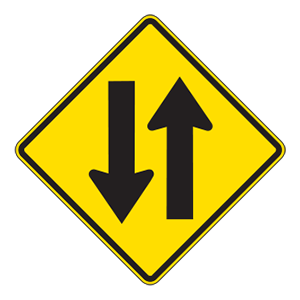
Q.36.
This sign means:
Two-way traffic.
Lane shifting.
Low clearance.
Added lane.
Q.37.
When a traffic signal light turns green, you should:
Yield the right-of-way to pedestrians.
Accelerate as quickly as possible.
Back up slowly.
Not move until another driver waves you on.
Q.38.
Your vehicle's stopping distance increases when stopping:
On a wet or icy road.
On paved highways.
When driving at night.
All of the above.
Q.39.
Driving at night requires increased caution because:
Traffic moves faster at night.
There is a larger volume of traffic at night.
Drivers cannot see as well at night.
Accidents occur more frequently at night.
Q.40.
Driving is:
Automatically easy.
Very simple.
A complex activity mastered over time.
A right.
Support mcqgeeks.com by disabling your adblocker.
×
Please disable the adBlock and continue.
Thank you.
Reload page