MCQGeeks
CBSE
JEE
NTSE
NEET
English
UK Quiz
Quiz
Driving Test
Practice
Games
Driving Test
Louisiana
Louisiana Car Driving Permit Test-5
Answers
Q.1.
The correct way to use a freeway exit ramp is to:
Slow down before entering the exit ramp.
Slow down once moving onto the exit ramp.
Keep your speed constant once in the exit ramp.
Pass slower traffic in the exit ramp.
Q.2.
When approaching a traffic signal displaying a steady green arrow, drivers:
Should merge into a lane in the direction of the arrow.
Should slow to a stop, if it is safe to do so.
May turn in the direction of the arrow after yielding to traffic and pedestrians already in the intersection.
May drive straight through the intersection.
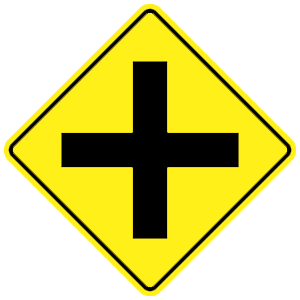
Q.3.
This sign means:
All traffic must turn.
Turn right at the intersection.
Parking area ahead.
Crossroad ahead. Watch for traffic.
Q.4.
It is important to be alert to motorcycles because:
They are more difficult to see than cars.
They rarely use their headlights.
Motorcyclists are less skilled drivers than other motorists.
All of the above.
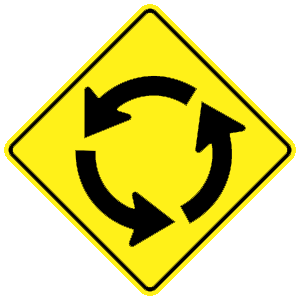
Q.5.
This sign means:
Roundabout ahead.
Lane ends, merge left.
Turn around.
Curve ahead.
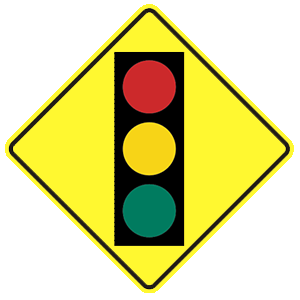
Q.6.
This sign means:
Emergency vehicles ahead.
Uncontrolled intersection ahead.
Four-way stop ahead.
Traffic signal ahead.
Q.7.
Before passing another vehicle, you should signal:
Just before changing lanes.
At any time.
After changing lanes.
Early enough for others to know your plans.
Q.8.
You are driving on a narrow road when you meet an oncoming vehicle. You must:
Pull completely off the road and stop.
Allow the oncoming vehicle at least one-half of the main-traveled portion of the road.
Demand the other vehicle pull over to make room.
Turn on your high beam headlights to make sure the other vehicle sees you.
Q.9.
Road rage and aggressive driving may be reduced by:
Allowing extra travel time.
Obeying posted speed limits.
Using proper turn signals.
All of the above.
Q.10.
Lanes of traffic moving in the same direction are divided by ____ lines.
Yellow
White
Red
Black
Q.11.
You come to an intersection displaying a flashing red light. You should:
Come to a full stop and go when it is safe to do so.
Stop only if other cars are also approaching the intersection.
Stop only if other cars are already within the intersection.
Slow down and be prepared to stop, if necessary.
Q.12.
When stopped for a traffic violation or at an equipment check, the driver must produce:
Proof of insurance.
Their license.
Proof of registration.
All of the above.
Q.13.
When traffic lights are horizontal instead of vertical, the red light is:
On the right.
In the middle.
On the left.
On a separate traffic signal.
Q.14.
To reduce the effects of headlight glare at night, you should look:
Straight ahead.
Over your shoulder.
At the center of the road
To the right edge of the road.
Q.15.
Which of the following influence(s) the effects of alcohol?
The amount of food in the stomach
The body weight of an individual
How much time passes between drinks
All three choices
Q.16.
A flashing red light on a traffic signal means:
The same thing as a stop sign.
The traffic signal is broken.
You do not have to come to a complete stop.
Driving conditions are dangerous.
Q.17.
If two drivers arrive at the same time to an open intersection:
The driver on the right has the right-of-way.
The driver on the left has the right-of-way.
One driver may continue driving without stopping.
One driver should honk to indicate that they are giving up the right-of-way.
Q.18.
When should drivers and passengers fasten their safety belts?
Before reaching 55 mph
When they feel unsafe
When making a sharp turn
Before starting the engine
Q.19.
Which is a characteristic of a defensive driver?
Anger
Passivity
Exhaustion
Alertness
Q.20.
If you are driving on a one-way street and an emergency vehicle using its flashing lights approaches your vehicle, you must:
Drive with your flashers turned on.
Drive toward the nearest roadside and stop.
Speed up and take the nearest exit.
Slow down until the vehicle passes you.
Q.21.
When parking your vehicle downhill on a two-way street:
Turn your wheels to the right.
Turn your wheels to the left.
Keep your wheels pointed straight ahead.
Leave your transmission in neutral.
Q.22.
A steady yellow traffic signal means that a ____ light will soon appear.
Flashing yellow
Steady green
Steady red
Flashing red
Q.23.
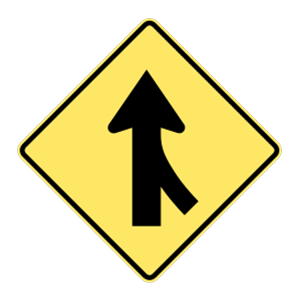
On the freeway, you see a "Merging traffic“ sign. You should:
Honk at incoming traffic.
Always remain at your present speed.
Speed up to avoid congesting traffic.
Move to another lane, if safe, to let traffic enter.
Q.24.
When passing a parked vehicle, you should:
Be prepared for a person or vehicle to unexpectedly enter your lane.
Expect all other drivers and pedestrians to respect your right-of-way.
Honk to alert drivers and pedestrians to your presence.
Pass quickly to avoid any pedestrians.
Q.25.
The risk of hydroplaning can can be reduced by driving:
Through shallow water.
More quickly.
More slowly.
Through deep water.
Q.26.
A driver who is taking a non-prescription drug should:
Read the labels on the drug before driving.
Drink alcohol instead.
Continue to drive regardless of any warning labels.
Drive only during daylight hours.
Q.27.
You are driving along a street and hear a siren. You cannot immediately see the emergency vehicle. You should:
Keep driving until you see the vehicle.
Pull to the curb and look to see if it is on your street.
Slow down. Don't stop until you see it.
Speed up and turn at the next intersection.
Q.28.
What kinds of drugs can affect your driving ability?
Allergy medicine
Marijuana
Cold remedies
All of these choices
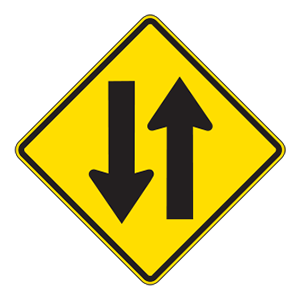
Q.29.
This sign means:
Two-way traffic.
Lane shifting.
Low clearance.
Added lane.
Q.30.
A seat belt should be adjusted so that it:
Is loose.
Is buckled snugly across your hip bones and lower abdomen.
Is hidden beneath the seat.
Keeps the seat belt buzzer or light from operating.
Q.31.
When adjusting your rearview mirror, you should be able to clearly see:
Your own reflection.
The passengers in the backseat.
The entire rear window.
Most of the lane next to you.
Q.32.
When a curb is painted ____, it indicates fire zone parking restrictions.
Blue
Yellow
White
Red
Q.33.
Drivers who eat and drink while driving:
Make no driving errors.
Have trouble driving slowly.
Are better drivers because they are not hungry.
Have trouble controlling their vehicles.
Q.34.
This sign means:
Watch for trucks.
Do not pass trucks.
Truck parking area ahead.
Steep downgrade ahead.
Q.35.
You may avoid the risks of alcohol-related crashes by:
Deciding before you start drinking that you are not going to drive.
Simply saying, "No thanks, I'm driving," if someone offers you a drink.
Calling a taxi.
Doing any of the above.
Q.36.
When you drive through an area where children are playing, you should expect them:
To know when it is safe to cross the street.
To stop at the curb before crossing the street.
To run out in front of you without looking.
Not to cross the street unless they are with an adult.
Q.37.
This road sign means:
Cars in right lane must slow down.
No left turn.
Merge.
Pass only in the right lane.
Q.38.
Railroad crossings should always be considered:
Safe to cross, as it is unlikely that a train will be coming.
Dangerous.
Safe locations to park a car.
A place where it is required to stop
Q.39.
What might happen when alcohol is combined with another drug?
The effects of the alcohol and the drug may both be increased.
Nothing will happen.
The effects of the alcohol and the drug may both be reduced.
The effects of only the alcohol may be reduced.
Q.40.
You may cross double solid yellow lines:
To pass a slow-moving truck.
To turn into a driveway.
To pass another car.
Under no conditions.
Support mcqgeeks.com by disabling your adblocker.
×
Please disable the adBlock and continue.
Thank you.
Reload page