MCQGeeks
CBSE
JEE
NTSE
NEET
English
UK Quiz
Quiz
Driving Test
Practice
Games
Driving Test
Louisiana
Louisiana Car Driving Permit Test-6
Answers
Q.1.
When you approach a railroad crossing without flashing warning signals or crossing gates, you should:
Cross the tracks immediately and as quickly as possible.
Always stop before crossing the tracks.
Prepare to yield to any train at the crossing.
Speed up to beat any oncoming train.
Q.2.
You are coming to an intersection with a flashing yellow light. You should:
Stop and wait for the light to change.
Make a U-turn because the intersection is closed.
Drive carefully through the intersection.
Prepare to stop; the light is about to turn red.
Q.3.
Double solid yellow lines painted down the middle of the road mean:
Railroad crossing ahead.
Pedestrian crossing ahead.
Passing is not permitted from either direction.
Passing is permitted from either direction.
Q.4.
When you need to change lanes, it is important to:
Signal your intentions ahead of the lane change.
Check your blind spot.
Make sure the lane is clear before entering.
All of the above.
Q.5.
A traffic light displaying a green arrow and a red light means that:
You may only drive straight ahead.
You may drive only in the direction of the green arrow.
You must wait for a solid green light to proceed in any direction.
Vehicles moving in any direction must stop.
Q.6.
A red flashing traffic light has the same meaning as a:
Solid red light.
Stop sign.
Yield sign.
Caution sign.
Q.7.
When turning or changing lanes, you must:
Always signal your intentions, even when no visible traffic is present.
Signal only if there is visible traffic.
Signal only when driving at night.
Signal only when driving in heavy traffic at night.
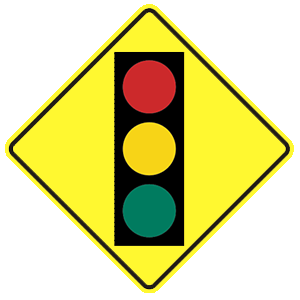
Q.8.
This road sign means:
Roundabout ahead.
No passing zone.
Left turn yield on green.
Traffic signal ahead.
Q.9.
If you are driving on the interstate and pass your exit, you should:
Quickly cut across traffic to make your turn.
Make a U-turn to go back to the exit.
Continue driving and use the next exit.
Put your vehicle in reverse to go back to the exit.
Q.10.
The act of turning your head and checking your blind spot before changing lanes, driving away from a curb, or merging your vehicle into traffic is:
A bad driving habit.
A good driving habit.
Unnecessary.
Not necessary if you use the rearview mirror.
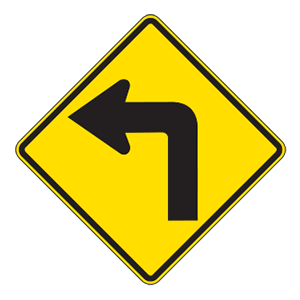
Q.11.
This sign means:
Sharp turn ahead, slow down.
Work crew ahead.
Side road.
Playground ahead.
Q.12.
If a transit vehicle is signaling to re-enter the main roadway following a stop, you must:
Honk to let them know you’re there.
Move to the left lane.
Yield.
Speed up to pass.
Q.13.
You are entering a crowded freeway. What should you do to merge into traffic?
Use your side and rearview mirrors and check your blind spots.
Use the acceleration lane to adjust your speed to match the speed of freeway traffic.
Yield to traffic already on the freeway.
All of the above.
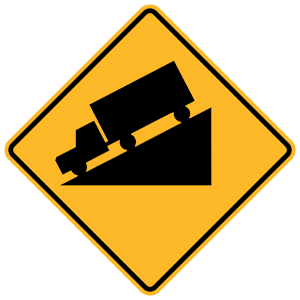
Q.14.
This sign means:
Trucks under 18,000 lbs. allowed.
Hill ahead.
Truck stop ahead.
No trucks allowed.
Q.15.
Always signal when:
Changing lanes.
Pulling into or out of a parking space.
Pulling into traffic from an alley or parking area.
All of the above.
Q.16.
Which of the following statements is true?
A sudden change in weather calls for a change in driving.
You should slow down when driving in rain and fog.
Be particularly aware of vehicles coming up behind you in inclement weather.
All of the above.
Q.17.
Diagonal stripes sloping downward right on a barricade or panel mean:
The driver should stop.
The driver should bear to the right.
The driver should bear to the left.
The driver should drive in a straight line.
Q.18.
In a city, you should look at least ____ block(s) ahead of your vehicle.
One
Two
Three
Four
Q.19.
Two solid white lines painted across a traffic lane show the boundaries of a crosswalk. As a driver, you should know that:
Motor vehicles have the right-of-way over pedestrians in crosswalks.
When pedestrians are in crosswalks, they should be given the right-of-way.
No one has the right-of-way in a crosswalk.
Pedestrians are responsible to stay out of the way of all traffic.
Q.20.
How can you help prevent rear-end collisions?
Avoid sudden stops.
Before stopping, check your mirrors and blind spots for traffic.
Release the gas pedal and let your vehicle slow before applying the brakes.
All of the above.
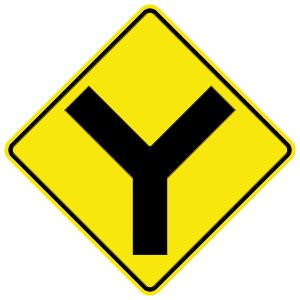
Q.21.
This road sign means:
Your current roadway ends ahead.
You must bear either right or left.
A four-way intersection is ahead.
A road joins from the right.
Q.22.
If you are following an emergency vehicle, your following distance should be a minimum of:
Two seconds.
Four seconds.
10 seconds.
20 seconds.
Q.23.
What is the meaning of the "S" in the SIPDE acronym?
See.
Stare.
Sweep, Search, and Scan.
Stop.
Q.24.
To check your blind spot when changing lanes to the left, you should glance:
Over your right shoulder.
At your side mirror.
Over your left shoulder.
At your rearview mirror.
Q.25.
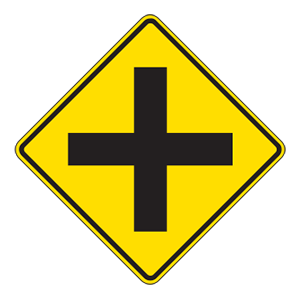
This sign means:
Crossroad ahead.
Flagger ahead.
Lane ends.
Turn right or go straight.
Q.26.
Which of the following statements is true?
It is okay for drivers of other vehicles to follow motorcycles closely.
A motorcycle with two people on it is more balanced than a motorcycle with just one rider.
The driver of a passenger vehicle must change lanes completely when passing a motorcycle.
Drivers of other vehicles can expect a motorcycle's brake lights to turn on when the motorcyclist slows down.
Q.27.
A steady green light at an intersection means that you:
Must slow down and prepare to stop.
Must stop and check for oncoming traffic before proceeding.
May drive through the intersection if the road is clear.
May not turn right.
Q.28.
The Highway Transportation System is made up of:
People.
Vehicles.
Roads.
All of the above.
Q.29.
If your vehicle begins to skid, you should:
Overcorrect.
Turn your steering wheel into traffic.
Turn your steering wheel in the direction you want to go.
Release the steering wheel.
Q.30.
Roads freeze quickly when they are:
Flat.
Curvy.
In the sun.
Shaded.
Q.31.
When passing a large vehicle, the driver of a small vehicle must be prepared for:
Loud noises.
Excess air pollution.
Wind gusts produced by the large vehicle.
Falling vehicle parts.
Q.32.
Characteristics of drivers with road rage include:
Deliberately obstructing other vehicles.
Flashing headlights.
Cutting off or swerving in front of other drivers.
All of the above.
Q.33.
What should you do when you see this sign?
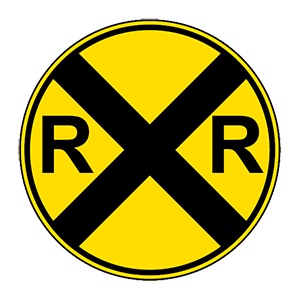
Look for a train station ahead.
Signal before going any further.
Slow down and yield for trains.
Stop.
Q.34.
If you are following a motorcycle, your following distance should be at least:
Four seconds.
Three seconds.
Two seconds.
One second.
Q.35.
How can you prevent "Highway hypnosis?"
Begin your drive well-rested.
Regularly stop, even if you don't feel tired.
Keep your eyes moving.
All of the above.
Q.36.
If you drink alcohol socially, what helps ensure safe driving?
Drink coffee before driving.
Ride home with a friend who has not been drinking.
Take a cold shower before driving.
Stop drinking one half hour before driving.
Q.37.
You are driving when it starts to sleet or snow. You should:
Keep your windshield and mirrors clear.
Allow additional distance between your vehicle and the vehicles that you are following.
Approach all vehicles with caution.
All of the above.
Q.38.
Defensive driving is:
Identifying dangerous driving situations and taking action to avoid accidents.
Defending yourself against poor drivers by getting ahead of them in traffic.
Following the vehicle ahead of you at a close distance.
Quickly changing lanes and shifting in and out of traffic congestion.
Q.39.
If you are involved in a serious motor vehicle crash:
Stop.
Call the police.
Determine if anyone is injured.
All of the above.
Q.40.
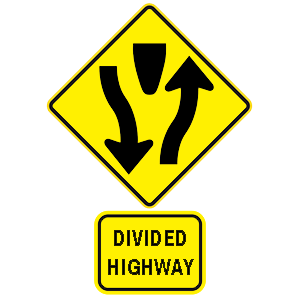
This sign means:
One-way traffic.
Divided highway ahead.
Two-way traffic.
Keep left.
Support mcqgeeks.com by disabling your adblocker.
×
Please disable the adBlock and continue.
Thank you.
Reload page