MCQGeeks
CBSE
JEE
NTSE
NEET
English
UK Quiz
Quiz
Driving Test
Practice
Games
Driving Test
Maine
Maine Car Driving Permit Test-11
Answers
Q.1.
A large truck is ahead of you and is turning right onto a street with two lanes in each direction. The truck:
May complete its turn in either of the two lanes.
May have to swing wide to complete the right turn.
Must stay in the right lane at all times while turning.
Q.2.
A solid yellow line on your side of the centerline means:
Slow down.
Pass with caution.
Do not pass.
Keep right on hills.
Q.3.
Driving under the influence of any medication which impairs your driving is permitted:
Under no circumstances.
If you don't feel drowsy.
If it is prescribed by a physician.
Q.4.
If you park facing uphill on a street with a curb, set the parking brake and:
Turn the front wheels toward the curb.
Turn the front wheels away from the curb.
Leave the front wheels straight.
Q.5.
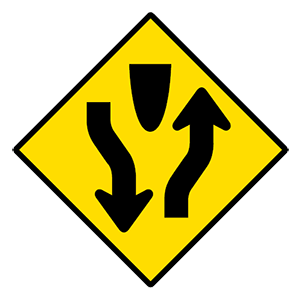
This road sign means:
Keep right.
Keep left.
Pass with caution.
No passing.
Q.6.
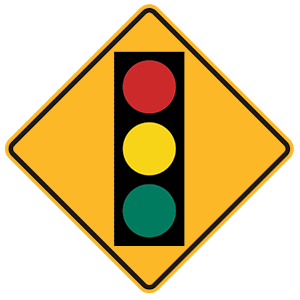
This sign means:
Continue at your current speed.
You must stop ahead.
Speeding is not allowed.
There is a traffic signal ahead.
Q.7.
Which of the following is a dangerous habit when driving in work zones?
Tailgating another vehicle
Failing to carefully watch for workers and moving equipment
Both of the above
Q.8.
Only ____ can reduce blood alcohol content (BAC) and alcohol's effects on the body.
Drinking caffeine
Eating foods high in fat
Time
Q.9.
Headlights must be used:
Whenever the driver is tired.
Between sunset and sunrise.
Only when the temperature drops below freezing.
During the day under favorable weather conditions.
Q.10.
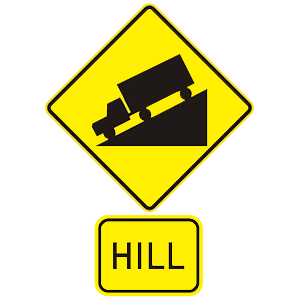
This sign means:
Trucks only.
Trucks are entering the highway.
Upcoming hill.
Trucks have the right-of-way.
Q.11.
When driving behind a motorcycle under normal weather and traffic conditions, maintain a minimum following distance of:
One second.
Two seconds.
Three to four seconds.
Q.12.
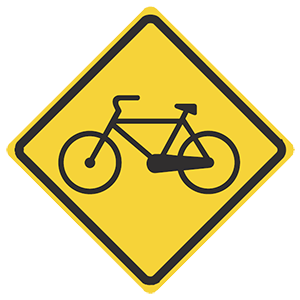
This sign means:
Watch for bicycles.
Bicycles not allowed.
Bicycle repair shop ahead.
Q.13.
Drivers turning left must yield to:
Overtaking cars.
Oncoming cars.
No one.
Q.14.
What should you do if your vehicle’s right wheels leave the pavement?
Stop quickly.
Immediately pull all the way off of the road and get back on when it is safe.
Accelerate and steer back on the road quickly.
Take your foot off the accelerator, slow down, then ease back onto the road when it is safe to do so.
Q.15.
When you see this sign, you should stop and:
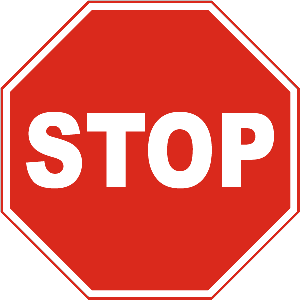
Check for vehicles only in the direction that you plan on going, then proceed.
Let all vehicles that arrive before or after you go first.
Check for traffic in all directions before proceeding.
Q.16.
Failing an alcohol level test is the only way you will receive an Operating Under the Influence (OUI) conviction.
True
False
Q.17.
When changing lanes:
Check your side mirror and look over your shoulder to make sure the lane is clear.
Check the inside rearview mirror.
Slow down.
Q.18.
You should increase the distance between your vehicle and the vehicle ahead when you:
Are following a small passenger vehicle.
Are being tailgated by another driver.
Are driving more slowly than the posted speed limit.
Q.19.
A diamond-shaped sign is a:
Road hazard sign.
Interstate route sign.
School crossing sign.
Speed limit sign.
Q.20.
This sign is used to warn drivers about:
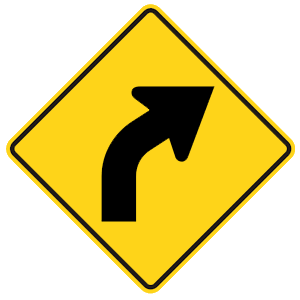
Upcoming intersections.
Road construction.
Road curves ahead.
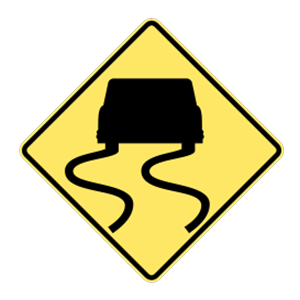
Q.21.
This sign means:
Watch for drunk drivers.
Curves ahead.
Slippery when wet.
Apply your brakes quickly.
Q.22.
To ensure that your physical condition does not cause you to drive in an unsafe manner, you should:
Keep physically fit and have regular physical examinations.
Know the effect of any medicine on your driving ability.
Drive within your physical limitations.
All of the above.
Q.23.
When turning left at an intersection:
You should always yield to oncoming traffic and pedestrians.
Oncoming traffic and pedestrians should yield to you.
You should never yield to oncoming traffic and pedestrians.
Q.24.
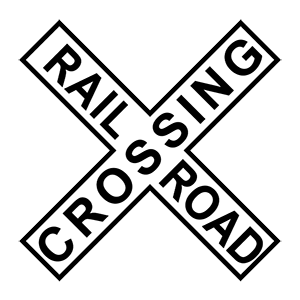
This white sign means:
The railroad crossing is controlled. Continue at your regular speed.
Look, listen, and prepare to stop at the crossing if necessary.
Stop at the railroad tracks and wait for a signal before crossing.
Q.25.
Regulatory signs:
Are placed in every location where there is a present danger.
Indicate what a driver must or must not do.
Are diamond-shaped and yellow or green.
May warn drivers that they are approaching a school zone.
Q.26.
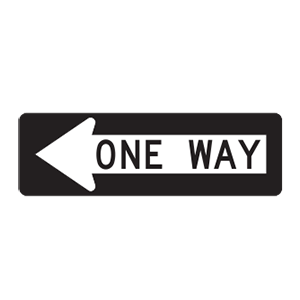
This sign means:
One-way traffic.
Two-way left turn.
Two-way traffic.
Minimum speed limit.
Q.27.
Which of the following is most likely to be slippery in cold weather after snow or rain?
A hilly, open road
A residential road
A road in a shaded area
Q.28.
A bicyclist who doesn’t obey traffic laws:
Is in the right because bicyclists don’t have to obey traffic laws.
Can be ticketed.
Will always receive a warning from law enforcement.
Will have their bicycle impounded.
Q.29.
What does a lane use control signal displaying a green arrow indicate?
The signal is about to change to a red X.
Drivers should not drive in this lane.
Drivers may use the indicated lane only to make a left turn.
Drivers may drive normally in the indicated lane.
Q.30.
You experience an incident at work that has left you feeling angry. When you get to your car, you should:
Play the radio loudly so you won’t think about it.
Drive fast on the interstate to let off steam.
Take a few minutes to cool off before you begin your drive home.
Stop at your favorite bar and have a few drinks before driving home.
Q.31.
If you are driving in another driver's blind spot, you should:
Move forward or drop back so the other driver can see you.
Keep a steady pace.
Stay in the driver's blind spot.
Honk to let them know you are there.
Q.32.
When you are being tailgated:
Move over to the right, if there is an open lane to your right.
If there is not an open lane to your right, wait until the way is clear ahead and reduce your speed slowly to encourage the tailgater to drive around you.
Never slow down abruptly.
All of the above.
Q.33.
On a road which has no sidewalks, a pedestrian should walk on the:
Side of the road which has the lightest traffic.
Same side of the road on which traffic is moving.
Side of the road facing oncoming traffic.
Side of the road which has the heaviest traffic.
Q.34.
When changing lanes, you can check your blind spots by:
Using the inside rearview mirror.
Using the outside rearview mirror.
Using both inside and outside rearview mirrors.
Turning your head and looking over your shoulder.
Q.35.
If you parallel park facing downward on a hill:
Turn your wheels sharply toward the side of the road.
Turn your wheels away from the side of the road.
Keep your wheels straight.
Q.36.
When entering the interstate, check for a gap in traffic in the nearest lane, adjust your speed to match traffic, signal, and:
Expect traffic to allow you to proceed into the lane, since you have the right-of-way.
Merge carefully into the gap.
Wait for the lane to clear before merging.
Q.37.
How can you lower the risk of hydroplaning?
Do not speed when the roads are wet.
Use tires with proper air pressure.
Replace tires with bad tread.
All of the above.
Q.38.
If you must park your vehicle in an area not usually used for parking:
Park with your reverse lights on.
Make sure your vehicle is visible to drivers approaching from any direction.
Park five feet from the curb.
Q.39.
What does a single dashed white line separating traffic mean?
Drivers may pass, even if it could be dangerous.
Lanes move in opposite directions.
Drivers may not pass.
Drivers may pass if it is safe to do so.
Q.40.
If parking near a fire hydrant, you may park no closer than ____ from the fire hydrant.
15 feet
10 feet
Five feet
One foot
Q.41.
If two vehicles arrive to a four-way stop at the same time:
The vehicle on the left must yield to the vehicle on the right.
The vehicle on the right must yield to the vehicle on the left.
Drivers must make hand motions to communicate with each other.
One driver should proceed without stopping.
Q.42.
When driving normally, where should your hands be positioned on the steering wheel?
3 and 9 o'clock
1 and 11 o'clock
2 and 10 o'clock
4 and 8 o'clock
Q.43.
Each time you pass a car, there is:
An increased chance of collision.
A decreased chance of collision.
No more or less chance of a collision.
Q.44.
If it feels like your tires have lost contact with the surface of the road, you should:
Slow down by shifting into a lower gear.
Ease your foot off the gas pedal.
Slow down by pumping the brakes quickly and firmly.
Q.45.
After you have passed a vehicle moving in the same direction, it is safe to move back into the right lane:
After about three seconds.
When you can no longer see the passed vehicle over your right shoulder.
When you can see the entire front of the passed vehicle in your rearview mirror.
Q.46.
A broken yellow line down the center of a road indicates that:
A construction zone is ahead.
Passing is not permitted from either direction.
Passing is permitted from either direction.
Q.47.
If you need to stop quickly and your vehicle is not equipped with an Anti-Lock Braking System (ABS), you should:
Hold down the brake pedal.
Firmly pump your brakes.
Lightly tap the brakes.
Release the brake pedal.
Q.48.
Drivers must be careful when passing large vehicles and should avoid driving beside large vehicles for long periods of time.
TRUE
FALSE
Q.49.
Temporary signs used in construction and maintenance work areas:
Have a red background with green writing.
Have an orange background with black writing.
Have a yellow background with blue writing.
Q.50.
You are approaching an intersection at the posted speed limit when the signal turns yellow. You should:
Slow down and proceed through the intersection without caution.
Speed up to cross the intersection before the light turns red.
Stop before entering the intersection, if you can do so safely.
Q.51.
When getting ready to change lanes, you should:
Check your side view mirror.
Check your rearview mirror.
Quickly turn your head to check for other vehicles.
All of the above.
Q.52.
In a vehicle equipped with airbags, the safest place for children ageand under to ride is in:
The front seat.
The back seat.
The bed of a pick-up truck.
Q.53.
Lanes of traffic moving in opposite directions are divided by ____ lines.
White
Red
Black
Yellow
Q.54.
Which of the following is a safe way to drive through a curve?
Slow down as you enter, speed up as you exit.
Maintain a constant speed throughout the curve.
Speed up as you enter, slow down as you exit.
Stay near the right edge of your lane.
Q.55.
Posters, signs, and window decals on the windshield and windows:
Are a fun way to personalize your vehicle.
Are permitted if they allow the driver at least a little visibility.
Are prohibited, unless they are otherwise specifically required by law.
Are permitted only if they do not contain offensive language.
Q.56.
Yellow pavement markings indicate that lanes of traffic are moving in opposite directions.
True
False
Q.57.
On which side(s) of a vehicle should drivers maintain a space cushion?
Only to the front of the vehicle
Only to the back of the vehicle
Only to the left and right of the vehicle
All sides of the vehicle
Q.58.
You should drive on the shoulder to pass a car:
If the vehicle ahead of you is turning left.
Under no circumstances.
If the shoulder is wide enough.
Q.59.
Solid or dashed white pavement markings indicate that traffic is moving in opposite directions.
True
False
Q.60.
When approaching a railroad crossing, you should:
Slow down.
Look for a train.
Be ready to stop.
All of the above.
Support mcqgeeks.com by disabling your adblocker.
×
Please disable the adBlock and continue.
Thank you.
Reload page