MCQGeeks
CBSE
JEE
NTSE
NEET
English
UK Quiz
Quiz
Driving Test
Practice
Games
Driving Test
Maine
Maine Car Driving Permit Test-19
Answers
Q.1.
A solid yellow line on your side of the centerline means:
Reduce your speed.
Traffic light ahead.
Do not pass.
Q.2.
The absence of a sign or pavement marking preventing passing means that it is safe to pass.
True
False
Q.3.
Which of the following statements is true?
It is okay for drivers of other vehicles to follow motorcycles closely.
A motorcycle with two people on it is more balanced than a motorcycle with just one rider.
The driver of a passenger vehicle must change lanes completely when passing a motorcycle.
Drivers of other vehicles can expect a motorcycle's brake lights to turn on when the motorcyclist slows down.
Q.4.
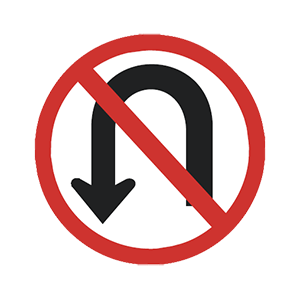
This sign means:
No U-turn.
Traffic signal ahead.
Railroad ahead.
Q.5.
If you come to a railroad crossing with lowered gates and flashing warning lights, you should:
Drive around the crossing gates if you can't see a train.
Come to a complete stop well behind the gates, wait for the tracks to clear, and proceed once the gates are lifted.
Slow down and drive around the gates.
Q.6.
Before turning, you should:
Use your signal.
Turn the wheel.
Increase your speed.
Change lanes.
Q.7.
When you are in a line of traffic that is crossing a railroad track that has no signals or gates:
You have the right-of-way and do not need to check for trains.
You may pass slower drivers while crossing the track.
You need to make sure there is space for your vehicle to get all the way across the tracks without stopping.
All of the above
Q.8.
You are driving along a street and hear a siren. You cannot immediately see the emergency vehicle. You should:
Keep driving until you see the vehicle.
Pull to the curb and look to see if it is on your street.
Slow down. Don't stop until you see it.
Speed up and turn at the next intersection.
Q.9.
Traffic signals sometimes display arrows to control turns from specific lanes. A solid red arrow:
Is never used as a traffic signal.
Has the same meaning as a circular red traffic light.
Means that drivers may turn in the direction indicated by the arrow.
Means that the traffic the arrow is pointing toward must stop.
Q.10.
You reach an intersection with stop signs on all four corners at the same time as the driver on your left. Who has the right-of-way?
The driver on your left has the right-of-way.
You have the right-of-way.
Whoever is signaling to make a turn has the right-of-way.
Q.11.
Roads become very slippery:
When it has been raining for an hour or more.
The day after it rains.
For the first 10 to 15 minutes of a rainstorm.
Right after the rain has stopped.
Q.12.
To avoid traction loss on wet roads, you should:
Make abrupt turns.
Apply the brakes firmly.
Slow down.
Q.13.
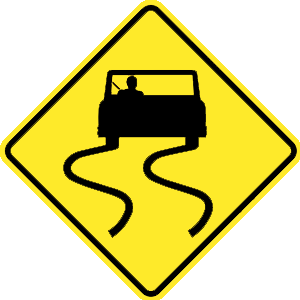
This road sign means:
When pavement is wet, reduce your speed.
The road ahead winds a series of turns or curves.
Traffic increases ahead.
Steep grade ahead.
Q.14.
You are approaching an intersection when the traffic light changes from green to solid yellow. You should:
Consider it the same as a caution sign and continue through the intersection.
Stop immediately.
Stop before entering the intersection, unless you are too close to stop safely.
Speed up to get through the intersection before the red light appears.
Q.15.
What does this road sign indicate?
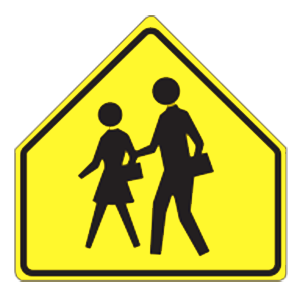
Directions for children
School zone ahead
Playground area ahead
Q.16.
It is best to keep a space cushion:
Only in back of your vehicle.
Only on the left and right sides of your vehicle.
Only in front of the vehicle.
On all sides of the vehicle.
Q.17.
If you see this sign above your lane, you:
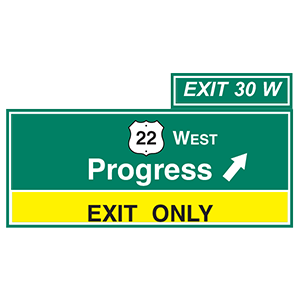
May not exit the freeway.
May either continue through the interchange or exit the freeway from your current lane.
May stay in your lane and continue through the interchange.
Must exit the freeway, if you stay in your current lane.
Q.18.
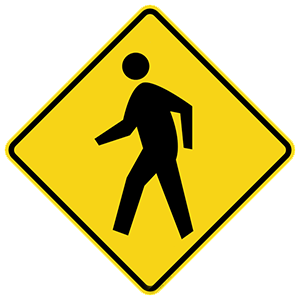
This road sign means:
School crossing.
Pedestrian crossing.
Jogging trail.
Q.19.
Safe passing depends on the cooperation of two drivers.
True
False
Q.20.
If you are driving and the rear end of your car starts skidding to the left, you should:
Steer to the right.
Steer to the left.
Tap your brakes lightly and shift into neutral.
Q.21.
Extra space in front of a large truck is needed for:
Other drivers to merge onto the freeway.
The truck driver to stop the vehicle.
Other drivers when they want to slow down.
Q.22.
A solid white line on the right edge of the highway slants in to the left. That shows that:
There is an intersection just ahead.
You are approaching a construction area.
You will be required to turn left just ahead.
The road will get narrower.
Q.23.
Drivers should not pass other vehicles at:
Intersections.
Railroad crossings.
Crossroads.
Any of the above.
Q.24.
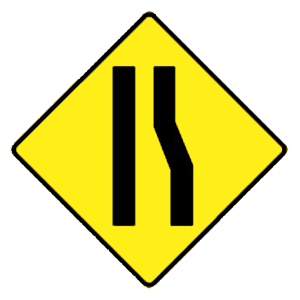
This road sign means:
Road widens ahead.
Lane reduction; the right lane ends soon.
Highway entrance ramp ahead.
Lane reduction; the left lane ends soon.
Q.25.
When crossing a sidewalk to enter traffic from an alley or driveway, drivers should:
Stop only if pedestrians are on the sidewalk.
Stop before driving onto the sidewalk or sidewalk area.
Expect pedestrians on the sidewalk to yield the right-of-way.
Q.26.
Only vehicles displaying special plates or parking placards for persons with disabilities may park in spaces reserved for them by an official sign.
True
False
Q.27.
Before switching on the ignition, you should:
Be sure only backseat passengers have buckled their seat belts.
Be sure only adult passengers have buckled their seat belts.
Be sure only child passengers have buckled their seat belts.
Be sure all of the vehicle's occupants have buckled their seat belts.
Q.28.
A broken yellow centerline means that:
Passing is not permitted.
Passing on the right is permitted when the way ahead is clear.
Passing on the left is permitted when the way ahead is clear.
Q.29.
A work zone:
May be moving or stationary.
Is marked with black and white signs.
Does not require a driver to slow down and pay extra attention.
All of the above.
Q.30.
When passing an animal which is being driven, ridden, or led down a public road, drivers should:
Increase their speed.
Slow down.
Honk their horn.
Ride next to the animal for as long as possible.
Q.31.
Anything that requires you to ____ could cause you to crash.
Take your eyes off the road
Take your hands off the wheel
Take your attention away from the task of driving
All of the above
Q.32.
Highway markings:
Are usually not important.
Are only found in construction zones.
Provide information for drivers.
Are usually red and blue in color.
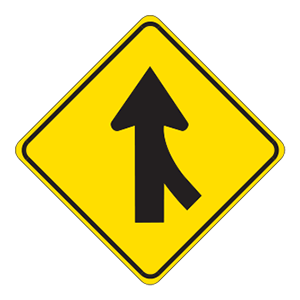
Q.33.
This sign means:
Merging traffic.
Multiple turns.
Lane shifting.
Do not block intersection.
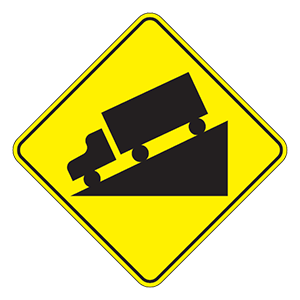
Q.34.
This sign means:
Trucks entering.
Truck exit only.
Steep downgrade ahead.
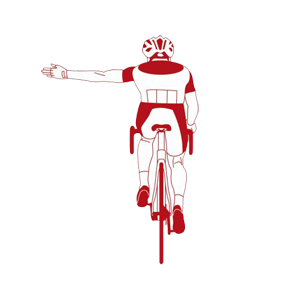
Q.35.
This bicyclist is signaling:
A left turn.
An upcoming stop.
A right turn.
Q.36.
What should you do when an emergency vehicle is approaching while displaying flashing red or blue lights?
See if you can reach your destination before the emergency vehicle catches up to you.
Continue driving but try to stay out of its way.
Pull over to the side of the road and come to a complete stop.
Stop in the middle of an intersection.
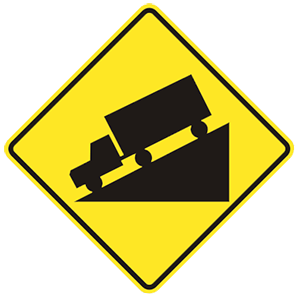
Q.37.
This road sign means:
Intersection ahead.
Steep grade ahead.
Winding road.
Merging traffic.
Q.38.
Vehicles stopped behind a school bus with its red lights flashing must remain stopped until:
All students are off the bus.
The stop arm is retracted.
The stop arm is retracted and the bus resumes motion.
Q.39.
Which of the following driving skills is/are affected by the use of alcohol and/or drugs?
Alertness.
Coordination.
Both of the above.
Q.40.
Before stopping your vehicle at a traffic signal or sign, you should:
Press down hard on the accelerator.
Check your mirrors for surrounding traffic.
Set the parking brake.
Q.41.
You may be able to identify an aggressive driver by:
Their erratic and improper lane changes.
The number of passengers in their car.
Their tendency to drive slowly.
Q.42.
You must yield to other drivers:
When entering a street from a garage or alley.
When they are on a road to your left and you have reached an unmarked intersection at the same time.
When your traffic signal is a green arrow.
All of the above.
Q.43.
Your tire blows out while you are driving. You should:
Slam on your brakes.
Hold your steering wheel tightly and slow to a stop.
Keep driving normally.
Turn on your emergency flashers and continue driving.
Q.44.
When driving in fog or mist, never put your headlights on the high beam setting because:
The light will reflect back into your eyes.
Approaching vehicles might not see you.
Vehicles behind you may follow too closely.
Q.45.
A speed restriction sign:
May be ignored in rainy, snowy, or icy conditions.
Has a triangular shape.
Is blue with black lettering.
Shows a recommended speed for a curve or turn.
Q.46.
When passing a large vehicle, the driver of a small vehicle must be prepared for:
Loud noises.
Excess air pollution.
Wind gusts produced by the large vehicle.
Falling vehicle parts.
Q.47.
You may drive across a dashed white line:
At any time.
Only during daylight hours.
When it is safe to change lanes.
Only when passing a motorcycle.
Q.48.
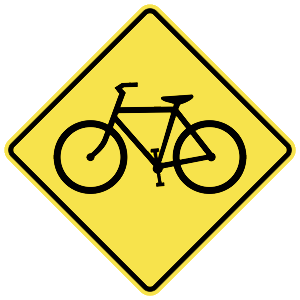
This road sign means:
Bicycle crossing.
Stop only if other cars are approaching.
Yield the right-of-way to pedestrians.
Q.49.
Defensive driving is:
Identifying dangerous driving situations and taking action to avoid accidents.
Defending yourself against poor drivers by getting ahead of them in traffic.
Following the vehicle ahead of you at a close distance.
Quickly changing lanes and shifting in and out of traffic congestion.
Q.50.
If you have a sudden tire blowout:
Use the brakes lightly.
Pump the brakes.
Apply the brakes firmly.
Q.51.
Yield also means stop if you cannot merge safely into the flow of traffic.
True
False
Q.52.
You are coming to an intersection with a flashing yellow light. You should:
Stop and wait for the light to change.
Make a U-turn because the intersection is closed.
Drive carefully through the intersection.
Prepare to stop; the light is about to turn red.
Q.53.
You may drive around the gates at a railroad crossing:
When the train has passed.
Under no circumstances.
When the lights have stopped flashing.
When other drivers drive around the gates.
Q.54.
As you drive, you're required to stop your vehicle:
At an intersection with a stop sign.
Where there is a red light.
When a traffic officer orders you to stop.
All of the above.
Q.55.
Posters, signs, and window decals on the windshield and windows:
Are a fun way to personalize your vehicle.
Are permitted if they allow the driver at least a little visibility.
Are prohibited, unless they are otherwise specifically required by law.
Are permitted only if they do not contain offensive language.
Q.56.
If you stop at a railroad crossing with more than one track:
Wait to proceed until you have a clear view of all tracks.
Stop on the first railroad track and watch for another train.
Go through as soon as the train passes.
Go through when one of the tracks is free.
Q.57.
When turning left, drivers must yield the right-of-way to:
Other drivers who are already in the intersection.
Oncoming traffic.
Pedestrians who are already in the intersection.
All of the above.
Q.58.
When parallel parking between two cars, you should first:
Turn your wheels to the left.
Turn your wheels to the right.
Pull up even with the car in front of your desired parking space.
Back slowly.
Q.59.
When passing on the left of a vehicle, it is safe to move back into the right lane:
After about three seconds.
When you can no longer see the vehicle over your right shoulder.
When you can see the front of the vehicle in your rearview mirror.
Q.60.
When entering a street from a driveway, you:
Must drive slowly to allow approaching vehicles and pedestrians time to get out of your way.
Must honk your horn so approaching vehicles and pedestrians know to give you room.
Must stop and proceed only when there are no pedestrians or vehicles approaching.
Can disregard any pedestrians if there is no sidewalk.
Support mcqgeeks.com by disabling your adblocker.
×
Please disable the adBlock and continue.
Thank you.
Reload page