MCQGeeks
CBSE
JEE
NTSE
NEET
English
UK Quiz
Quiz
Driving Test
Practice
Games
Driving Test
Maine
Maine Car Driving Permit Test-2
Answers
Q.1.
This sign means:
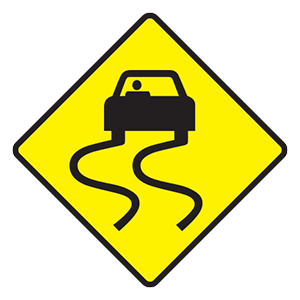
Slow down; curving road ahead.
Slow down and do not use your brakes.
Slow down; slippery when wet.
Q.2.
When approaching a roundabout, you should:
Increase your speed.
Maintain your speed.
Decrease your speed.
Q.3.
You are required to stop your vehicle:
At any intersection where a police officer orders you to stop.
Where there is a red traffic light.
Both of the above.
Q.4.
If you become stranded in a snowstorm, the best thing to do is to:
Get out of the car and go for help.
Lay down in your car and go to sleep.
Walk into the road and get the attention of other drivers.
Stay in the car, as you are most likely to be found when you stay in your vehicle.
Q.5.
Airbags give you full protection during a crash.
True
False
Q.6.
When two vehicles arrive to an intersection at the same time, which one has the right-of-way when no signs or signals indicate rules?
The car approaching from the right has the right-of-way.
The car approaching from the left has the right-of-way.
The car in which the driver sounds his horn first has the right-of-way.
The car that is traveling the fastest has the right-of-way.
Q.7.
Which of the following driving skills is/are affected by the use of alcohol and/or drugs?
Alertness.
Coordination.
Both of the above.
Q.8.
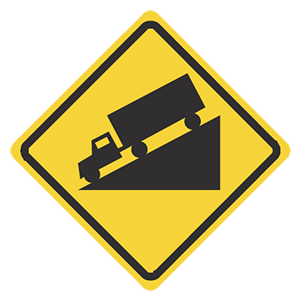
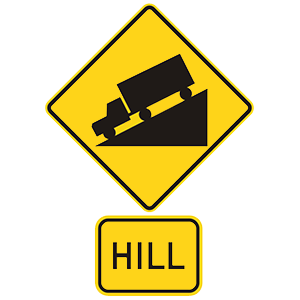
This sign means:
Upcoming downgrade or hill.
Road construction area.
Upcoming narrowing of roadway.
Q.9.
It is important to be alert to motorcycles because:
They are more difficult to see than cars.
They rarely use their headlights.
Motorcyclists are less skilled drivers than other motorists.
All of the above.
Q.10.
Various traffic control devices in construction and maintenance work areas are the color:
Red.
Orange.
Yellow.
Q.11.
When completing an emergency roadside stop, it is not necessary to put on your parking brake.
True
False
Q.12.
Which is the most common cause of traffic crashes?
New drivers
Human error
Bad weather
Bad roads
Q.13.
When a school bus is stopped on the road ahead to load or unload children, you must:
Come to a complete stop until all the children have left the bus.
Come to a complete stop until the red lights stop flashing and the stop arm is withdrawn.
Change lanes, drive slowly, and pass the bus cautiously.
Q.14.
There are oncoming vehicles to your left and a row of parked vehicles to your right. You should steer:
Closer to the oncoming vehicles than the parked vehicles.
Closer to the parked vehicles than the oncoming vehicles.
A middle course between the oncoming and parked vehicles.
Q.15.
Every motor vehicle in the state of Maine is required to be covered by liability insurance.
True
False
Q.16.
When meeting a car with blinding headlights, you should:
Use your bright lights until the other vehicle dims theirs.
Flash your lights on and off to warn the other driver.
Dim your lights and then speed up to pass quickly.
Look toward the right side of the road.
Q.17.
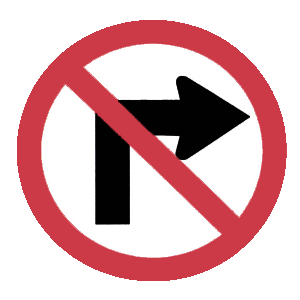
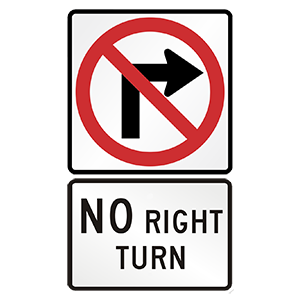
This road sign means:
No left turn.
No U-turns.
No exit.
No right turn.
Q.18.
Before entering a roundabout, you must slow down and yield to:
Vehicles in the roundabout.
Bicyclists in the roundabout.
Pedestrians in the roundabout.
All of the above.
Q.19.
To drive safely at night, you should:
Increase your following distance.
Not drive if you are tired.
Make sure your headlights are working properly.
All of the above.
Q.20.
The “No zone” is:
A term used to describe blind spots around a truck or bus.
A special speed zone.
A roadway with restrictions on vehicle stereo volume.
The television show that replaced The Twilight Zone.
Q.21.
A solid yellow line next to a broken yellow line means that vehicles:
Driving in both directions may pass.
Next to the broken line may pass.
Next to the solid line may pass.
Q.22.
What is a "No zone?"
A designated no passing zone
A one-way traffic area
The blind spot of a large vehicle
An area designated for motor vehicles
Q.23.
What are the colors of signs that tell you the distance to the next exit on a highway?
Yellow with black letters
Black with white letters
Red with white letters
Green with white letters
Q.24.
When approaching a traffic signal displaying a steady green arrow, drivers:
Should merge into a lane in the direction of the arrow.
Should slow to a stop, if it is safe to do so.
May turn in the direction of the arrow after yielding to traffic and pedestrians already in the intersection.
May drive straight through the intersection.
Q.25.
When driving in thick fog with very bad visibility, the safest option is to:
Drive at a speed under 10 miles per hour.
Use your high beam headlights.
Pull off the road and stop, using your emergency flashers.
Honk periodically.
Q.26.
Only vehicles displaying special plates or parking placards for persons with disabilities may park in spaces reserved for them by an official sign.
True
False
Q.27.
Highways and roads freeze before ramps and bridges.
True
False
Q.28.
What does alcohol do to your driving skills and judgement?
It helps driving skills but harms your judgement.
It harms both driving skills and judgement.
It has no effect on either driving skills or judgement.
It has no effect on judgement but it harms driving skills.
Q.29.
Which of the following must you obey over the other three?
A steady red light
A police officer
A stop sign
A flashing red light
Q.30.
How many alcoholic drinks does it take to affect your driving ability?
Three
Two
One
Q.31.
When passing other vehicles:
Check your mirrors and blind spots.
Honk your horn at least three times.
Re-enter your lane within 10 feet of the passed vehicle.
There is no need to signal.
Q.32.
Which of these statements is true about drinking alcohol and driving?
If you can walk in a straight line after drinking, it is safe to drive.
If you are under the legal blood alcohol concentration limit, your driving isn't impaired.
Alcohol affects judgement, which is needed to drive safely.
Q.33.
A driver does not need to allow as much distance when following a motorcycle as when following a car.
True
False
Q.34.
It is unlawful to drive alongside a motorcycle in the same lane.
True
False
Q.35.
A good rule to remember for passing is:
Pass on the right whenever possible.
Drive with the flow of traffic and pass only as needed.
Try to get to the front of any slow-moving traffic so that you can see better.
Always flash your lights and sound your horn to alert other drivers to your intentions.
Q.36.
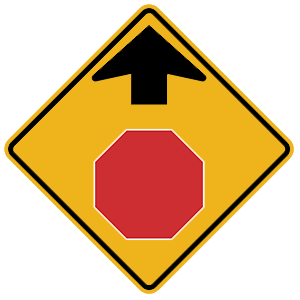
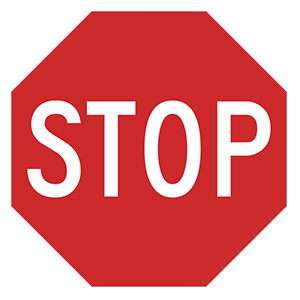
This sign means:
Stop Sign Ahead.
Side Road.
Railroad Warning.
Q.37.
When you are behind a motorcycle, you should:
Be ready to use your horn.
Drive more slowly.
Allow a larger following distance.
Q.38.
Many crashes are caused by:
Drivers traveling too fast for conditions.
Drivers consistently checking their mirrors and blind spots.
Drivers yielding the right-of-way.
Drivers maintaining a four-second following distance.
Q.39.
You are involved in a minor collision at an intersection. There are no injuries and there is very little vehicle damage. You should:
Leave your vehicle in the traffic lane until law enforcement arrives.
Move your vehicle out of the traffic lane, if possible.
Not move your vehicle for any reason.
Q.40.
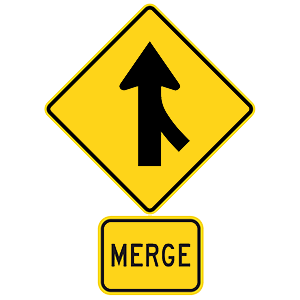
What does this road sign mean?
Be ready to merge with traffic entering your lane.
Always stop.
Divided highway ahead.
Q.41.
You are approaching a railroad crossing that has no visible gates or flashing lights, but has a standard crossbuck. You should:
Approach all tracks with extreme caution and cross only when you know that there is no train coming.
Turn your radio down to hear if there may be an approaching train.
Only continue once cleared to do so by a flagger, if applicable.
All of the above.
Q.42.
What does this road sign mean?
Slow down and prepare to stop if cars are approaching you.
Come to a full stop then proceed when it is safe to do so.
Proceed carefully through the intersection, not always stopping.
Q.43.
Interstate driving requires drivers to:
Have the ability to safely drive at increased speeds.
Be constantly alert.
Both of the above.
Q.44.
Your brake lights tell other drivers that you:
Are making a turn.
Have your emergency brake on.
Are changing lanes.
Are slowing down or stopping.
Q.45.
When turning or changing lanes, you must:
Always signal your intentions, even when no visible traffic is present.
Signal only if there is visible traffic.
Signal only when driving at night.
Signal only when driving in heavy traffic at night.
Q.46.
You are entering a crowded freeway. What should you do to merge into traffic?
Use your side and rearview mirrors and check your blind spots.
Use the acceleration lane to adjust your speed to match the speed of freeway traffic.
Yield to traffic already on the freeway.
All of the above.
Q.47.
As you enter into a roundabout, you should slow down and:
Yield to any crossing pedestrians and bicyclists.
Yield to any car already within the roundabout.
Both of the above.
Q.48.
Stress can affect your driving by:
Lowing your ability to focus on driving.
Decreasing your chances of an accident.
Causing you to fall asleep at the wheel.
Making you more aware of others around you.
Q.49.
This sign means:
No right turns.
Right turns are permitted.
Stop before turning right.
Sharp curve ahead.
Q.50.
If your vehicle has a two-part safety belt system, you should:
Use only the lap belt.
Use both the lap and shoulder belts.
Use only the shoulder belt.
Q.51.
You come to an intersection displaying a flashing red light. You should:
Come to a full stop and go when it is safe to do so.
Stop only if other cars are also approaching the intersection.
Stop only if other cars are already within the intersection.
Slow down and be prepared to stop, if necessary.
Q.52.
You must stop for a school bus:
That is parked on the shoulder of the road with no one in it.
When it approaches you, even if its lights are not flashing.
If you are both driving on a two-lane highway and its red lights are flashing.
Whenever the driver waves at you.
Q.53.
If your car breaks down on a highway, you should:
Sit in your car and wait for help.
Use your four-way flashers to warn other drivers.
Sound your horn at passing motorists.
Flash your headlights at oncoming traffic.
Q.54.
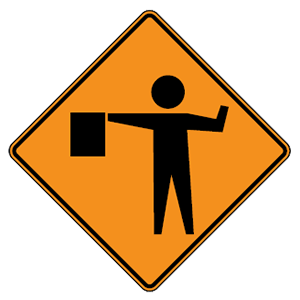
This road sign means:
Flagger ahead.
Turn left at the intersection.
Last turn before a toll road.
Q.55.
You are approaching an intersection when the traffic light changes from green to solid yellow. You should:
Consider it the same as a caution sign and continue through the intersection.
Stop immediately.
Stop before entering the intersection, unless you are too close to stop safely.
Speed up to get through the intersection before the red light appears.
Q.56.
Pedestrians in crosswalks and at intersections always have the right-of-way.
True
False
Q.57.
To avoid the need for last-minute braking and turning, you should consistently look down the road ____ ahead of your vehicle.
One to three seconds
Five to seven seconds
10 to 15 seconds
20 seconds
Q.58.
If you need to slow down while driving on a slippery road, the first thing you should do is:
Firmly apply your brakes.
Take your foot off the gas pedal.
Apply your parking brake.
Pump your brakes.
Q.59.
What does this road sign mean?
Falling rocks
Trucks use second gear
Steep hill
Q.60.
You should always travel:
At the speed of vehicles surrounding you.
At the speed limit.
At a speed appropriate for road and weather conditions.
Support mcqgeeks.com by disabling your adblocker.
×
Please disable the adBlock and continue.
Thank you.
Reload page