MCQGeeks
CBSE
JEE
NTSE
NEET
English
UK Quiz
Quiz
Driving Test
Practice
Games
Driving Test
Maine
Maine Motorcycle Driving Permit Test-10
Answers
Q.1.
A passenger should never:
Wear a helmet.
Lean when the operator leans.
Wear clothing that is tight.
Ride sidesaddle.
Q.2.
When checking tire pressure:
Eyeballing the tire is a good method.
Use a tire gauge.
It is best to squeeze the tire.
Compare the height of the tire to another tire.
Q.3.
Which of the following is not a factor in determining blood alcohol content (BAC)?
The amount of alcohol consumed
How fast the alcohol is consumed
The drinker's body weight
How often the drinker consumes alcohol
Q.4.
A motorcyclist should continually scan the road ahead for:
Road conditions.
Traffic conditions.
Escape routes.
All of the above.
Q.5.
When riding in a group, what does it mean when the lead rider raises their left arm and extends their index finger, as shown in the image?
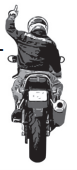
Speed up.
Slow down.
Ride in a single-file formation.
The group will pull off at the next exit.
Q.6.
If hazards are on your left, you should ride:
In the left portion of the lane.
In the right portion of the lane.
In any portion of the lane.
On the shoulder.
Q.7.
If you are riding when it starts to rain, it is a good idea to:
Ride down the center of the lane.
Increase your speed.
Ride in the tire tracks left by cars.
Pull onto the shoulder of the road.
Q.8.
In regards to drinking and riding, many penalties are:
Severe.
Up to a judge to decide.
Not too harsh.
Optional.
Q.9.
Increase your following distance:
If the roadway is slippery.
If there are only a few vehicles on the roadway.
If the sun is shining.
If drivers are following the speed limit.
Q.10.
The best way to handle tailgaters is to:
Change lanes and let them pass.
Use your horn and make obscene gestures.
Speed up to put distance between you and the tailgater.
Come to a complete stop.
Q.11.
When securing a load, you should place the load:
As high as possible.
As low as possible.
On a sissy bar.
Only on one side of the motorcycle.
Q.12.
More than half of all crashes:
Occur at speeds greater than 35 mph.
Happen at night.
Are caused by worn tires.
Involve riders who have operated the involved motorcycle for less than six months.
Q.13.
It is a good idea to wear reflective clothing:
At night.
During the day.
At dusk.
All of the above.
Q.14.
To swerve correctly:
Shift your weight quickly.
Turn the handlebars quickly.
Press the handgrip in the direction of the turn.
Press the handgrip in the direction opposite of the turn.
Q.15.
Riding alongside a car:
Is encouraged.
Can place you in a blind spot.
Is not an issue unless the roadway is wet.
Can make driving easier for the other motorist.
Q.16.
A passenger on a motorcycle should:
Mount the motorcycle before the engine starts.
Mount the motorcycle after the engine starts.
Sit as close to the rear of the motorcycle as possible.
Hold onto the seat.
Q.17.
When riding with a passenger, you should:
Assume the passenger has traveled by motorcycle before.
Not assume the passenger has traveled by motorcycle before and explain the process.
Not let them ask questions.
Not bother with explaining anything since they are only a passenger and not in control of the motorcycle.
Q.18.
When you are stopped, you:
Should remain in first gear.
Should remain in neutral.
Should remain in fifth gear.
Can remain in any gear.
Q.19.
A rectangular sign may be a:
School crossing sign.
Railroad crossing sign.
Stop sign.
Speed limit sign.
Q.20.
One of the benefits of performing regular maintenance on your motorcycle is that:
The motorcycle will ride well for a long period of time.
The maintenance check will take a lot of time.
Maintenance will be costly.
Maintenance checks can often prevent parking tickets.
Q.21.
The center portion of a traffic lane is where:
Debris and oil drippings from cars often collect.
Motorcycle riders should always travel for safety.
Most accidents happen.
Drivers are least likely to see a motorcyclist.
Q.22.
When riding in a vehicle's blind spot, you should:
Stay where you are to avoid surprising the driver.
Wave at the other driver to get their attention.
Slow down until you are out of the blind spot.
Pull over to the shoulder.
Q.23.
Where is the front brake lever usually located?
On the left handgrip
On the right handgrip
By the left foot peg
By the right foot peg
Q.24.
When riding under ideal conditions, you should maintain a minimum following distance of:
One second.
Two seconds.
Three seconds.
Four seconds.
Q.25.
Use special care to use your mirrors in all of the following situations, except:
Before you slow down.
Before you change lanes.
When you are stopped.
After you get off the motorcycle.
Q.26.
Taking corners too fast:
Can cause the rider to go into another lane.
Is better than going too slowly.
Often causes the rider to stay in their lane.
Is acceptable because motorcycles are smaller than other types of vehicles.
Q.27.
When crossing railroad tracks that are parallel to the road, you should:
Cross the tracks at a 90-degree angle.
Avoid crossing the tracks for any reason.
Try to cross the tracks at a 45-degree angle.
Slowly inch across the tracks.
Q.28.
Passengers should:
Lean as the operator leans.
Hold onto their seat.
Sit as far back on the bike as possible.
Never hold onto the operator.
Q.29.
When passing a row of parked cars to your right when there is no oncoming traffic to your left, you should:
Stay toward the right side of your lane.
Stay toward the left side of your lane.
Look to your left frequently.
Use your rearview mirrors more frequently than usual.
Q.30.
Which of the following types of clothing can help you to be seen by other drivers?
Darkly-colored clothes
Clothes made from synthetic materials
Reflective clothes
A leather jacket
Q.31.
When being passed, do not move into the portion of the lane farthest from the passing vehicle because:
The passing vehicle may re-enter your lane too early.
You may prevent another vehicle from passing you.
The portion of the lane nearest the passing vehicle is better.
You are more likely to experience a wind blast from the passing vehicle on the far side of the lane.
Q.32.
A three-wheeled motorcycle:
Handles curves about the same as a two-wheeled motorcycle.
Handles curves differently than a two-wheeled motorcycle.
Should not be operated in curves.
Should use the shoulder when taking a curve.
Q.33.
A danger of riding next to a row of parked cars is:
You may not find a parking spot.
A driver may unexpectedly pull out from the row into your path.
Others may be driving slowly while looking for a parking spot.
The road may be uneven.
Q.34.
As weight transfers to the front of your bike while you are braking, you should:
Gradually increase pressure to the front brake.
Use more rear brake pressure.
Not worry. The weight transfer will not have an effect on your motorcycle.
Try to lock the front tire.
Q.35.
The best way to stop quickly is to:
Use the front brake only.
Use the front brake first.
Throttle down and use the front brake.
Use both brakes at the same time.
Q.36.
The right clothing can protect you from all of the following, except:
Heat.
Debris.
Injury.
Other drivers.
Q.37.
When someone follows you too closely, you should:
Speed up.
Not worry about them and just focus on the road in front of you.
Change lanes and let them pass.
Ride on the shoulder and let them pass.
Q.38.
Making eye contact with other drivers:
Means that they see you.
Guarantees that they will yield to you.
Doesn’t mean that they see you.
Is not worth the effort it takes.
Q.39.
Several factors influence blood alcohol concentration (BAC). Which of the following does not play a role?
The amount of alcohol consumed
How fast a person drinks
Body weight
Height
Q.40.
In general, the body gets rid of almost ______ per hour.
One drink
Two drinks
Three drinks
Four drinks
Q.41.
When passing a vehicle:
You may exceed the speed limit until the pass is complete.
You may disregard "No passing zone" markings if the pass was started in a passing zone.
You may pass on the shoulder.
You must complete the pass within the posted speed limits and within a legal passing zone.
Q.42.
Where is the engine cut-off switch usually located?
Near the left handgrip
Near the right handgrip
Near the left footrest
Near the right footrest
Q.43.
It is difficult for other motorists to see motorcycles at night. To make up for that, a motorcycle rider should:
Reduce their speed when riding at night.
Sound their horn repeatedly when riding at night.
Not ride at night.
Stay directly in front of another vehicle to be seen in their headlights when riding at night.
Q.44.
Which formation is best for keeping the riders in a group close together?
Pyramid
Staggered
Single-file
Compressed
Q.45.
Small vehicles can appear ______ and seem to be traveling ______ than they actually are.
Farther away, more slowly
Farther away, faster
Closer, more slowly
Closer, faster
Q.46.
The proper footwear for riding a motorcycle:
Has long, loose laces.
Has short heels.
Has tall heels.
Is always sneakers.
Q.47.
When passing parked cars, which part of the lane should you usually use?
The left portion of the lane
The center portion of the lane
The right portion of the lane
Either the left or right portion of the lane
Q.48.
If the throttle is stuck, you should:
Jump off the motorcycle.
Apply the brakes.
Twist the throttle back and forth several times.
Not try to twist the throttle.
Q.49.
A motorcyclist is well-protected if they are wearing:
A jacket that allows the arms to be exposed.
Boots with tall heels.
Leather gloves.
Shoes that stop below their ankle.
Q.50.
After entering a turn, you should roll on the throttle and:
Always slow down.
Maintain a steady speed or accelerate gradually.
Accelerate drastically.
Not worry about your speed.
Support mcqgeeks.com by disabling your adblocker.
×
Please disable the adBlock and continue.
Thank you.
Reload page