MCQGeeks
CBSE
JEE
NTSE
NEET
English
UK Quiz
Quiz
Driving Test
Practice
Games
Driving Test
Maine
Maine Motorcycle Driving Permit Test-4
Answers
Q.1.
When riding, you should:
Turn your head and shoulders to look through turns.
Keep your arms straight.
Keep your knees away from the gas tank.
Turn just your head and eyes to look through turns.
Q.2.
Crashes are more likely to occur among:
Experienced riders.
Beginning riders.
Those familiar with their motorcycle.
Those who have completed a safety course.
Q.3.
An integrated braking system:
Applies partial rear braking when the front brake is applied.
Applies partial front braking when the rear brake is applied.
Applies even braking for both the front and rear brakes when either is applied.
Learns and remembers the approximate braking force used by the rider.
Q.4.
When choosing a lane position, you should consider:
Whether or not other drivers will see you.
How many cars are on the road ahead.
Which portion of the lane will result in a shorter trip.
If you can pass more vehicles in a certain position than in another.
Q.5.
To carry a passenger, you may need to adjust all of the following, except:
Tire pressure.
Mirror positions.
Headlight position.
Brake light position.
Q.6.
When adjusting your rearview mirror, be sure you can:
See the lane behind you and the lane next to you.
See only the lane behind you.
See only the lane next to you.
See most of your helmet.
Q.7.
During your pre-ride inspection, you should check all of the following, except the:
Fluids.
Headlight and taillight.
Turn signals.
Reflectors.
Q.8.
You should choose the lane position that can:
Minimize your space cushion and allow you to be seen by others.
Maximize your space cushion and allow you to be seen by others.
Maximize your potential for encountering road hazards and allow others to pass you.
Minimize your potential for encountering road hazards and allow you to closely follow another vehicle.
Q.9.
When riding a motorcycle, you should:
Always pick one part of the lane to occupy and never leave that part of the lane.
Vary your lane position as conditions warrant.
Only ride in the center of the lane so other vehicles can see you more easily.
Ride in a zigzag pattern so other drivers notice you.
Q.10.
Taking a turn too fast:
Is acceptable as long as you stay under the speed limit.
Is safer on a motorcycle than in a car.
Is acceptable as long as no vehicles are near you.
Can cause you to end up in another lane or leave the road.
Q.11.
When crossing angled railroad tracks, it is usually safest to approach the tracks:
By proceeding straight within your lane.
At a 45-degree angle.
At a 90-degree angle.
At a fast speed.
Q.12.
Successful motorcyclists know they are safest when they are:
Seen by other motorists.
Faster than other vehicles.
On the side of the road.
In the left side of the lane.
Q.13.
Drivers on an entrance ramp may not see you on the highway. What should you do to help an entering driver merge safely?
Stay in your lane, as it is not your responsibility to be seen.
Change to a lane away from the entrance ramp, if possible.
Move to the shoulder.
Weave within your lane to be more obvious to the entering driver.
Q.14.
When passing parked vehicles, motorcycle riders should be especially cautious of:
Motorists looking for a place to park.
Cars leaving their parking spaces.
Oncoming traffic.
Noise.
Q.15.
When riding in a group, inexperienced riders should position themselves:
Just behind the leader.
In the front of the group.
At the tail end of the group.
Beside the lead rider.
Q.16.
When entering a turn, a rider should:
Speed up.
Reduce their speed.
Move their shoulders to match the angle of the turn.
Sit up as high as possible.
Q.17.
When riding in a group, inexperienced riders should be placed:
In the front of the group.
Just behind the lead rider.
At the back of the group.
Anywhere within the group.
Q.18.
When riding at night, you should travel:
More slowly than you would during the day under similar conditions.
At the speed you would travel during the day under similar conditions.
Faster than you would during the day under similar conditions.
On the shoulder of the road so other vehicles can see you.
Q.19.
To be effective, an eye or face shield should:
Be easily broken.
Restrict your view to both sides.
Be tight to your face, not allowing eyeglasses to fit underneath.
Fasten securely.
Q.20.
A potential danger of braking too hard is:
Losing traction on one or both wheels.
Coming to a complete stop before you expect to.
Popping a tire.
Taking too long to stop.
Q.21.
A rectangular sign may be a:
School crossing sign.
Railroad crossing sign.
Stop sign.
Speed limit sign.
Q.22.
When you are riding on a bridge grating, you should:
Always ride on the far right side of the lane.
Always ride on the far left side of the lane.
Slowly zigzag across the grating.
Relax, maintain a steady speed, and ride straight across the surface.
Q.23.
Which of the following is not an example of a slippery surface?
A dirt or gravel road
A strip of oil in the center of a lane
Mud on pavement
Dry pavement
Q.24.
Low-speed crashes:
Can be fatal.
Are never serious.
Rarely cause injuries.
Happen frequently, so there is no need to worry about them.
Q.25.
Mirror checks:
Are unimportant.
Should only be done on long trips.
Should be part of your normal scanning routine.
Are not helpful since you can’t do anything about what is behind you.
Q.26.
If you are hit by a wind blast caused by a passing vehicle, you will have the most room for error if you are riding:
In the left portion of the lane.
In the center portion of the lane.
In the right portion of the lane.
On the shoulder.
Q.27.
Motorcycle riders should not rely on their mirrors to see what’s going on around them because:
Motorcycle mirrors are smaller than the mirrors on other vehicles, so you can't see as much.
Motorcycles, like cars, have blind spots.
Mirrors are never accurate.
Mirrors take your eyes off the road in front of you and they should not be used.
Q.28.
A skidding rear tire:
Is not serious.
Eliminates your ability to change direction.
Will usually correct itself.
Is only a concern if the front tire is also skidding.
Q.29.
How can you regain control if your rear tire locks up?
Release the rear brake.
Continue using the rear brake.
Swerve the bike in the direction with the fewest hazards.
With the brake engaged, try to accelerate.
Q.30.
Each traffic lane gives the motorcyclist how many paths of travel?
One
Two
Three
Four
Q.31.
When riding in a group, it is best to put inexperienced riders near the front because:
Experienced riders can more easily keep an eye on them.
They will get lost if they are leading.
They may slow the group down as the leaders.
They will ride too fast in any other position.
Q.32.
When braking, you should:
First apply the front brake, then the rear.
First apply the rear brake, then the front.
Use both brakes at the same time.
Use brakes in any order.
Q.33.
Which of the following does not offer protection to a motorcycle rider?
A leather jacket
Boots that go over the ankle
A baseball cap that fits snugly
Gloves
Q.34.
When riding at night, you should:
Be flexible about your lane position and adjust to changing conditions.
Travel at a faster speed than usual to get to your destination more quickly.
Always use your low beam headlight to see better.
Decrease your following distance so you can be as close as possible to the vehicle ahead.
Q.35.
If a tire goes flat and you must brake, you should:
Apply the brake of the tire that is not flat.
Apply the brake of the tire that is flat.
Apply both brakes.
Not use either brake.
Q.36.
If you are riding in the right side of your lane while following a car:
You are likely riding in the best position to be seen.
You may not be seen unless the driver uses their side mirror.
The driver will most likely assume you are there.
You are discouraging other drivers from sharing your lane.
Q.37.
What does this hand signal mean?
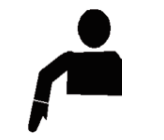
Slow or stop
Left turn
Right turn
Backing up
Q.38.
Which formation is best for a group of riders entering a curve?
Pyramid
Staggered
Single-file
Compressed
Q.39.
To discourage lane sharing by other drivers, you should:
Ride in the center portion of the lane.
Make eye contact with each of the drivers.
Not allow other motorists to get in front of you.
Occasionally flash your brake light to remind them that you are in the lane.
Q.40.
When braking, you should:
Squeeze the front brake and press the rear brake.
Grab at the front brake and squeeze the rear brake.
Jam on the front brake and grab at the rear brake.
Press down on the front brake and jam on the rear brake.
Q.41.
To reduce your reaction time, you should:
Ride under the speed limit.
Cover the clutch and brakes.
Shift into neutral when slowing.
Accelerate before turning.
Q.42.
Checking your mirrors:
Is a bad idea because you should be focussed on the road ahead.
Is only important if you think there is a reason to check them.
Is an important part of making safe riding decisions.
Should only be done if there is no other traffic on the roadway.
Q.43.
Use a turn signal:
When you’re planning to increase your speed.
Only when there is a lot of traffic.
Any time you plan on changing lanes.
Only if it is dark outside.
Q.44.
A passenger on a motorcycle should:
Mount the motorcycle before the engine starts.
Mount the motorcycle after the engine starts.
Sit as close to the rear of the motorcycle as possible.
Hold onto the seat.
Q.45.
If attempting to brake in a curve, you should:
Brake more gradually than you would on a straightaway.
Brake as hard as you would on a straightaway.
Wait until you are not in the curve to brake.
Only use the rear brake.
Q.46.
When riding in a group, inexperienced riders should position themselves:
In the front of the group.
Just behind the leader.
Close to the back of the group.
At the tail end of the group.
Q.47.
The only way to rid your body of alcohol is through:
Time.
Drinking coffee.
Exercising.
Taking a cold shower.
Q.48.
When consumed together, the effects of alcohol and drugs:
Can be more pronounced than when either is consumed alone.
Are less dangerous than when either is consumed alone.
Are usually minimal.
Often balance out.
Q.49.
If a friend has been drinking and wants to ride their motorcycle, you should:
Let them.
Encourage them to take less-crowded roads.
Push their bike over.
Encourage friends to talk them out of riding.
Q.50.
You should use a larger cushion of space:
When roads are slippery.
When it is sunny outside.
When it is colder than usual.
When you are following other motorcycles.
Support mcqgeeks.com by disabling your adblocker.
×
Please disable the adBlock and continue.
Thank you.
Reload page