MCQGeeks
CBSE
JEE
NTSE
NEET
English
UK Quiz
Quiz
Driving Test
Practice
Games
Driving Test
Maryland
Maryland Car Driving Permit Test-12
Answers
Q.1.
You must yield to a pedestrian using a white cane or guide dog:
Only when the guide dog is leading the person across the street.
At all times.
Only if a crossing guard is present.
Q.2.
When driving at night, you should:
Always use your high beams.
Look directly at the headlights of an oncoming vehicle.
Increase your following distance.
Q.3.
Tailgating other drivers (driving too closely to their rear bumper):
Can frustrate other drivers and make them angry.
Cannot result in a traffic citation.
Reduces collisions by preventing being "cut off."
Q.4.
What is the only medically proven method of removing alcohol or other drug combinations from your system?
Breathe in some fresh air.
Give your body time.
Drink coffee.
Q.5.
Double solid yellow lane markings mean that:
Neither lane may pass.
Both lanes may pass.
The lane to the right may pass.
Q.6.
Night driving presents unique problems because:
The speed limit is increased at night.
There are fewer cars on the roads at night.
Distance and vehicle speed are difficult to judge in the dark.
Q.7.
When using a deceleration lane to exit a roadway:
Do not use your turn signal until the vehicle has moved into the deceleration lane.
Do not follow the posted warning speeds unless the roadway is slippery.
Do not slow down until your vehicle has moved into the deceleration lane.
Q.8.
You want to park downhill on a two-way road and there is no curb. Which way do you turn your front wheels?
Straight ahead
Right, toward the side of the road
Left, toward the center of the road
Q.9.
If you see a pedestrian using a guide dog or carrying a white cane:
The pedestrian must yield the right-of-way.
You must yield the right-of-way.
Honk your horn to let them know you are there.
Q.10.
When driving at night, you should:
Always use your high beams.
Look directly at the headlights of an oncoming vehicle.
Increase your following distance.
Q.11.
It is very foggy. You should slow down and:
Turn on your emergency flashers.
Turn your lights to their high beam setting.
Turn your lights to their low beam setting.
Q.12.
When you see this sign, you should stop and:
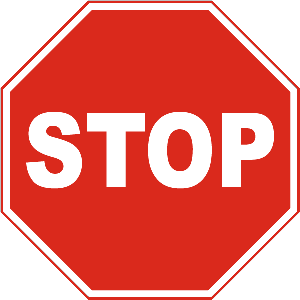
Check for vehicles only in the direction that you plan on going, then proceed.
Let all vehicles that arrive before or after you go first.
Check for traffic in all directions before proceeding.
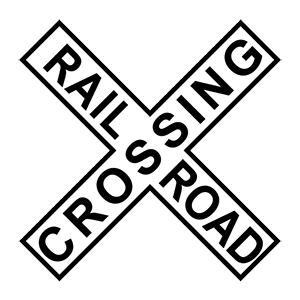
Q.13.
This white sign means:
The railroad crossing is controlled. Continue at your regular speed.
Look, listen, and prepare to stop at the crossing if necessary.
Stop at the railroad tracks and wait for a signal before crossing.
Q.14.
You should allow an extra cushion of space:
When following a station wagon.
When following a driver who cannot see the rear of their vehicle.
When following a small passenger car.
Q.15.
Only ____ can reduce blood alcohol content (BAC) and alcohol's effects on the body.
Drinking caffeine
Eating foods high in fat
Time
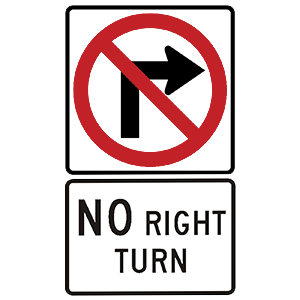
Q.16.
What does this road sign mean?
You must turn right.
No right turns permitted.
Right turns permitted on a red light.
Q.17.
At a red traffic light with a green arrow, you may proceed in the direction of the arrow if:
You first come to a complete stop.
You wait until the light changes.
You are in the proper lane and the roadway is clear.
Q.18.
When preparing to make a left turn from a two-way street, you should drive:
Near the right-hand side of the road.
Near the centerline.
On the left of the centerline.
Q.19.
When stopped at a red traffic light with a green arrow, you may proceed in the direction of the arrow if you:
First come to a complete stop.
Wait until the light changes.
Are in the proper lane and the intersection is clear.
Q.20.
When passing another vehicle:
Pass the vehicle as slowly as possible.
Drive at the same speed as the vehicle you are passing.
Pass the vehicle as safely and as quickly as possible.
Q.21.
The best way to avoid a dangerous situation while driving is to:
Know what is happening around your vehicle.
Turn off the radio.
Always keep your eyes focused ahead of your car.
Q.22.
When passing a row of parked vehicles, you should:
Be prepared for a person or vehicle to unexpectedly enter your lane.
Expect all other drivers and pedestrians to respect your right-of-way.
Drive closely to the parked vehicles to allow more room for moving traffic.
Q.23.
At intersections, crosswalks, and railroad crossings, you should always:
Stop, listen, and proceed cautiously.
Look to the sides of your vehicle to see what is coming.
Slowly pass vehicles that seem to be stopped for no reason.
Q.24.
When driving in fog, it is best to drive with:
High beam headlights.
Low beam headlights.
Four-way flashers.
Q.25.
What should a driver do when approaching a traffic control signal that is not in operation?
Come to a full stop and yield the right-of-way before entering the intersection.
If the intersection is clear, the driver does not need to stop.
Drive quickly through the intersection to get out of the way of other vehicles.
Support mcqgeeks.com by disabling your adblocker.
×
Please disable the adBlock and continue.
Thank you.
Reload page