MCQGeeks
CBSE
JEE
NTSE
NEET
English
UK Quiz
Quiz
Driving Test
Practice
Games
Driving Test
Maryland
Maryland Motorcycle Driving Permit Test-1
Answers
Q.1.
When selecting footwear, you should choose:
Shoes with long heels.
Shoes with long laces that cannot be tucked in.
Shoes that cover your ankles.
Shoes that are made from flimsy materials.
Q.2.
More than half of all crashes:
Involve riders who have operated their motorcycles for less than six months.
Are caused by faulty ignition systems.
Occur because of distractions caused by passengers.
Happen at night.
Q.3.
Shifting into a lower gear causes an effect similar to:
Using the brakes.
Accelerating.
Swerving.
Turning.
Q.4.
You should check your tires for all of the following, except:
Air pressure.
Tread.
General wear.
Flexibility.
Q.5.
Normally, you should maintain a following distance of:
One second.
Two seconds.
Three seconds.
Four seconds.
Q.6.
When riding in rain or fog, you should:
Use your high beam headlight.
Use your low beam headlight.
Not use your headlight.
Alternate between your headlight's low and high beam settings.
Q.7.
Do not change gears on railroad tracks because:
Your motorcycle may stall.
You might go too fast.
Other drivers may not be expecting you to change gears.
The uneven surface may make it more difficult to switch gears.
Q.8.
Riding between two vehicles moving in the same direction:
Is illegal.
Is encouraged if traffic is heavy.
Is encouraged during the day to prevent traffic jams.
Is acceptable if the motorcyclist is comfortable with the move.
Q.9.
Crashes are more likely to occur among:
Experienced riders.
Beginning riders.
Those familiar with their motorcycle.
Those who have completed a safety course.
Q.10.
To lessen your chances of being involved in a crash, you should:
Be visible to other drivers.
Keep your intentions unknown from other drivers.
Always stay within a foot of another vehicle.
Ride on the shoulder.
Q.11.
Motorcyclists riding in a group should avoid pairing up because:
A merging driver may not see both riders.
Reflections from both helmets may make it difficult for the riders to see.
Riding in pairs does not allow riders the necessary space to maneuver.
It is too difficult for riders on the left side of a pairing to exit a highway.
Q.12.
In hot weather, wearing a riding jacket:
Can help protect against heat exhaustion and dehydration.
Is discouraged because it can cause heat-related problems.
Should only be done if the jacket is a light color.
Is not important.
Q.13.
At a minimum, how often should a motorcycle's hydraulic fluid be checked?
Once a day
Once a week
Once a year
Before every ride
Q.14.
Which of the following is a good color to wear to be seen?
Orange
Black
Brown
Deep blue
Q.15.
When going through a curve, you should:
Always stay in the same portion of the lane throughout the entire curve.
Always stay in the left portion of the lane throughout the entire curve.
Always stay in the right portion of the lane throughout the entire curve.
Remember that the best path may not follow the curve of the road.
Q.16.
If you are riding when it starts to rain, it is a good idea to:
Ride down the center of the lane.
Increase your speed.
Ride in the tire tracks left by cars.
Pull onto the shoulder of the road.
Q.17.
What does this hand signal mean?
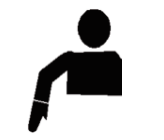
Slow or stop
Left turn
Right turn
Backing up
Q.18.
If a driver is tailgating you, you should:
Speed up.
Allow them to pass.
Prevent them from passing.
Move to one side of your lane to allow them to share the lane.
Q.19.
To control a motorcycle properly, you should:
Sit so you can use your arms to steer, not to hold yourself up.
Sit far enough back on the seat that you can keep your arms straight.
Keep your knees away from the gas tank.
Drag your feet on the ground.
Q.20.
When passing a row of parked cars to your right when there is no oncoming traffic to your left, you should:
Stay toward the right side of your lane.
Stay toward the left side of your lane.
Look to your left frequently.
Use your rearview mirrors more frequently than usual.
Q.21.
To provide the best protection, a helmet should:
Have a few cracks.
Not be certified.
Have frayed straps.
Fit snugly.
Q.22.
When you are being passed, you should:
Ride in the center portion of the lane.
Ride in the left portion of the lane.
Ride in the right portion of the lane.
Weave among the three portions of the lane as the vehicle passes.
Q.23.
The best way to handle tailgaters is to:
Change lanes and let them pass.
Use your horn and make obscene gestures.
Speed up to put distance between you and the tailgater.
Come to a complete stop.
Q.24.
Maximum straight-line braking is done by:
Using only the rear brake.
Using only the front brake.
Using both the front and rear brakes without locking either wheel.
Using both the front and rear brakes while locking the rear wheel.
Q.25.
A good way to handle tailgaters is to:
Change lanes and let them pass.
Ignore them.
Use your horn and make obscene gestures.
Speed up to put distance between you and the tailgater.
Support mcqgeeks.com by disabling your adblocker.
×
Please disable the adBlock and continue.
Thank you.
Reload page