MCQGeeks
CBSE
JEE
NTSE
NEET
English
UK Quiz
Quiz
Driving Test
Practice
Games
Driving Test
Massachusetts
Massachusetts Car Driving Permit Test-6
Answers
Q.1.
When sharing the road with a truck, it is important to remember that trucks generally:
Require longer distances to stop than smaller vehicles do.
Require less time to pass on a downgrade than smaller vehicles do.
Require a smaller turning radius than smaller vehicles do.
Require less time to pass on an incline than smaller vehicles do.
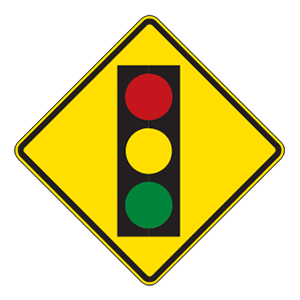
Q.2.
This sign means:
Traffic signal.
Fire station.
T intersection.
Left turn signal.
Q.3.
Drinking alcohol and driving is:
A minor traffic safety problem.
A serious traffic safety problem.
Safe if you have only had a few drinks.
Only dangerous to the driver who drinks.
Q.4.
Traffic signals sometimes display arrows to control turns from specific lanes. A solid yellow arrow:
Is never used as a traffic signal.
Has the same meaning as a circular yellow traffic light.
Means that drivers may turn in the direction indicated by the arrow.
Tells drivers that a green arrow is about to be shown.
Q.5.
Where should you never make a U-turn?
At the crest of a hill.
Near a curve.
Where drivers cannot see you for 500 feet in both directions.
Any of the above.
Q.6.
Unless otherwise posted, the speed limit in school zones is:
10 mph.
20 mph.
30 mph.
50 mph.
Q.7.
Railroad crossings should always be considered:
Safe to cross, as it is unlikely that a train will be coming.
Dangerous.
Safe locations to park a car.
A place where it is required to stop
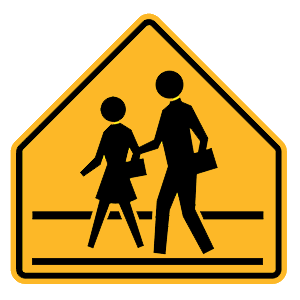
Q.8.
This sign means:
Pedestrians only.
Intersection ahead.
Hiking trails ahead.
School crossing ahead.
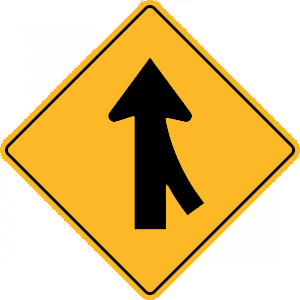
Q.9.
This sign means:
One-way traffic.
Intersection ahead.
Merging traffic from the right.
Highway curves ahead.
Q.10.
Highway markings:
Are usually not important.
Are only found in construction zones.
Provide information for drivers.
Are usually red and blue in color.
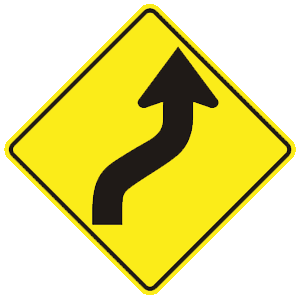
Q.11.
This sign means:
The highway ahead curves only to the right.
The highway ahead turns sharply to the right.
The highway ahead curves to the right and then to the left.
The highway ahead curves to the left and then to the right.
Q.12.
If you are driving behind a motorcycle, your following distance should be at least:
Four seconds.
Three seconds.
Two seconds.
One second.
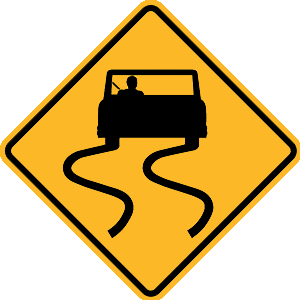
Q.13.
This sign means:
Don't drink if you are going to drive.
Slippery when wet.
Road curves ahead.
You are approaching a hill.
Q.14.
Drivers may not pass from either side of a ____ centerline.
Combination solid and broken yellow
Single broken yellow
Double solid yellow
Single broken white
Q.15.
A speed limit is:
The maximum or minimum legal speed you can travel on a road under dangerous conditions.
The maximum or minimum legal speed you can travel on a road under ideal conditions.
The suggested speed to travel on a road under ideal conditions.
None of the above.
Q.16.
A slow-moving vehicle emblem is:
A rectangular red sign.
A circular green sign.
A diamond-shaped yellow sign.
A triangular orange sign.
Q.17.
Your chances of being in a collision begin to increase after consuming:
Four alcoholic drinks.
Three alcoholic drinks.
Two alcoholic drinks.
One alcoholic drink.
Q.18.
Don’t follow other cars too closely because:
You may not see the road between the cars.
You may not have time to stop if the vehicle in front of you slows or stops suddenly.
You may not see the vehicle's turn signals.
You may not see the other vehicle’s brake lights.
Q.19.
A person who drives much slower than the speed limit:
Is a very safe driver.
Always has the right-of-way.
Should not let following cars pass.
May create a dangerous driving environment.
Q.20.
You notice a vehicle defect which may affect the safe operation of your vehicle. You should:
Correct the defect as soon as possible.
Correct the defect when you can afford it.
Drive the vehicle at slower speeds.
Drive normally.
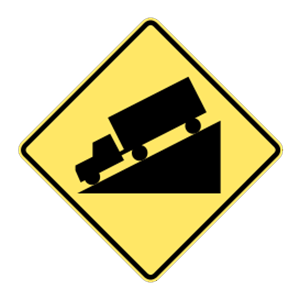
Q.21.
This sign means:
Watch for trucks.
Do not pass trucks.
Truck parking area ahead.
Steep downgrade ahead.
Q.22.
Unless otherwise posted, the speed limit in thickly settled areas and business districts is:
10 mph.
20 mph.
30 mph.
50 mph.
Q.23.
When changing lanes you should not:
Check your side and rearview mirrors.
Give a turn signal to signal your intentions.
Check for other drivers who may be moving into the same lane as you.
Use your cell phone to contact the police to determine if the road ahead is clear.
Q.24.
When meeting a car with blinding headlights, you should:
Use your bright lights until the other vehicle dims theirs.
Flash your lights on and off to warn the other driver.
Dim your lights and then speed up to pass quickly.
Look toward the right side of the road.
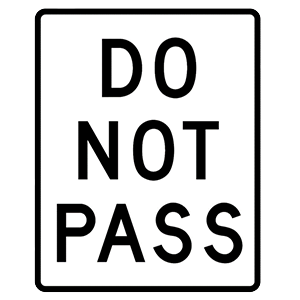
Q.25.
If you see this sign, you:
Must not pass another vehicle.
May pass a slow-moving vehicle if you can do so quickly.
May pass if you know the road ahead.
May pass, but only at night.
Support mcqgeeks.com by disabling your adblocker.
×
Please disable the adBlock and continue.
Thank you.
Reload page