MCQGeeks
CBSE
JEE
NTSE
NEET
English
UK Quiz
Quiz
Driving Test
Practice
Games
Driving Test
Massachusetts
Massachusetts Motorcycle Driving Permit Test-9
Answers
Q.1.
Which of the following is not a benefit of riding in a close group?
It takes up minimal space on the highway.
The group is easy to see.
The group is unlikely to be split up.
The riders will get to their destination more quickly in a close group than a group that is spread out.
Q.2.
If a tire goes flat while you are riding and you must stop, it is usually best to:
Relax on the handle grips.
Shift your weight toward the good tire.
Brake on the good tire and steer to the side of the road.
Use both brakes and stop quickly.
Q.3.
When riding over rough surfaces, you should:
Hold the handgrips loosely to allow for movement.
Hold the handgrips firmly to maintain control.
Use lots of throttle to help you get over the rough surface.
Ride without a helmet as the helmet could become loose and cover your face.
Q.4.
When an operator's left arm is bent at the elbow and pointing upward, it means the operator:
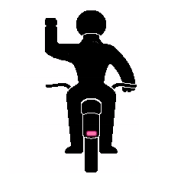
Plans to turn left.
Is about to stop.
Plans to turn right.
Is about to slow down.
Q.5.
When riding with a passenger, you should do all of the following, except:
Ride more slowly than you would normally.
Start slowing earlier than you would normally.
Increase your following distance.
Not communicate with the passenger while riding.
Q.6.
When you are stopped, you:
Can remain in any gear.
Should remain in first gear.
Should remain in neutral.
Should remain in fifth gear.
Q.7.
An advantage to keeping a cushion of space between your motorcycle and other vehicles is that:
You can pass danger more quickly.
You will have a more narrow view of the road so you can stay focused.
You will have more time to react to the movements of others.
You can more easily follow the path of the next vehicle.
Q.8.
Making eye contact with another driver:
Guarantees that the other driver will properly yield to you.
Is not worth the effort it takes.
Doesn’t mean that the driver will properly yield to you.
Means that the other driver knows you are there.
Q.9.
Maximum front-line braking is accomplished by:
Using the rear brake only.
Using the front brake only.
Using both brakes.
Using the rear brake while downshifting.
Q.10.
On a motorcycle, a horn:
Is useless.
Usually cannot be heard by others.
Can be used to get someone’s attention quickly.
Should not be used.
Q.11.
Before mounting the motorcycle, your pre-ride inspection should include all of the following, except:
A tire check.
A taillight test.
A headlight test.
A paint check.
Q.12.
Goggles will:
Protect only your eyes.
Be an equally as effective as a face shield.
Offer the same protection as a windshield.
Provide protection for your entire face.
Q.13.
A proper lane position should do all of the following, except:
Allow you to set up for turns.
Allow an escape route.
Allow you to avoid wind blasts from other vehicles.
Allow you to be in another vehicle’s blind spot.
Q.14.
Massachusetts law requires motorcycle riders to use headlights:
One half hour after sunset until one half hour before sunrise.
Whenever they want to.
When it seems dark enough to use them.
Only when traveling near other motorists.
Q.15.
Proper clothing for riding offers all of the following, except:
Comfort.
Protection in a collision.
Protection from the cold.
Discomfort.
Q.16.
If wearing footwear with laces, the laces:
Should be tucked in.
Should hang loose.
Should be taken off of the footwear.
Should be glued together.
Q.17.
Riding gloves are often:
Made of leather.
Made of wool.
Not pre-curved.
Unsafe for the rider.
Q.18.
Normally, you should maintain a following distance of:
One second.
Two seconds.
Three seconds.
Four seconds.
Q.19.
If a tire goes flat and you must brake, you should:
Apply the brake of the tire that is not flat.
Apply the brake of the tire that is flat.
Apply both brakes.
Not use either brake.
Q.20.
Mirror checks:
Should be part of your normal scanning routine.
Should be avoided because they will distract you.
Should be avoided since other drivers will see you easily.
Are only recommended in bad weather.
Q.21.
When riding downhill on a motorcycle with a sidecar:
Stopping will be easier than when riding without a sidecar.
Stopping will take longer than when riding without a sidecar.
You cannot stop.
Stopping is about as easy as it is when riding without the sidecar.
Q.22.
A larger cushion of space may not be necessary if:
The pavement is slippery.
You cannot see through the vehicle ahead of you.
Weather and traffic conditions are perfect.
Traffic is heavy.
Q.23.
If hazards are on your left, you should ride:
In the left portion of the lane.
In the right portion of the lane.
In any portion of the lane.
On the shoulder.
Q.24.
During the day, you should:
Not ride with your headlight on.
Ride with your headlight on, but only if it is cloudy.
Always ride with your headlight on.
Use your headlight if you think it helps.
Q.25.
When riding in a group, motorcyclists:
Do not need space cushions.
Should increase their space cushions.
Should reduce their usual space cushions by half.
Should maintain adequate space cushions.
Support mcqgeeks.com by disabling your adblocker.
×
Please disable the adBlock and continue.
Thank you.
Reload page