MCQGeeks
CBSE
JEE
NTSE
NEET
English
UK Quiz
Quiz
Driving Test
Practice
Games
Driving Test
Michigan
Michigan Car Driving Permit Test-11
Answers
Q.1.
Distracted drivers are at a greater risk of a crash when they are using which of the following?
CD player
Radio
Cell phone
All of the above
Q.2.
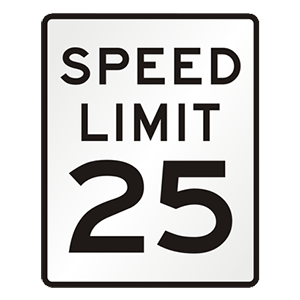
The posted speed limit shows:
Only a recommended driving speed.
The exact speed at which you must travel to avoid a ticket.
The maximum safe driving speed under ideal road and weather conditions.
The maximum safe driving speed under all road conditions.
Q.3.
You are driving when it begins to rain. You should:
Drive faster than surrounding traffic.
Drive at the maximum posted speed limit.
Slow down.
Drive closely behind the vehicle in front of you.
Q.4.
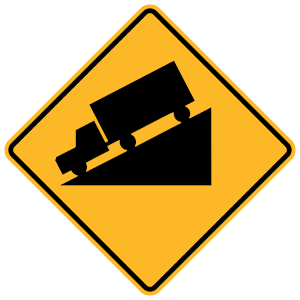
This sign means:
Trucks under 18,000 lbs. allowed.
Hill ahead.
Truck stop ahead.
No trucks allowed.
Q.5.
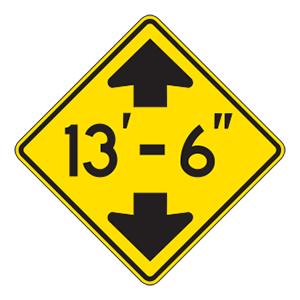
This sign means:
Low clearance.
Fines double in a work zone.
No left turn.
Do not block intersection.
Q.6.
Your tire blows out while you are driving. You should:
Slam on your brakes.
Hold your steering wheel tightly and slow to a stop.
Keep driving normally.
Turn on your emergency flashers and continue driving.
Q.7.
A driver who is taking a non-prescription drug should:
Read the labels on the drug before driving.
Drink alcohol instead.
Continue to drive regardless of any warning labels.
Drive only during daylight hours.
Q.8.
Drivers must yield to a pedestrian:
Even if the pedestrian crosses the street carelessly.
Only when the pedestrian is in a crosswalk.
Only if the pedestrian is on the same side of the road as the driver.
If the pedestrian uses a hand signal to ask oncoming drivers to stop.
Q.9.
When changing lanes, you can check your blind spots by:
Using the inside rearview mirror.
Using the outside rearview mirror.
Using both inside and outside rearview mirrors.
Turning your head and looking over your shoulder.
Q.10.
While driving, you come upon a sign displaying the words “Reduced speed,mph." This means:
That the new 35 mph speed limit begins at this sign.
That the new 35 mph speed limit begins at the next speed limit sign.
That you have plenty of time to slow down before the reduced speed zone.
That you should reduce your speed to 35 mph, but only under poor weather conditions.
Q.11.
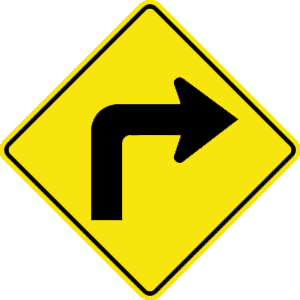
This road sign means:
One-way road.
No right turn.
Exit.
Sharp right turn in the road ahead.
Q.12.
What does alcohol do to your driving skills and judgement?
It helps driving skills but harms your judgement.
It harms both driving skills and judgement.
It has no effect on either driving skills or judgement.
It has no effect on judgement but it harms driving skills.
Q.13.
To check your blind spot when changing lanes to the left, you should glance:
Over your right shoulder.
At your side mirror.
Over your left shoulder.
At your rearview mirror.
Q.14.
You are involved in an accident and your vehicle is blocking traffic. You should:
Move your vehicle off the traveled portion of the roadway, if possible.
Not move your vehicle under any circumstances.
Wait until the police arrive before moving your vehicle.
None of the above.
Q.15.
You are waiting to turn left at a multilane intersection and opposing traffic is blocking your view. You should:
Accelerate rapidly when the first lane you need to cross is clear.
Wait until you can see all the lanes you need to cross before going ahead with your turn.
Wait for an oncoming driver to wave you across the intersection.
Edge your car into each lane of opposing traffic as soon as it clears.
Q.16.
When entering a highway from an entrance ramp, you should generally:
Enter above the speed of traffic to get ahead.
Enter slowly to avoid other vehicles.
Stop first, then slowly enter traffic.
Accelerate to the speed of traffic.
Q.17.
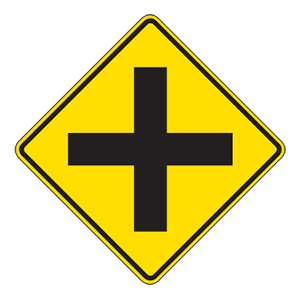
This sign means:
Crossroad ahead.
Flagger ahead.
Lane ends.
Turn right or go straight.
Q.18.
“Highway hypnosis” is a driving condition that can result from:
Staring at the roadway for long periods of time.
Frequent rest stops.
Too much sleep the night before your trip.
Short trips on expressways.
Q.19.
Taking drugs along with alcohol:
Increases the risk of causing a crash.
Is no more dangerous than consuming alcohol by itself.
Lessens the effect of alcohol on your ability to drive.
Has no effect on your general driving ability.
Q.20.
If you drink alcohol socially, what helps ensure safe driving?
Drink coffee before driving.
Ride home with a friend who has not been drinking.
Take a cold shower before driving.
Stop drinking one half hour before driving.
Q.21.
When parallel parking between two cars, you should first:
Turn your wheels to the left.
Turn your wheels to the right.
Pull up even with the car in front of your desired parking space.
Back slowly.
Q.22.
This sign tells you that:
No turns are allowed on this road.
The road narrows ahead.
There are a series of curves ahead.
The road may be slippery when wet.
Q.23.
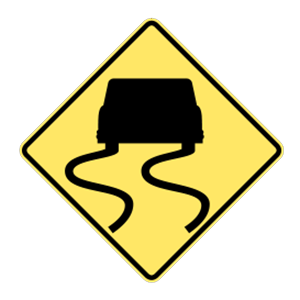
This sign means:
Watch for drunk drivers.
Curves ahead.
Slippery when wet.
Apply your brakes quickly.
Q.24.
When you park uphill on a street with a curb:
Keep the front wheel straight and set the parking brake.
Turn the front wheels away from the curb.
Turn the front wheels toward the curb.
Turn the back wheels into the curb.
Q.25.
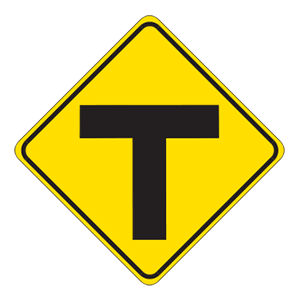
This sign means:
T intersection.
Lane shifting.
Side road.
Do not block intersection.
Q.26.
When driving on an interstate:
Stop on the shoulder of the road if you are tired.
You should always use cruise control.
Signal, check mirrors, and check blind spots before changing lanes.
You should change lanes often.
Q.27.
The act of turning your head and checking your blind spot before changing lanes, driving away from a curb, or merging your vehicle into traffic is:
A bad driving habit.
A good driving habit.
Unnecessary.
Not necessary if you use the rearview mirror.
Q.28.
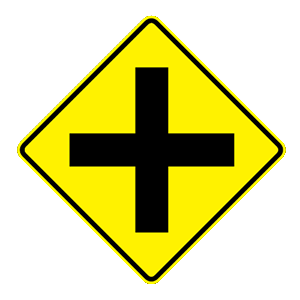
This road sign means:
A steep grade is ahead.
You must turn left ahead.
Do not enter.
A four-way intersection is ahead.
Q.29.
Which of the following statements is true?
Signal at least 100 feet before changing lanes to pass and ensure there is no oncoming traffic.
Use your mirrors and look over your left shoulder to check your blind spot when passing to the left.
When passing, wait until you can see both headlights of the passed car in your rearview mirror before returning to your original lane.
All of the above.
Q.30.
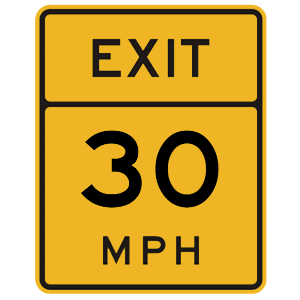
This road sign indicates:
The maximum safe speed for a residential area.
The maximum safe speed for an expressway exit.
The maximum safe speed for an expressway entrance.
The maximum safe speed for a work zone.
Q.31.
Road rage and aggressive driving may be reduced by:
Allowing extra travel time.
Obeying posted speed limits.
Using proper turn signals.
All of the above.
Q.32.
A leaky exhaust system in your vehicle is dangerous because it can cause:
A loss of hearing.
Pollution.
Carbon monoxide poisoning.
Poor engine performance.
Q.33.
A single broken yellow line down the center of a two-lane road indicates:
Lanes are moving in opposite directions and drivers are not permitted to pass.
Lanes are moving in opposite directions and drivers are permitted to pass when it is safe to do so.
Lanes are moving in the same direction and drivers are not permitted to pass.
Lanes are moving in the same direction and drivers are permitted to pass when it is safe to do so.
Q.34.
You come to an intersection that is blocked by other traffic. You should:
Go slowly until the traffic ahead moves.
Get as close as possible to the car in front of you.
Stay out of the intersection until you can pass through.
Sound your horn to make the cars move up.
Q.35.
Is it legal cross a double solid yellow centerline to pass?
Yes.
No.
If there is no oncoming traffic.
If the vehicle ahead of you is driving under the speed limit.
Q.36.
Signs that are colored orange are:
Work zone signs.
Regulatory signs.
School zone signs.
Guide signs.
Q.37.
You cannot pass safely on a two-way, two-lane street unless:
You are able to clearly see the road ahead.
You can return to your lane before meeting oncoming traffic.
Your vehicle is capable of the speed necessary to pass.
All of the above.
Q.38.
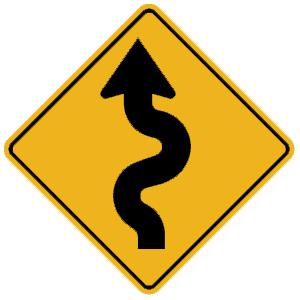
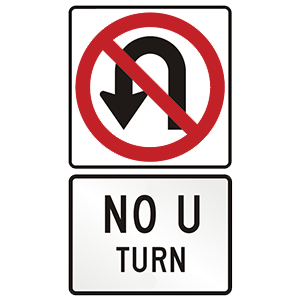
This sign means:
U-turns are prohibited.
U-turns are permitted.
Winding road ahead.
Sharp left turn ahead.
Q.39.
When riding in a vehicle, small children:
May be safely held by a strong adult.
Will be safe if they are standing on the floor in the back of the vehicle.
Will not be hurt in an accident because they are small.
Must never be allowed to ride while standing in the vehicle.
Q.40.
It is best to keep a space cushion:
Only in back of your vehicle.
Only on the left and right sides of your vehicle.
Only in front of the vehicle.
On all sides of the vehicle.
Q.41.
If you need to drive in foggy weather:
Turn on your low beam headlights.
Turn on your hazard lights.
It is okay to drive at the maximum speed limit.
Do not drive at a speed above 10 miles per hour.
Q.42.
When driving near heavy trucks, other drivers and highway users must make allowances for:
The increased stopping distance required by large vehicles.
The decreased stopping distance required by large vehicles.
The decreased noise of larger vehicles.
The increased speed of larger vehicles.
Q.43.
When is it acceptable to park in an access aisle next to a disability parking space?
Under no circumstances.
When you have a disability plate or parking placard.
When all other parking spaces are full.
When you are only parking for a couple minutes.
Q.44.
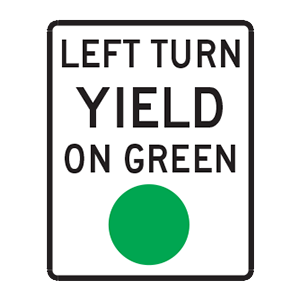
This sign means:
Left turn yield on green.
One-way.
Cattle crossing.
Two-way left turn.
Q.45.
Another driver is trying to pass your car. You should:
Pull off the road.
Signal to the other driver when it is safe for them to pass.
Check for oncoming traffic and adjust your speed to allow safe passing.
Speed up.
Q.46.
You may pass another vehicle:
In a curve or on a hill because the chance is small that another vehicle is coming.
By using the shoulder of the highway.
If your lane is next to a solid yellow line and the passing lane is clear ahead.
None of the above.
Q.47.
A driver can legally pass on the right side of another vehicle:
If the vehicle is waiting to turn left and there is an available passing lane.
Even if it means driving off the pavement.
On a narrow bridge.
At any time.
Q.48.
When you are being tailgated:
Move over to the right, if there is an open lane to your right.
If there is not an open lane to your right, wait until the way is clear ahead and reduce your speed slowly to encourage the tailgater to drive around you.
Never slow down abruptly.
All of the above.
Q.49.
Many crashes are caused by:
Drivers traveling too fast for conditions.
Drivers consistently checking their mirrors and blind spots.
Drivers yielding the right-of-way.
Drivers maintaining a four-second following distance.
Q.50.
If you become stranded in a snowstorm, the best thing to do is to:
Get out of the car and go for help.
Lay down in your car and go to sleep.
Walk into the road and get the attention of other drivers.
Stay in the car, as you are most likely to be found when you stay in your vehicle.
Support mcqgeeks.com by disabling your adblocker.
×
Please disable the adBlock and continue.
Thank you.
Reload page