MCQGeeks
CBSE
JEE
NTSE
NEET
English
UK Quiz
Quiz
Driving Test
Practice
Games
Driving Test
Michigan
Michigan Car Driving Permit Test-13
Answers
Q.1.
Traffic signals sometimes display arrows to control turns from specific lanes. A solid red arrow:
Is never used as a traffic signal.
Has the same meaning as a circular red traffic light.
Means that drivers may turn in the direction indicated by the arrow.
Means that the traffic the arrow is pointing toward must stop.
Q.2.
When you hear a fire engine siren behind you, you must:
Slow down until it passes you.
Drive with your flashers on.
Pull over to the side of the road and stop.
Speed up and take the nearest exit.
Q.3.
You may continue carefully through an intersection with a yellow light if:
There is an emergency vehicle crossing your lane.
There are pedestrians crossing.
You are turning right.
You are already within the intersection when the light changes to yellow.
Q.4.
Crossbuck signs indicate:
Railroad crossings.
School zones.
No passing zones.
Hospitals.
Q.5.
If you are stopped by a police officer, you should:
Unbuckle your seat belt and lower your window.
Get your paperwork ready before the officer reaches your car.
Stay in your vehicle with your hands on the steering wheel and wait for the officer to approach you.
Get out of your car and walk toward the patrol car.
Q.6.
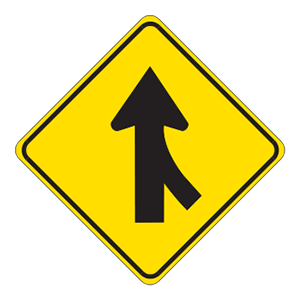
This sign means:
Merging traffic.
Multiple turns.
Lane shifting.
Do not block intersection.
Q.7.
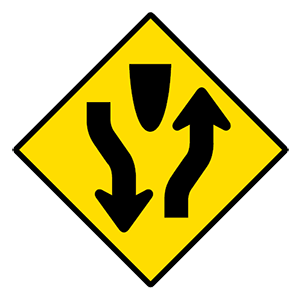
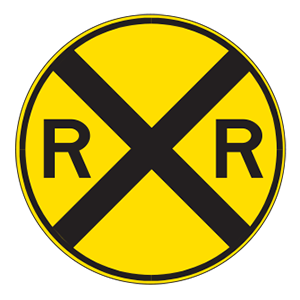
This sign is a warning that you are approaching:
An intersection.
A crosswalk.
A railroad crossing.
A blasting zone.
Q.8.
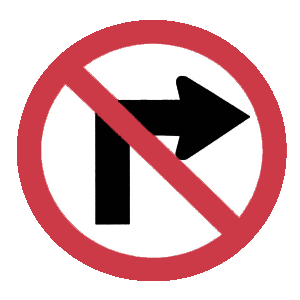
This road sign means:
No left turn.
No U-turns.
No exit.
No right turn.
Q.9.
When exiting a highway, you should slow down:
On the main road, just before the exit lane.
Once you see a toll booth.
Once you have moved into the exit lane.
When you first see the exit sign.
Q.10.
When parking your vehicle downhill on a two-way street:
Turn your wheels to the right.
Turn your wheels to the left.
Keep your wheels pointed straight ahead.
Leave your transmission in neutral.
Q.11.
As a pedestrian, you should:
Always insist on the right-of-way over a vehicle when using a crosswalk.
Never enter a street or crosswalk when vehicles are approaching.
Enter a crosswalk at any time because it is the vehicle driver’s responsibility to stop.
Use crosswalks only if they are convenient.
Q.12.
This sign means:
Winding road.
No parking.
Right lane closed.
Multiple turns.
Q.13.
A diamond-shaped sign is a:
Road hazard sign.
Interstate route sign.
School crossing sign.
Speed limit sign.
Q.14.
You may turn right on red:
After coming to a complete stop and yielding to pedestrians and vehicles in the intersection.
Before pedestrians have crossed any intersecting crosswalks.
Where there is a sign prohibiting turning right on red.
Before coming to a complete stop.
Q.15.
If you want to get off the freeway but you have missed your exit, you should:
Go to the next exit.
Make a U-turn through the median.
Pull onto the shoulder and back your car to the exit.
Flag down a police officer for an escort back to your exit.
Q.16.
To safely pass a bicycle, you should:
Honk at the bicyclist to let them know you're trying to pass.
Drive in the bicycle lane until you get a chance to pass.
Slow down and give them as much space as possible.
Rush ahead to pull in front of the bicyclist.
Q.17.
The best way to deal with tailgaters is to:
Speed up to increase the distance between you and the tailgater.
Slam on your brakes to get the other driver to back off.
Change lanes or gradually slow down to encourage them to pass.
Ignore them.
Q.18.
Allowing a space cushion between your vehicle and its surroundings is important because it:
Prevents distractions from other vehicles.
Allows you time to react to unexpected situations.
Keeps traffic flowing at a safe pace.
Keeps other drivers alert.
Q.19.
A yellow and black diamond-shaped sign:
Warns you about conditions on or near the road.
Helps direct you to cities and towns ahead.
Tells you about traffic laws and regulations.
Tells you about road construction ahead.
Q.20.
What is the appropriate action to take when approaching a railroad crossing that does not have signals to direct traffic?
Always bring the car to a complete stop.
Slow down and be prepared to stop.
All railroad crossings have signals so you will never encounter this situation.
Increase your speed to get across the tracks quickly.
Q.21.
When parallel parking, you should park within ____ inches of the curb.
24
20
18
12
Q.22.
This road sign means:
Do not pass.
Do not enter.
No turn on red.
Keep right.
Q.23.
You are entering a crowded freeway. What should you do to merge into traffic?
Use your side and rearview mirrors and check your blind spots.
Use the acceleration lane to adjust your speed to match the speed of freeway traffic.
Yield to traffic already on the freeway.
All of the above.
Q.24.
You are waiting in the intersection to complete a left turn. You should:
Signal and keep your wheels turned to the left.
Signal and keep your wheels straight.
Flash your headlights so drivers will let you through.
Drive around the rear of a car if it blocks you.
Q.25.
You must yield for emergency vehicles:
Under no circumstances.
When you see a flashing red or blue light or hear a siren.
Only when other vehicles yield.
None of the above.
Q.26.
At a light rail intersection, always:
Look both ways before crossing tracks.
Pay attention and obey all traffic signals.
Share the road with pedestrians and bicyclists.
All of these.
Q.27.
What should you do if your accelerator sticks while you are driving?
Reach down and attempt to pull it up.
Shift to park.
Shift to neutral and apply steady pressure on the brake.
Turn the engine off.
Q.28.
If you are turning onto a street with more than one lane traveling in your direction, you should:
Turn into the lane closest to your previous lane.
Turn into the lane marked with an arrow.
Turn into the middle lane.
Turn into any lane.
Q.29.
Which of the following is a safe way to drive through a curve?
Slow down as you enter, speed up as you exit.
Maintain a constant speed throughout the curve.
Speed up as you enter, slow down as you exit.
Stay near the right edge of your lane.
Q.30.
Unless otherwise posted, the speed limit on state highways is:
25 mph.
35 mph.
45 mph.
55 mph.
Q.31.
You are approaching an intersection when the traffic light changes from green to solid yellow. You should:
Consider it the same as a caution sign and continue through the intersection.
Stop immediately.
Stop before entering the intersection, unless you are too close to stop safely.
Speed up to get through the intersection before the red light appears.
Q.32.
A solid yellow line on your side of the centerline means:
Slow down.
Pass with caution.
Do not pass.
Keep right on hills.
Q.33.
You are approaching a railroad crossing and you do not see or hear a train. You must stop:
If a stop sign is posted.
If a crossing gate is lowered.
If the crossing lights are flashing.
All of the above.
Q.34.
When you want to make a right turn, your car must be:
Near the center of the street.
Close to the left side of the street.
Close to the right side of the street.
Past the center of the intersection when you begin to turn.
Q.35.
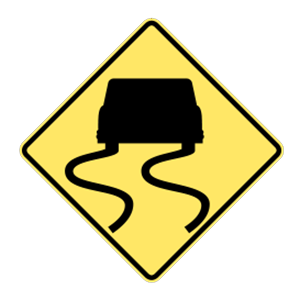
This sign means:
Watch for drunk drivers.
Curves ahead.
Slippery when wet.
Apply your brakes quickly.
Q.36.
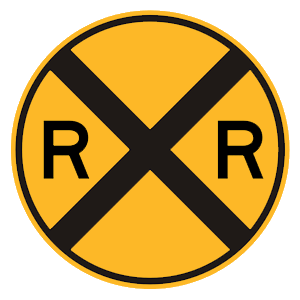
This sign means:
Railroad crossing.
One-way traffic.
Limited parking.
Playground ahead.
Q.37.
Compared to driving during the day, driving at night is:
Less dangerous.
No more or less dangerous.
More dangerous.
Easier on your eyes.
Q.38.
Don’t follow other cars too closely because:
You may not see the road between the cars.
You may not have time to stop if the vehicle in front of you slows or stops suddenly.
You may not see the vehicle's turn signals.
You may not see the other vehicle’s brake lights.
Q.39.
If an aggressive driver cuts you off, you should:
Call the police immediately.
Stay calm and move out of the aggressive driver's way.
Flash your vehicle's lights to let the aggressive driver know he is wrong.
Use a driving action of your own to get back at the aggressive driver.
Q.40.
A red and white triangular sign at an intersection means:
Slow down if an emergency vehicle is approaching.
Look both ways as you cross the intersection.
Always come to a full stop at the intersection.
Slow down and be prepared to stop if necessary.
Q.41.
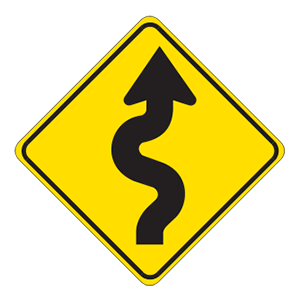
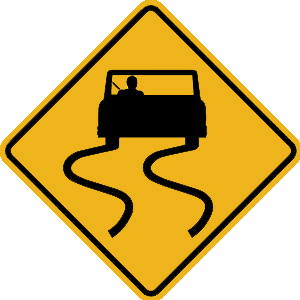
This sign means:
A left curve is ahead.
A series of curves is ahead.
An S-curve is ahead.
The road will be slippery when wet.
Q.42.
You may not cross a single broken white or yellow line:
When doing so would interfere with traffic.
When turning left into a driveway.
When the car in front of you is disabled.
When passing to the right on a one-way street.
Q.43.
To turn left from multilane, one-way streets and highways, you should start from:
The middle of the intersection.
The right lane.
The left lane.
Any lane.
Q.44.
What does a flashing yellow traffic light mean?
Merging traffic
Proceed with caution.
Pedestrian crossing
Come to a full stop.
Q.45.
A steady yellow light at an intersection means:
Go.
Yield to other cars.
Slow down and prepare to stop.
Stop.
Q.46.
When meeting a car with blinding headlights, you should:
Use your bright lights until the other vehicle dims theirs.
Flash your lights on and off to warn the other driver.
Dim your lights and then speed up to pass quickly.
Look toward the right side of the road.
Q.47.
If you miss your exit on an interstate expressway:
Stop and make a U-turn.
Get off at the next exit and come back to the exit you missed.
Roll down your window and ask the driver next to you for help.
Back up on the highway.
Q.48.
Braking distance is affected by:
The speed your vehicle is traveling.
The condition of your brakes and tires.
The condition of the pavement.
All of the above.
Q.49.
You are involved in an accident. You should:
Stop immediately.
Help the injured.
Call the police.
All of the above.
Q.50.
When may you proceed through an intersection that has a stop sign but no stop line or crosswalk?
After slowing down to verify that there is no cross traffic
After coming to a complete stop and verifying that it is safe to proceed
After you have stopped at least 20 feet prior to the intersection
After slowing down to a speed of 10 mph
Support mcqgeeks.com by disabling your adblocker.
×
Please disable the adBlock and continue.
Thank you.
Reload page