MCQGeeks
CBSE
JEE
NTSE
NEET
English
UK Quiz
Quiz
Driving Test
Practice
Games
Driving Test
Michigan
Michigan Car Driving Permit Test-24
Answers
Q.1.
As you near an intersection, the traffic light changes from green to yellow. Your best action is to:
Speed up to beat the red light.
Apply the brakes sharply to stop.
Be prepared to stop in the center of the intersection.
Be prepared to stop before the intersection.
Q.2.
An inattentive driver is a driver who:
Stares at objects off the roadway or daydreams while driving.
Maintains eye contact during a conversation with a passenger while driving.
Only watches the vehicle ahead of their vehicle.
All of the above.
Q.3.
When merging onto a freeway, it is usually best to:
Proceed slowly while waiting for an opening.
Accelerate to a speed that is faster than the speed of traffic.
Turn on your hazard lights until safely on the freeway.
Accelerate to the speed of freeway traffic.
Q.4.
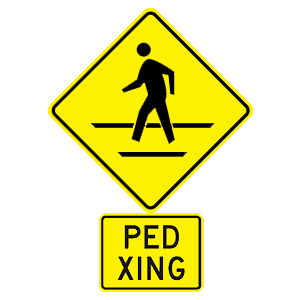
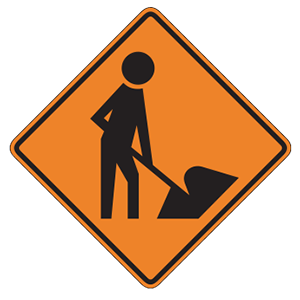
This sign means:
School ahead.
School crossing.
Pedestrian crossing.
Construction workers on or near the roadway.
Q.5.
A traffic light displaying a green arrow and a red light means that:
You may only drive straight ahead.
You may drive only in the direction of the green arrow.
You must wait for a solid green light to proceed in any direction.
Vehicles moving in any direction must stop.
Q.6.
You are waiting to turn left at a multilane intersection and opposing traffic is blocking your view. You should:
Accelerate rapidly when the first lane you need to cross is clear.
Wait until you can see all the lanes you need to cross before going ahead with your turn.
Wait for an oncoming driver to wave you across the intersection.
Edge your car into each lane of opposing traffic as soon as it clears.
Q.7.
You are driving when your power steering stops working. You should:
Honk your horn and turn off the ignition.
Turn on your hazard lights and brace yourself.
Work hard to steer, reduce your speed, drive to a safe area, and stop.
Slam on your brakes.
Q.8.
Drive below the posted speed limit when:
Anything makes conditions less than perfect.
You see a police car.
Entering a highway where there are other cars.
You are on a four-lane road.
Q.9.
At an intersection with a stop sign, you should stop and:
Check your rearview mirror for cars tailgating.
Move when the vehicle ahead of you moves.
Look right first, then left, then right again.
Look left first, then right, then left again.
Q.10.
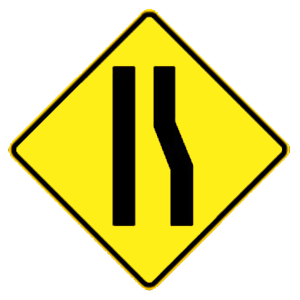
This sign means:
Narrow bridge ahead.
Lane ends or roadway narrows ahead.
Industrial area.
Freeway on-ramp ahead.
Q.11.
A person's ability to drive can be impaired by:
Alcohol.
Any medication.
A lack of sleep.
All of the above.
Q.12.
A person walking with a white cane or guide dog is likely to be:
A deaf person.
A person involved with a traffic study.
A blind person.
None of the above.
Q.13.
When driving in normal traffic conditions, you should signal to turn ____ before beginning the turn.
20 feet
50 feet
100 feet
300 feet
Q.14.
When stopped for a traffic violation or at an equipment check, the driver must produce:
Proof of insurance.
Their license.
Proof of registration.
All of the above.
Q.15.
When entering a street from a driveway, you:
Must drive slowly to allow approaching vehicles and pedestrians time to get out of your way.
Must honk your horn so approaching vehicles and pedestrians know to give you room.
Must stop and proceed only when there are no pedestrians or vehicles approaching.
Can disregard any pedestrians if there is no sidewalk.
Q.16.
A driver can legally pass on the right side of another vehicle:
If the vehicle is waiting to turn left and there is an available passing lane.
Even if it means driving off the pavement.
On a narrow bridge.
At any time.
Q.17.
What should you do when you are going to enter a roadway from a private road?
Blow your horn to warn cars you are entering the roadway.
Stop with part of your car on the roadway to alert other drivers.
Drive out fast to merge smoothly with the traffic.
Yield the right-of-way to pedestrians and roadway traffic.
Q.18.
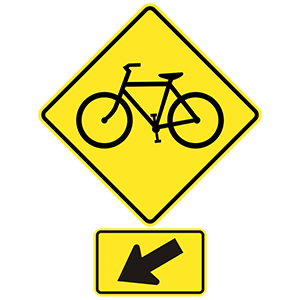
This road sign means:
Bicycle crossing.
Stop only if other cars are approaching.
Bicycle store.
Soft shoulders.
Q.19.
When the driver behind you wants to pass, you should:
Speed up.
Go the same speed.
Slow down to allow room in front of your vehicle for the other driver to complete the pass easily.
Change lanes.
Q.20.
The posted speed limit shows:
Only a recommended driving speed.
The exact speed at which you must travel to avoid a ticket.
The maximum safe driving speed under ideal road and weather conditions.
The maximum safe driving speed under all road conditions.
Q.21.
This sign means that:
A community service group is picking up trash along the highway ahead.
Workers are on or very close to the road in the work zone ahead.
Children are at play ahead.
There is a pedestrian crosswalk ahead.
Q.22.
You may avoid the risks of alcohol-related crashes by:
Deciding before you start drinking that you are not going to drive.
Simply saying, "No thanks, I'm driving," if someone offers you a drink.
Calling a taxi.
Doing any of the above.
Q.23.
A solid white line down the center of a two-lane road indicates:
Lanes are moving in opposite directions and drivers are not permitted to pass.
Lanes are moving in opposite directions and drivers are permitted to pass when it is safe to do so.
Lanes are moving in the same direction and drivers are not permitted to pass.
Lanes are moving in the same direction and drivers are permitted to pass when it is safe to do so.
Q.24.
When approaching a steady green traffic light, drivers should:
Continue driving, unless there are vehicles or pedestrians already in the intersection.
Stop if a police officer is nearby.
Treat the intersection like a four-way stop.
Come to a complete stop before proceeding.
Q.25.
Anything that requires you to ____ could cause you to crash.
Take your eyes off the road
Take your hands off the wheel
Take your attention away from the task of driving
All of the above
Q.26.
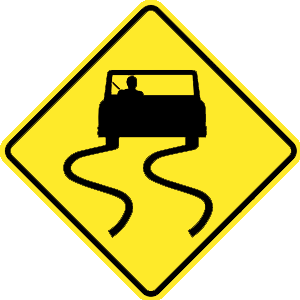
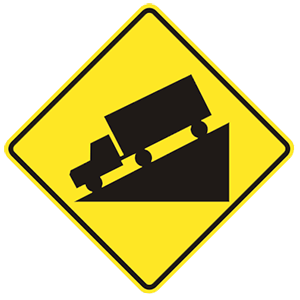
This road sign means:
When pavement is wet, reduce your speed.
The road ahead winds a series of turns or curves.
Traffic increases ahead.
Steep grade ahead.
Q.27.
Certain highway signs require drivers to obey an indicated instruction. Such signs are known as:
Regulatory signs.
Warning signs.
Information signs.
Guide signs.
Q.28.
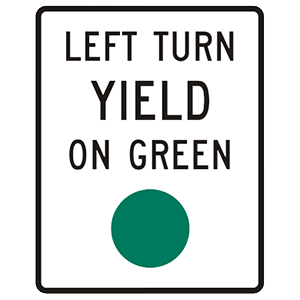
This road sign means:
You are about to enter a one-way street the wrong way.
School crossing ahead.
Do not drive in this lane.
Traffic turning left on the green light must yield to oncoming traffic.
Q.29.
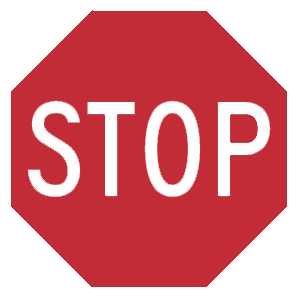
This road sign means:
Slow down or stop.
Stop, if necessary.
You must come to a complete stop.
Drive with caution and be ready to stop.
Q.30.
A regulatory sign containing a red circle with a slash through the middle indicates:
That drivers should come to a complete stop.
That an action is forbidden.
That some drivers should yield to other drivers.
That drivers should drive under the speed limit.
Q.31.
Hydroplaning is usually caused by:
Excessive stops.
Sudden stops.
Sudden turns.
Excessive speed.
Q.32.
Your brake lights tell other drivers that you:
Are making a turn.
Have your emergency brake on.
Are changing lanes.
Are slowing down or stopping.
Q.33.
During adverse weather and traffic conditions, or increased driving speeds, keep a following distance of:
Three seconds.
Four seconds.
Five seconds.
Six or more seconds.
Q.34.
This road sign means:
Intersection ahead.
Steep grade ahead.
Winding road.
Merging traffic.
Q.35.
Your tire blows out while you are driving. You should:
Slam on your brakes.
Hold your steering wheel tightly and slow to a stop.
Keep driving normally.
Turn on your emergency flashers and continue driving.
Q.36.
The amount of space you need to cross traffic depends on the:
Road conditions, weather conditions, and oncoming traffic.
Presence of a stop sign.
Use of your turn signals.
Cars behind you.
Q.37.
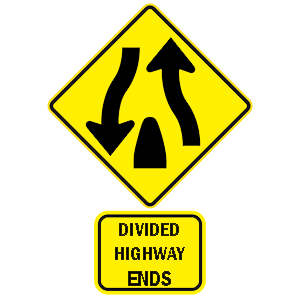
This sign means:
One-way traffic.
Divided highway ends.
Two-way traffic.
Keep left.
Q.38.
Motorcycles are entitled to:
The bicycle lane.
The same full lane width as other motor vehicles.
Half the width of a lane.
The width of the sidewalk.
Q.39.
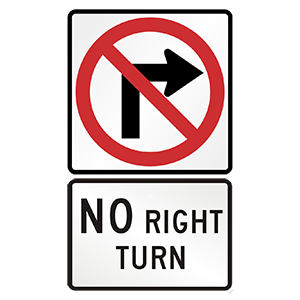
This sign means:
No right turns.
Right turns are permitted.
Stop before turning right.
Sharp curve ahead.
Q.40.
You must pull over to the edge of the road and allow an emergency vehicle to pass:
Regardless of your direction.
Only if it is following you.
Only if it is approaching you from the opposite direction.
None of the above.
Q.41.
If you are driving near a motorcycle, you must:
Allow the motorcycle to use a complete lane.
Drive on the shoulder beside the motorcycle.
Allow the motorcycle to use only half of a lane.
Pass using the same lane as the motorcycle.
Q.42.
This sign means:
There is a detour ahead.
You must stop for flaggers.
The road ahead is closed to traffic.
The highway ahead is undergoing maintenance.
Q.43.
You are driving in the right lane on an expressway. You should move into the left lane when:
Traffic is heavy but moving steadily.
The weather is bad and roads are slippery.
Traffic is slow in your lane and cars are in the left lane.
Traffic is light and cars are merging onto the expressway from the right.
Q.44.
The most effective safety restraints in a traffic crash are:
Only a lap and shoulder belt.
Only an airbag.
Both a lap/shoulder belt and an airbag.
No safety restraints.
Q.45.
To drive safely at night, you should:
Increase your following distance.
Not drive if you are tired.
Make sure your headlights are working properly.
All of the above.
Q.46.
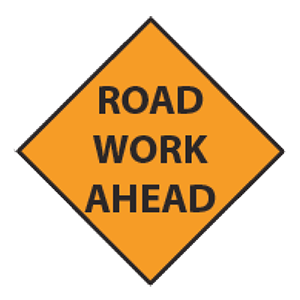
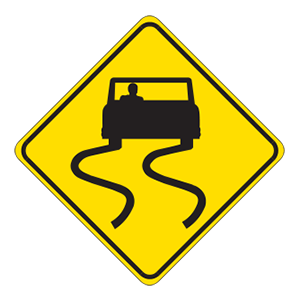
This sign means:
Slippery when wet.
Tow-away zone.
Steep downgrade.
Roadwork ahead.
Q.47.
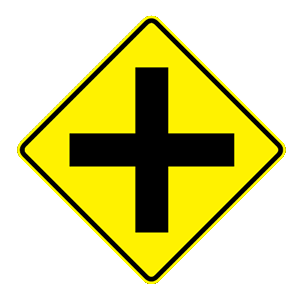
This road sign means:
A steep grade is ahead.
You must turn left ahead.
Do not enter.
A four-way intersection is ahead.
Q.48.
Before changing lanes on a multilane highway, you should:
Sound your horn.
Turn on your headlights.
Reduce your speed.
Check your mirrors and blind spots.
Q.49.
When driving on an interstate:
Stop on the shoulder of the road if you are tired.
You should always use cruise control.
Signal, check mirrors, and check blind spots before changing lanes.
You should change lanes often.
Q.50.
To check your blind spot before changing lanes:
Look into the left side mirror.
Look into the right side mirror.
Look into the rearview mirror.
Look over your shoulder in the direction you plan to move.
Support mcqgeeks.com by disabling your adblocker.
×
Please disable the adBlock and continue.
Thank you.
Reload page