MCQGeeks
CBSE
JEE
NTSE
NEET
English
UK Quiz
Quiz
Driving Test
Practice
Games
Driving Test
Minnesota
Minnesota Car Driving Permit Test-12
Answers
Q.1.
If you want to get off the freeway but you have missed your exit, you should:
Go to the next exit.
Make a U-turn through the median.
Pull onto the shoulder and back your car to the exit.
Flag down a police officer for an escort back to your exit.
Q.2.
A pedestrian starts to cross in front of your vehicle. You should:
Flash your lights.
Slow down.
Speed up and pass in front of the pedestrian.
Stop and let the pedestrian cross.
Q.3.
Stress can affect your driving by:
Lowing your ability to focus on driving.
Decreasing your chances of an accident.
Causing you to fall asleep at the wheel.
Making you more aware of others around you.
Q.4.
If an oncoming driver is heading toward you in your lane, you should:
Blow your horn, steer right, and accelerate.
Blow your horn, steer left, and brake.
Blow your horn, steer right, and brake.
Stay in the center of your lane, blow your horn, and brake.
Q.5.
What should you do when you see this sign?
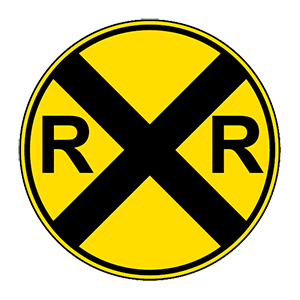
Look for a train station ahead.
Signal before going any further.
Slow down and yield for trains.
Stop.
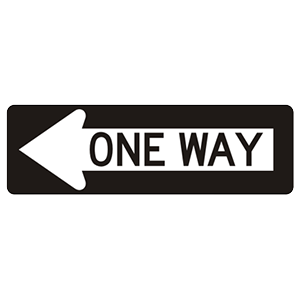
Q.6.
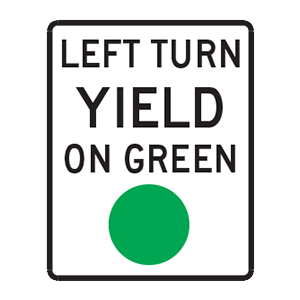
This sign means:
Left turn yield on green.
One-way.
Cattle crossing.
Two-way left turn.
Q.7.
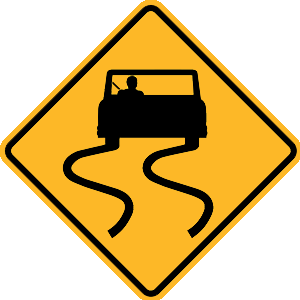
This road sign means:
When pavement is wet, reduce your speed.
The road ahead winds a series of turns or curves.
Traffic increases ahead.
Steep grade ahead.
Q.8.
When approaching a stop sign that is not marked by a crosswalk, drivers should stop their vehicles before entering the intersection.
True
False
Q.9.
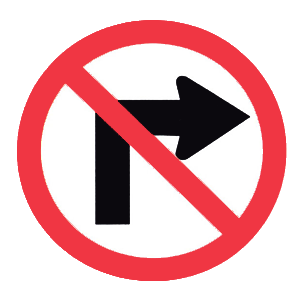
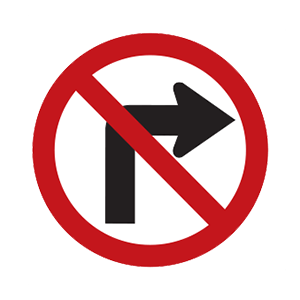
This sign means:
No U-turn.
No left turn.
No right turn.
No turning.
Q.10.
When dealing with pedestrians, a driver must:
Make sure the pedestrian is aware of their vehicle.
Always yield the right-of-way, even if the pedestrian is in the wrong.
Yield the right-of-way only when the pedestrian is legally entitled to it.
Slow down and sound their horn near a crosswalk.
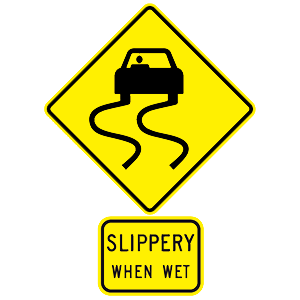
Q.11.
This sign means:
Don't drink if you are going to drive.
Slippery when wet.
Road curves ahead.
You are approaching a hill.
Q.12.
To help prevent crashes, you should:
Communicate with other road users.
Ignore other drivers on the road.
Drive only on side streets and back roads.
Avoid driving during rush hour.
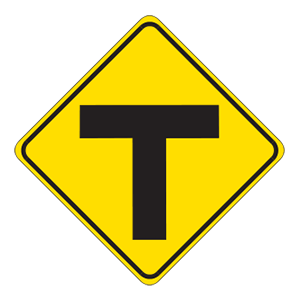
Q.13.
This sign means:
T intersection.
Lane shifting.
Side road.
Do not block intersection.
Q.14.
Only vehicles displaying special plates or parking placards for persons with disabilities may park in spaces reserved for them by an official sign.
True
False
Q.15.
When you approach a railroad crossing without flashing warning signals or crossing gates, you should:
Cross the tracks immediately and as quickly as possible.
Always stop before crossing the tracks.
Prepare to yield to any train at the crossing.
Speed up to beat any oncoming train.
Q.16.
What do lane use control signals with a green arrow indicate?
The signal is about to change to a red X.
Drivers should not drive in this lane.
Drivers may use this lane only to make a left turn.
Drivers may drive normally in this lane.
Q.17.
A yellow and black diamond-shaped sign:
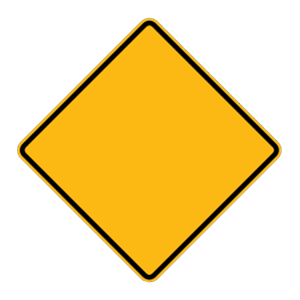
Warns you about conditions on or near the road.
Helps direct you to cities and towns ahead.
Tells you about traffic laws and regulations.
Tells you about road construction ahead.
Q.18.
Drinking alcohol and driving is:
A minor traffic safety problem.
A serious traffic safety problem.
Safe if you have only had a few drinks.
Only dangerous to the driver who drinks.
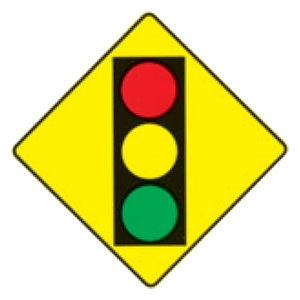
Q.19.
This sign means:
Stop sign ahead.
Lane closed ahead.
Railroad crossing ahead.
Traffic signal ahead.
Q.20.
If you are following a school bus or tank truck, you should:
Pass them on the right.
Be prepared to stop at all railroad crossings.
Expect them to drive above the speed limit.
Decrease your following distance.
Q.21.
Which of the following does not happen after drinking?
Your reflexes and reaction time slow down.
Your judgement of speed and distance is distorted.
You are less alert.
You calm down and can concentrate better.
Q.22.
Compared to driving during the day, driving at night is:
Less dangerous.
No more or less dangerous.
More dangerous.
Easier on your eyes.
Q.23.
Which of the following statements is true?
A sudden change in weather calls for a change in driving.
You should slow down when driving in rain and fog.
Be particularly aware of vehicles coming up behind you in inclement weather.
All of the above.
Q.24.
You may not cross a single broken white or yellow line:
When doing so would interfere with traffic.
When turning left into a driveway.
When the car in front of you is disabled.
When passing to the right on a one-way street.
Q.25.
Which statement about speed is true?
Driving too slowly on certain highways can be dangerous.
Speeding can kill.
Speeding is not dangerous if you are a skilled driver.
Both "Driving too slowly on certain highways can be dangerous" and "Speeding can kill."
Q.26.
You are coming to a railroad crossing where the crossing signals are flashing. You should:
Stop and look for a train.
Slow down and look for a train.
Look for a train, then speed up.
Do what the vehicle ahead of you does.
Q.27.
The most common mistake that drivers make when backing is failing to look both ways behind them.
True
False
Q.28.
You want to back out of your driveway. You see children playing nearby. Before you start to move your car, you should:
Rev your engine to warn the children that you are moving.
Sound your horn so the children will hear you.
Walk to the back of the car to be sure the way is clear.
Tell the children to stay away from the driveway.
Q.29.
This road sign means:
No right turn.
Curve.
Turn right or left.
Traffic flows only in the direction of the arrow.
Q.30.
When should you return to your previous lane while completing a pass?
When you sense that you are far enough ahead of the other vehicle.
When the other vehicle signals for you to return to the lane.
When you can see the other vehicle's headlights in your rearview mirror.
When you are directly next to the other vehicle.
Q.31.
It is important to slow down:
On narrow or winding roads.
At intersections or railroad crossings.
When the road is wet or slippery.
All of the above.
Q.32.
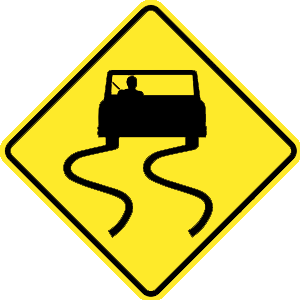
This sign means:
Slippery when wet.
Watch for drunk drivers.
Dangerous curve ahead.
Bump in the road ahead.
Q.33.
Distracted drivers are at a greater risk of a crash when they are using which of the following?
CD player
Radio
Cell phone
All of the above
Q.34.
Traffic signs and pavement markings:
Must always be obeyed.
Are merely suggestions.
Must be followed only when there is other traffic.
Must be followed only when a police officer is present.
Q.35.
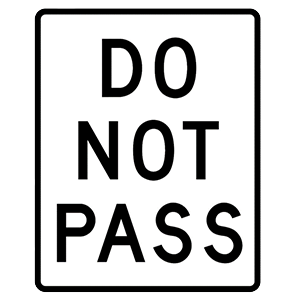
If you see this sign, you:
Must not pass another vehicle.
May pass a slow-moving vehicle if you can do so quickly.
May pass if you know the road ahead.
May pass, but only at night.
Q.36.
This sign means:
No right turn.
Keep right.
No U-turn.
Left lane must turn left.
Q.37.
Seat belts are most effective when they are worn by:
The person driving the car.
Passengers when they are on a long drive.
All occupants of a car being driven on an expressway.
All occupants of a car every time the car is driven.
Q.38.
If you need to stop quickly and your vehicle is not equipped with an Anti-Lock Braking System (ABS), you should:
Hold down the brake pedal.
Firmly pump your brakes.
Lightly tap the brakes.
Release the brake pedal.
Q.39.
To check your blind spot when changing lanes to the left, you should glance:
Over your right shoulder.
At your side mirror.
Over your left shoulder.
At your rearview mirror.
Q.40.
Regulatory signs are usually ____ and should always be obeyed.
White
Blue
Green
Orange
Support mcqgeeks.com by disabling your adblocker.
×
Please disable the adBlock and continue.
Thank you.
Reload page