MCQGeeks
CBSE
JEE
NTSE
NEET
English
UK Quiz
Quiz
Driving Test
Practice
Games
Driving Test
Minnesota
Minnesota Car Driving Permit Test-23
Answers
Q.1.
Downward-facing triangular signs:
Indicate school zones.
Tell drivers to yield.
Indicate construction zones.
Indicate railroad crossings.
Q.2.
A red flashing traffic light has the same meaning as a:
Solid red light.
Stop sign.
Yield sign.
Caution sign.
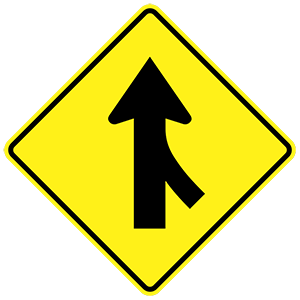
Q.3.
This road sign means:
Cars in right lane must slow down.
No left turn.
Merge.
Pass only in the right lane.
Q.4.
This sign means:
Curve ahead.
Roadwork ahead.
Merging traffic.
No left turn.
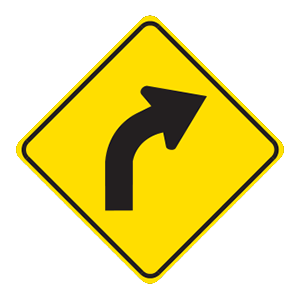
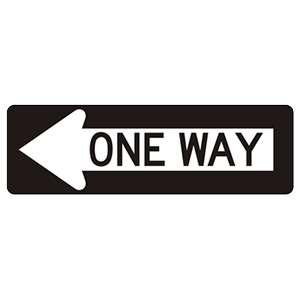
Q.5.
This road sign means:
No right turn.
Curve.
Turn right or left.
Traffic flows only in the direction of the arrow.
Q.6.
Talking or texting on a cell phone while driving will not significantly increase your chances being involved in a crash.
TRUE
FALSE
Q.7.
When approached by an emergency vehicle that is using its siren and/or flashing lights, a driver must immediately:
Pull to the right and stop.
Pull to the right and slow down.
Pull to the right and turn on their vehicle's four-way flashers.
Stop and let the emergency vehicle pass.
Q.8.
When driving past a vehicle that has just stopped in a parked position on the side of the road, you should:
Assume that the driver will open the car door as you approach.
Speed up.
Slam on your brakes.
Assume that the driver will wait for you to pass before opening the door.
Q.9.
If involved in an accident, a driver should:
Stop their vehicle at or near the scene.
Not stand or walk in traffic lanes.
Turn off the ignitions of wrecked vehicles.
All of the above.
Q.10.
A telltale sign of a drunk driver is:
They are weaving between lanes.
They are driving more slowly than the normal traffic flow.
They are making quick and sudden stops.
All of the above.
Q.11.
You notice that the driver in the vehicle ahead of you is driving with one hand and talking to a passenger. You should:
Give the vehicle extra space.
Know that the driver in the vehicle ahead is reducing their safety margin by being an inattentive driver.
Avoid following the driver's example.
All of the above.
Q.12.
If you drink alcohol socially, what helps ensure safe driving?
Drink coffee before driving.
Ride home with a friend who has not been drinking.
Take a cold shower before driving.
Stop drinking one half hour before driving.
Q.13.
When merging onto a freeway, it is usually best to:
Proceed slowly while waiting for an opening.
Accelerate to a speed that is faster than the speed of traffic.
Turn on your hazard lights until safely on the freeway.
Accelerate to the speed of freeway traffic.
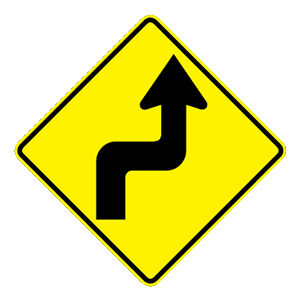
Q.14.
This road sign means:
The road ahead turns sharply right, then left.
The road ahead turns sharply left, then right.
The road ahead curves to the left.
Construction ahead.
Q.15.
The correct way to use a freeway exit ramp is to:
Slow down before entering the exit ramp.
Slow down once moving onto the exit ramp.
Keep your speed constant once in the exit ramp.
Pass slower traffic in the exit ramp.
Q.16.
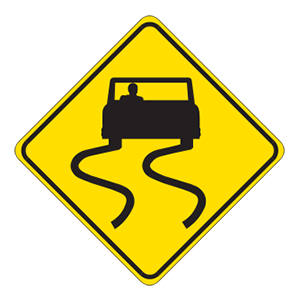
This sign means:
Slippery when wet.
Tow-away zone.
Steep downgrade.
Roadwork ahead.
Q.17.
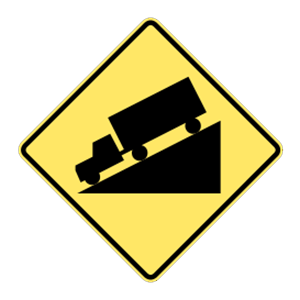
This sign means:
Watch for trucks.
Do not pass trucks.
Truck parking area ahead.
Steep downgrade ahead.
Q.18.
If you are stopped by a police officer, you should:
Unbuckle your seat belt and lower your window.
Get your paperwork ready before the officer reaches your car.
Stay in your vehicle with your hands on the steering wheel and wait for the officer to approach you.
Get out of your car and walk toward the patrol car.
Q.19.
What should you do when you are going to enter a roadway from a private road?
Blow your horn to warn cars you are entering the roadway.
Stop with part of your car on the roadway to alert other drivers.
Drive out fast to merge smoothly with the traffic.
Yield the right-of-way to pedestrians and roadway traffic.
Q.20.
Night driving can be more difficult than driving during the day because:
Cars overheat more quickly at night.
Visibility is reduced in the dark.
It is more likely to be raining at night.
You are more likely to encounter a motorcycle at night.
Q.21.
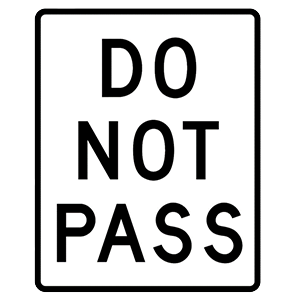
If you see this sign, you:
Must not pass another vehicle.
May pass a slow-moving vehicle if you can do so quickly.
May pass if you know the road ahead.
May pass, but only at night.
Q.22.
To avoid collisions with vehicles in your blind spots, you should:
Quickly turn your head to see if your blind spot is clear before changing lanes.
Adjust your rearview mirrors every few minutes.
Honk your horn right before turning or changing lanes.
None of the above.
Q.23.
Your ability to stop is affected by:
Signal lights.
Other cars on the road.
The time of day.
The condition of the road.
Q.24.
Drivers must yield to a pedestrian:
Even if the pedestrian crosses the street carelessly.
Only when the pedestrian is in a crosswalk.
Only if the pedestrian is on the same side of the road as the driver.
If the pedestrian uses a hand signal to ask oncoming drivers to stop.
Q.25.
The most effective thing you can do to reduce your risk of being injured or killed in a traffic crash is to:
Wear your seat belt.
Limit your driving to weekdays.
Stay in the right lane on multilane highways.
Limit your driving to hours between 3:00 p.m. and 6:00 p.m.
Q.26.
When driving near a blind pedestrian who is carrying a white cane or using a guide dog, you should:
Slow down and be prepared to stop.
Take the right-of-way.
Proceed normally.
Drive away quickly.
Q.27.
When driving on wet pavement, it's important to remember:
That pavement is especially slippery right after it starts to rain.
That wet roads can cause hydroplaning.
To give yourself additional space when coming to a stop.
All of the above.
Q.28.
You are borrowing an unfamiliar vehicle from a friend. You should:
Not put too much thought into it because all vehicles are the same.
Hide from your friend that you are unfamiliar with the vehicle.
Disregard any obvious defects to avoid embarrassing your friend.
Take a few minutes before driving to familiarize yourself with the operation and location of all the vehicle’s equipment.
Q.29.
A stop sign is shaped like a(n):
Rectangle.
Square.
Circle.
Octagon.
Q.30.
If a vehicle using high beams comes toward you, you should look toward ____ of the road.
Either side
The center
The right side
The left side
Q.31.
The most common color of warning signs is:
Red.
Yellow.
Green.
Blue.
Q.32.
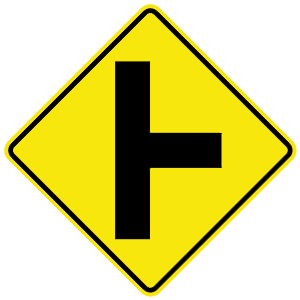
This road sign means:
All traffic must turn right.
No right turn.
All traffic must go straight ahead.
A road joins from the right.
Q.33.
How do you check your blind spots?
By looking in your side mirrors.
By turning your head and looking over your shoulders.
By looking in your rearview mirror.
By staring straight ahead.
Q.34.
A motorist making a left turn at an intersection must yield the right-of-way to a bicyclist entering the intersection from the opposite direction.
True
False
Q.35.
How can you help prevent rear-end collisions?
Avoid sudden stops.
Before stopping, check your mirrors and blind spots for traffic.
Release the gas pedal and let your vehicle slow before applying the brakes.
All of the above.
Q.36.
When the road is marked with a solid yellow line and a broken yellow line, with the broken line next to your lane, you may pass:
Only in an emergency.
If you are on an expressway.
If traffic is clear.
Only at an intersection.
Q.37.
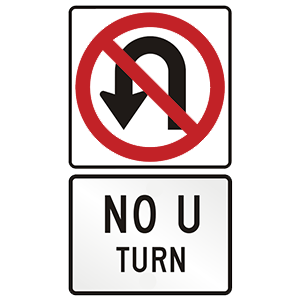
This sign means:
U-turns are prohibited.
U-turns are permitted.
Winding road ahead.
Sharp left turn ahead.
Q.38.
When parking uphill on a hill or incline with a curb:
Turn your front wheels sharply toward the curb.
Turn your front wheels slightly to the right.
Turn your front wheels sharply away from the curb.
Keep your front wheels straight.
Q.39.
When a stop is required at an intersection and no markings appear to indicate a stop line or crosswalk, a driver:
Is not required to stop.
Is required to slow down to make sure crossing traffic is clear.
Should stop only at a place where they can see at least 200 feet on either side, even if they have to enter the intersecting roadway.
Should stop where they have a clear view of approaching traffic before they enter the intersecting roadway.
Q.40.
If two vehicles arrive to a four-way stop at the same time:
The vehicle on the left must yield to the vehicle on the right.
The vehicle on the right must yield to the vehicle on the left.
Drivers must make hand motions to communicate with each other.
One driver should proceed without stopping.
Support mcqgeeks.com by disabling your adblocker.
×
Please disable the adBlock and continue.
Thank you.
Reload page