MCQGeeks
CBSE
JEE
NTSE
NEET
English
UK Quiz
Quiz
Driving Test
Practice
Games
Driving Test
Minnesota
Minnesota Car Driving Permit Test-8
Answers
Q.1.
This sign means:
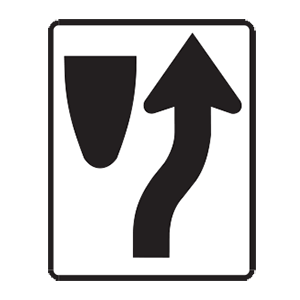
Keep right.
Low shoulder.
No parking at any time.
Lane ends.
Q.2.
When passing an emergency vehicle stopped on the side of the road, drivers should:
Increase their speed.
Vacate the lane closest to the emergency vehicle or slow down.
Pull off the road behind the stationary vehicle.
Move to the lane closest to the stationary vehicle.
Q.3.
You are making a left turn from a two-way street onto a one-way street. When you have completed the turn, your car should be:
In the right lane of the street.
In the center of the street.
In the left lane of the street.
In the lane with the least traffic.
Q.4.
When approaching a railroad crossing, you should:
Slow down.
Look for a train.
Be ready to stop.
All of the above.
Q.5.
Lanes of traffic moving in the same direction are divided by ____ lines.
Yellow
White
Red
Black
Q.6.
When approached by an emergency vehicle that is using its siren and/or flashing lights, a driver must immediately:
Pull to the right and stop.
Pull to the right and slow down.
Pull to the right and turn on their vehicle's four-way flashers.
Stop and let the emergency vehicle pass.
Q.7.
At a light rail intersection, always:
Look both ways before crossing tracks.
Pay attention and obey all traffic signals.
Share the road with pedestrians and bicyclists.
All of these.
Q.8.
If another car is in danger of hitting you, you should:
Sound your horn.
Wave your arms.
Use your emergency lights.
Flash your headlights.
Q.9.
A leaky exhaust system in your vehicle is dangerous because it can cause:
A loss of hearing.
Pollution.
Carbon monoxide poisoning.
Poor engine performance.
Q.10.
From the center lane, which maneuver(s) can you perform?
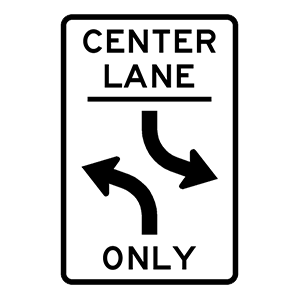
You may make left turns.
You may make U-turns.
You may pass slow-moving traffic.
All of the above.
Q.11.
If you are turning onto a street with more than one lane traveling in your direction, you should:
Turn into the lane closest to your previous lane.
Turn into the lane marked with an arrow.
Turn into the middle lane.
Turn into any lane.
Q.12.
When parallel parking, you should park within ____ of the curb.
10 inches
12 inches
18 inches
20 inches
Q.13.
When driving in fog:
Use your parking lights.
Use your low beams.
Use your high beams.
It makes no difference which lights you use.
Q.14.
Nighttime is the safest time for cyclists to ride their bikes.
TRUE
FALSE
Q.15.
This sign means:
Bicycle crossing.
Stop.
Fines double in a work zone.
Stop ahead.
Q.16.
Drivers may not park:
In front of mailboxes.
On bridges.
Within a highway tunnel.
All of the above.
Q.17.
A driver entering public traffic from a driveway or private road:
Has the right-of-way.
Should yield to drivers already on the public road.
May force their way into traffic.
Can assume that other drivers will change lanes to make room.
Q.18.
You are driving at night and another vehicle is approaching from the opposite direction. Your headlights:
Should be on their high beam setting.
Should be on their low beam setting.
Should be off. Use your parking lights.
May be on either their high or low beam setting.
Q.19.
A telltale sign of a drunk driver is:
They are weaving between lanes.
They are driving more slowly than the normal traffic flow.
They are making quick and sudden stops.
All of the above.
Q.20.
An "End school zone" sign indicates:
That the speed limit is 20 mph.
The beginning of a reduced speed zone.
The increased possibility of encountering pedestrians.
The end of a reduced speed zone.
Q.21.
A railroad crossbuck sign should be treated the same as a yield sign.
True
False
Q.22.
If you need to slow down while driving on a slippery road, the first thing you should do is:
Firmly apply your brakes.
Take your foot off the gas pedal.
Apply your parking brake.
Pump your brakes.
Q.23.
This road sign means:
Cars in right lane must slow down.
No left turn.
Merge.
Pass only in the right lane.
Q.24.
If you are driving near a motorcycle, you must:
Allow the motorcycle to use a complete lane.
Drive on the shoulder beside the motorcycle.
Allow the motorcycle to use only half of a lane.
Pass using the same lane as the motorcycle.
Q.25.
When parallel parking between two cars, you should first:
Turn your wheels to the left.
Turn your wheels to the right.
Pull up even with the car in front of your desired parking space.
Back slowly.
Q.26.
When meeting a car with blinding headlights, you should:
Use your bright lights until the other vehicle dims theirs.
Flash your lights on and off to warn the other driver.
Dim your lights and then speed up to pass quickly.
Look toward the right side of the road.
Q.27.
Your ability to stop is affected by:
Signal lights.
Other cars on the road.
The time of day.
The condition of the road.
Q.28.
Drivers may park in the handicap parking access aisles located directly beside handicap parking stalls.
True
False
Q.29.
The driver's left arm and hand are extended upward. This hand signal means that the driver plans to:
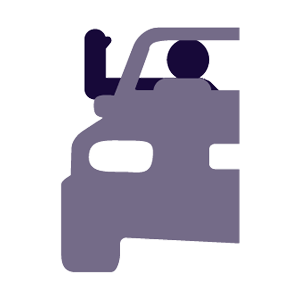
Turn left.
Turn right.
Come to a stop.
Go straight ahead.
Q.30.
You are waiting in the intersection to complete a left turn. You should:
Signal and keep your wheels turned to the left.
Signal and keep your wheels straight.
Flash your headlights so drivers will let you through.
Drive around the rear of a car if it blocks you.
Q.31.
Cell phones can be a serious source of driver distractions.
True
False
Q.32.
Two solid white lines painted across a traffic lane show the boundaries of a crosswalk. As a driver, you should know that:
Motor vehicles have the right-of-way over pedestrians in crosswalks.
When pedestrians are in crosswalks, they should be given the right-of-way.
No one has the right-of-way in a crosswalk.
Pedestrians are responsible to stay out of the way of all traffic.
Q.33.
You notice that the driver in the vehicle ahead of you is driving with one hand and talking to a passenger. You should:
Give the vehicle extra space.
Know that the driver in the vehicle ahead is reducing their safety margin by being an inattentive driver.
Avoid following the driver's example.
All of the above.
Q.34.
Look over your shoulder to check your blind spot when:
Pulling toward or away from a curb.
Turning left or right.
Changing lanes.
All of the above.
Q.35.
A yellow light that flashes on and off means:
Stop and look for other vehicles, then go if there is no traffic.
Stop and wait for a green light.
Speed up to clear the intersection quickly.
Slow down and proceed with caution.
Q.36.
A good defensive driver:
Drives slowly at all times.
Looks out for the actions of other drivers.
Travels at a constant speed.
Only drives in familiar areas.
Q.37.
What does a lane use control signal with a flashing yellow X indicate?
The signal is about to change to a red X.
The signal is about to change to a green arrow.
Drivers may use this lane only to make a left turn.
Drivers may drive slowly in this lane.
Q.38.
If two vehicles arrive to an uncontrolled intersection at the same time:
The largest vehicle has the right-of-way.
The car on the left has the right-of-way.
The car on the left shall yield to the car on the right.
The car on the right shall yield to the car on the left.
Q.39.
Two solid yellow lines on the pavement mean:
Passing is allowed for drivers from both directions.
Passing is not allowed.
Passing is allowed if you are at the top a hill.
Passing is allowed during daylight only.
Q.40.
Which is not a factor in determining the distance that it takes to stop your vehicle?
Steering ability
Braking distance
Reaction distance
Perception time
Support mcqgeeks.com by disabling your adblocker.
×
Please disable the adBlock and continue.
Thank you.
Reload page