MCQGeeks
CBSE
JEE
NTSE
NEET
English
UK Quiz
Quiz
Driving Test
Practice
Games
Driving Test
Minnesota
Minnesota Motorcycle Driving Permit Test-2
Answers
Q.1.
When riding in a group, inexperienced riders should be placed:
In the front of the group.
Just behind the lead rider.
At the back of the group.
Anywhere within the group.
Q.2.
Riding in cold weather for long periods of time could result in all of the following, except:
Fatigue.
Hypothermia.
Severe chills.
Hot flashes.
Q.3.
Which of the following is a good color to wear to be seen?
Orange
Black
Brown
Deep blue
Q.4.
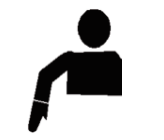
What does this hand signal mean?
Slow or stop
Left turn
Right turn
Backing up
Q.5.
An experienced rider:
Changes positions within their lane as conditions change.
Stays in one portion of a lane at all times.
Weaves within the lane to be more visible.
Travels only on the oily portion of the lane.
Q.6.
To effectively provide protection for a motorcycle rider, pants should:
Be made of a soft material.
Be made of a heavy material.
Fit loosely enough that they flap in the wind.
Be short and expose some parts of the legs.
Q.7.
Where is the engine cut-off switch usually located?
Near the left handgrip
Near the right handgrip
Near the left footrest
Near the right footrest
Q.8.
What can help reduce the risk of a head or neck injury in the event of a crash?
Riding on the shoulder
Riding under the speed limit
Wearing a helmet
Not allowing a passenger on the motorcycle
Q.9.
When checking tires before a ride, you should look at all of the following except:
Air pressure
General wear
General tread
Shininess
Q.10.
When an operator's left arm is extended straight out to the left, it means the operator:
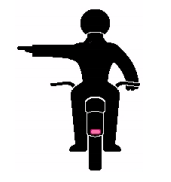
Plans to turn left.
Is about to stop.
Plans to turn right.
Is about to slow down.
Q.11.
Brightly-colored helmets:
May make it easier for the wearer to be seen.
Can be distracting.
Don’t help to improve a rider's visibility.
Are not permitted.
Q.12.
Increase your following distance:
If the roadway is slippery.
If there are only a few vehicles on the roadway.
If the sun is shining.
If drivers are following the speed limit.
Q.13.
When braking:
Use only the front brake.
Use only one brake if it is a non-emergency situation.
Only use both brakes if you are riding on wet pavement.
Use both brakes regardless of the circumstances.
Q.14.
Of the following, which clothing item will not reduce injuries in a crash?
Heavy shoes
Full-length pants
Shorts
Full-fingered gloves
Q.15.
When riding, goggles:
Protect your eyes, but not the rest of your face.
Protect your face, but not your eyes.
Are not as effective at protecting your eyes as eyeglasses.
Are not effective in providing any protection.
Q.16.
A motorcyclist's cushion of space:
Should always stay the same.
Should vary according to riding conditions.
Is not necessary in most situations.
Should be avoided to keep traffic moving safely.
Q.17.
The best lane position is:
The one that lets you travel the fastest.
The one that allows you to draft off of other vehicles.
The one that allows you be seen by other motorists.
The one that places you in other vehicles’ blind spots.
Q.18.
A motorcycle with a sidecar:
Cannot tip over.
Can tip over if making a turn too fast.
Is designed to take corners at any speed.
Should not be used for loading items.
Q.19.
To reduce your reaction time, you should:
Ride under the speed limit.
Cover the clutch and brakes.
Shift into neutral when slowing.
Accelerate before turning.
Q.20.
If a friend has had too much to drink and wants to ride their motorcycle, you should:
Let them.
Encourage them to take roads that are not crowded.
Not get involved.
Take their keys.
Q.21.
Can clothing help prevent injuries in the event of a crash?
No, clothing is not really for protection.
No, clothing is more of a personal choice.
Yes, but only if garments are very loose and flap in the wind.
Yes, if pants and a jacket cover your arms and legs completely.
Q.22.
When riding, you should:
Turn your head and shoulders to look through turns.
Keep your arms straight.
Keep your knees away from the gas tank.
Turn just your head and eyes to look through turns.
Q.23.
When passing parked vehicles, motorcycle riders should be especially cautious of:
Motorists looking for a place to park.
Cars leaving their parking spaces.
Oncoming traffic.
Noise.
Q.24.
To be legal, a motorcycle must be equipped with all of the following, except:
At least one headlight.
A brake light.
A windshield wiper.
A horn.
Q.25.
It is recommended that a motorcyclist:
Shift gears in a turn.
Shift gears before a turn.
Change power suddenly in a turn.
Ride the brake throughout the turn.
Q.26.
Of the crashes involving both a motorcycle and a car, how many are caused by the driver failing to properly yield the right-of-way to the rider?
About 10 percent
About 25 percent
Over 50 percent
About 90 percent
Q.27.
The primary source of information about your motorcycle should come from:
The motorcycle's former owner.
The owner’s manual.
A library book about motorcycles.
A motorcycle enthusiast.
Q.28.
If your motorcycle starts to wobble, you should:
Accelerate out of the wobble.
Use the brakes immediately.
Grip the handlebars firmly and gradually close the throttle.
Downshift.
Q.29.
The best source of information for your motorcycle is:
The owner’s manual.
A general book about motorcycles.
Someone who has a different type of motorcycle.
A television show about motorcycle riding.
Q.30.
Swerving a motorcycle:
Requires a lot of traction.
Requires little traction.
Is a slow maneuver.
Should be done to avoid a hazard on a slippery road.
Q.31.
If your front wheel skids as a result of braking, you should:
Keep the front brake engaged.
Release the front brake immediately and re-apply the brake smoothly.
Release the front brake and only use the rear brake.
Release both brakes and coast to a stop.
Q.32.
When riding at night, how should your following distance compare to your following distance during the day?
You should allow a longer following distance when following another vehicle at night.
You should allow a shorter following distance when following another vehicle at night.
You should always maintain the same following distance regardless of the time of day.
Following distance really doesn’t matter.
Q.33.
Most motorcycle crashes happen:
At high speeds.
After riding for a long time.
Far from home.
On short trips.
Q.34.
If a driver is tailgating you, you should:
Speed up.
Allow them to pass.
Prevent them from passing.
Move to one side of your lane to allow them to share the lane.
Q.35.
Which of the following is not considered protective eye wear?
Contact lenses
Glasses
Goggles
A face shield
Q.36.
All of the following will lessen your chances of being involved in an accident, except:
Remaining alert.
Identifying hazards and prioritizing risks.
Riding without a headlight.
Maintaining a space cushion.
Q.37.
Taking a turn too fast:
Is acceptable as long as you stay under the speed limit.
Is safer on a motorcycle than in a car.
Is acceptable as long as no vehicles are near you.
Can cause you to end up in another lane or leave the road.
Q.38.
What may help if you experience slippage of your drive chain?
Tightening the chain
Loosening the chain
Using the throttle more
Applying the rear brake
Q.39.
When riding in a group, what does it mean when the lead rider raises their left arm and extends their index finger, as shown in the image?
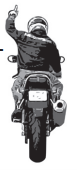
Speed up.
Slow down.
Ride in a single-file formation.
The group will pull off at the next exit.
Q.40.
When riding a motorcycle and trying to turn, you should:
Press the grip in the direction you want to turn.
Press the grip opposite of the direction you want to turn.
Not hold the grip because it can be dangerous.
Not lean the motorcycle as that can be unsafe.
Support mcqgeeks.com by disabling your adblocker.
×
Please disable the adBlock and continue.
Thank you.
Reload page