MCQGeeks
CBSE
JEE
NTSE
NEET
English
UK Quiz
Quiz
Driving Test
Practice
Games
Driving Test
Mississippi
Mississippi Car Driving Permit Test-10
Answers
Q.1.
Which of the following factors affect an individual's absorption of alcohol?
Weight
Height
Intelligence
Q.2.
Construction zone signs are generally:
Square or rectangular with white and red coloring.
Round or octagonal with black and yellow coloring.
Diamond-shaped or rectangular with orange and black coloring.
Q.3.
Night driving presents unique problems because:
The speed limit is increased at night.
There are fewer cars on the roads at night.
Distance and vehicle speed are difficult to judge in the dark.
Q.4.
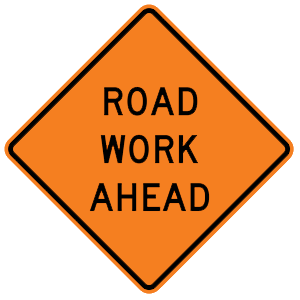
This road sign means:
Watch for people crossing your path.
No passing zone.
Work zone ahead.
Q.5.
When entering the interstate on a short entrance ramp where there is no acceleration lane, you should:
Immediately enter the far-right traffic lane on the interstate and speed up to match the flow of traffic.
Use the shoulder of the main road to get up to the speed of traffic.
Speed up and enter the interstate only after you have identified a gap in traffic.
Q.6.
Which of the following is most likely to be slippery in cold weather after snow or rain?
A hilly, open road
A residential road
A road in a shaded area
Q.7.
When driving on a narrow and winding road, drivers should:
Increase their speed.
Decrease their speed.
Maintain their normal speed.
Q.8.
A broken yellow centerline means that:
Passing is not permitted.
Passing on the right is permitted when the way ahead is clear.
Passing on the left is permitted when the way ahead is clear.
Q.9.
Mississippi law requires headlights to be used:
When a driver is tired.
Between sunset and sunrise.
When the temperature drops below freezing.
Q.10.
When you see this black and yellow sign, it means:
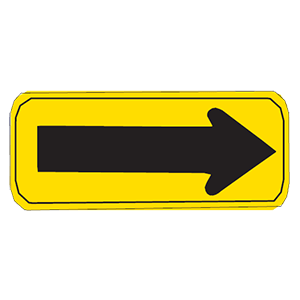
The road to the right is for one-way traffic only.
There is a detour to the right due to road construction.
The road ahead changes direction at an extreme angle.
Q.11.
Driving under the influence of any medication which impairs your driving is permitted:
Under no circumstances.
If you don't feel drowsy.
If it is prescribed by a physician.
Q.12.
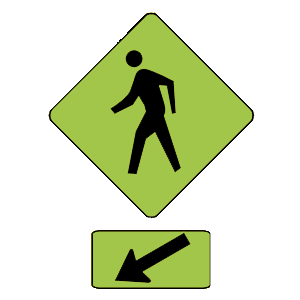
This sign means:
Pedestrian crossing.
Side road.
Railroad ahead.
Q.13.
It is dangerous to follow a motorcycle too closely because:
They do not follow the same rules as motor vehicles.
A motorcycle can stop much faster than a standard vehicle.
They brake more slowly than motor vehicles.
Q.14.
At a red traffic light with a green arrow, you may proceed in the direction of the arrow if:
You first come to a complete stop.
You wait until the light changes.
You are in the proper lane and the roadway is clear.
Q.15.
While driving on a roadway with a single broken white centerline:
You must stay within your lane.
You may cross the centerline to change lanes.
You may change lanes only from the left lane.
Q.16.
When a school bus is stopped on the road ahead to load or unload children, you must:
Come to a complete stop until all the children have left the bus.
Come to a complete stop until the red lights stop flashing and the stop arm is withdrawn.
Change lanes, drive slowly, and pass the bus cautiously.
Q.17.
When approaching a school bus stopped with its stop arm extended and red lights flashing, drivers should:
Come to a complete stop and wait to proceed.
Honk their horn before passing the bus on its left.
Continue driving when they think most kids are probably done exiting the bus.
Q.18.
When changing lanes, you should never:
Cross the centerline in an intersection.
Check your blind spots by looking over your left or right shoulder.
Check for other drivers moving into the same lane.
Q.19.
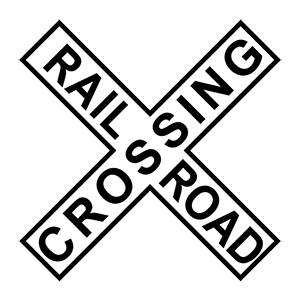
This white sign means:
The railroad crossing is controlled. Continue at your regular speed.
Look, listen, and prepare to stop at the crossing if necessary.
Stop at the railroad tracks and wait for a signal before crossing.
Q.20.
To improve visibility lowered by rain or fog, drivers should use their:
Low beam headlights.
High beam headlights.
Parking lights.
Q.21.
What is an important step in turning?
Check traffic in all directions.
Increase your speed.
Always move to the left lane.
Q.22.
When a bicyclist is making a left turn:
They may use the left lane.
They may cut through all lanes.
They may wait on the side of the road.
Q.23.
Driving more slowly than surrounding traffic is:
A good idea if the weather is bad.
Appropriate if you don’t know the speed limit.
Often a hazard because other drivers may become frustrated and try to pass you.
Q.24.
This sign means:
No left turn can be made here.
A left turn can be made only after stopping.
All traffic must turn right at the next intersection.
Q.25.
Before changing lanes or attempting to pass another vehicle, you should:
Check your blind spots and mirrors.
Signal your intention before changing lanes.
All of the above.
Q.26.
When a school bus is picking up or dropping off children, you must:
Stop, regardless of your direction of travel.
Stop if you are driving in the same direction.
Slow down and be prepared to stop.
Q.27.
If you have an argument with another person and you are angry, you should:
Loudly play the radio while driving so you won’t think about your argument.
Take a few minutes to cool off before driving.
Drive on the interstate to let off steam.
Q.28.
When you see this yellow sign, you should:
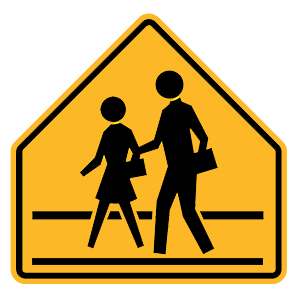
Always stop at the crosswalk.
Stop at the crosswalk until a crossing guards signals for you to go.
Be prepared to stop if children are in the crosswalk.
Q.29.
When approaching a railroad crossing sign:
Be ready to drive faster than the train.
Look for a way around any lowered gates.
Be prepared to stop if a train is nearby.
Q.30.
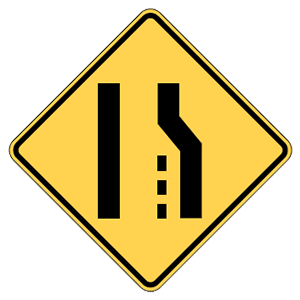
This road sign means:
Highway entrance ramp.
Road widens.
Right lane ends.
Support mcqgeeks.com by disabling your adblocker.
×
Please disable the adBlock and continue.
Thank you.
Reload page