MCQGeeks
CBSE
JEE
NTSE
NEET
English
UK Quiz
Quiz
Driving Test
Practice
Games
Driving Test
Mississippi
Mississippi Car Driving Permit Test-22
Answers
Q.1.
If you approach a stopped school bus that has its lights flashing and signal arm extended, you should:
Stop.
Proceed at 15 mph if no children are present.
Proceed at normal speed, but watch for children.
Q.2.
A broken yellow centerline indicates that:
Passing is not permitted.
Passing on the right is permitted when the way ahead is clear.
Passing on the left is permitted when the way ahead is clear.
Q.3.
If your vehicle begins to skid, you should:
Ease up on the gas pedal.
Brake as hard as possible.
Turn off the ignition.
Q.4.
This sign is used to warn drivers about:
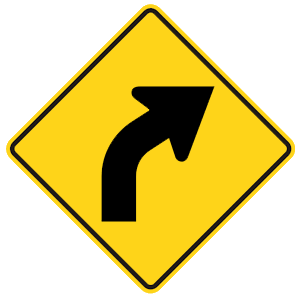
Upcoming intersections.
Road construction.
Road curves ahead.
Q.5.
You must show proof of insurance to law enforcement:
Only if you are involved in a collision.
If you are involved in a collision or stopped for a citation.
Only if you are stopped and cited.
Q.6.
While in a motor vehicle on a highway, it is:
Illegal to either drink from or possess open containers of alcohol.
Legal to drink alcohol if you're not driving.
Legal to drink alcohol if you're driving but not drunk.
Q.7.
Construction zone signs are generally:
Square or rectangular with white and red coloring.
Round or octagonal with black and yellow coloring.
Diamond-shaped or rectangular with orange and black coloring.
Q.8.
When preparing to make a left turn from a two-way street, you should drive:
Near the right-hand side of the road.
Near the centerline.
On the left of the centerline.
Q.9.
If you are facing a green traffic light but the intersection ahead is blocked by traffic, you should:
Turn left and find another route.
Stay out of the intersection until traffic clears.
Follow the other vehicles and enter the intersection.
Q.10.
What should a driver do when approaching a traffic control signal that is not in operation?
Come to a full stop and yield the right-of-way before entering the intersection.
If the intersection is clear, the driver does not need to stop.
Drive quickly through the intersection to get out of the way of other vehicles.
Q.11.
To pass on a two-lane road, you should:
Sound your horn as you pass.
Flash your headlights as you pass.
Judge the distance to any oncoming vehicles.
Q.12.
In a vehicle equipped with airbags, the safest place for children ageand under to ride is in:
The front seat.
The back seat.
The bed of a pick-up truck.
Q.13.
You may pass a vehicle when:
You are on a hill or curve.
You are on a road with a solid line next to your lane.
You are on a road with a broken line next to your lane.
Q.14.
An orange and red triangular sign on a vehicle always means:
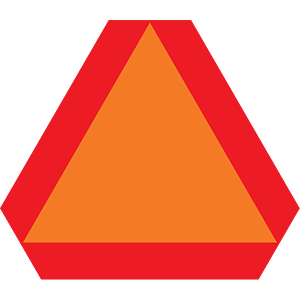
The vehicle has the right-of-way.
Slow-moving vehicle.
Shoulder work ahead.
Q.15.
A broken yellow line down the center of a road indicates that:
A construction zone is ahead.
Passing is not permitted from either direction.
Passing is permitted from either direction.
Q.16.
Which of the following substances can affect the ability to drive?
Tranquilizers, marijuana, and sedatives.
Cough syrups and cold tablets containing codeine or antihistamines.
All of the above.
Q.17.
It is illegal for a personyears of age or older to drive with a minimum blood alcohol concentration (BAC) of:
0.05 percent.
0.08 percent.
0.02 percent.
Q.18.
To see objects in their blind spot when changing lanes, drivers should check:
Only the left outside mirror.
Over their left or right shoulder.
Only the inside rearview mirror.
Q.19.
If you are about to be hit from the rear, you should not:
Release your seat belt.
Brace yourself.
Press your head against the head restraint.
Q.20.
When changing lanes:
Rely on the rearview mirror.
Look over your shoulder in the direction you plan to move.
Rely on the left side mirror.
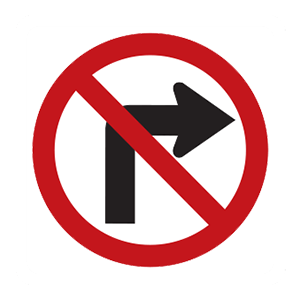
Q.21.
This road sign means:
No right turn.
No U-turns.
No left turn.
Q.22.
Which of the following is most likely to be slippery in cold weather after snow or rain?
A hilly, open road
A residential road
A road in a shaded area
Q.23.
You should use your horn when:
Another vehicle is in your way.
It may help prevent a collision.
Another driver makes a mistake.
Q.24.
If you are following a school bus or tank truck, you should:
Pass them on the right.
Be prepared to stop at all railroad crossings.
Decrease your following distance.
Q.25.
Adjust your rearview and side mirrors:
Before you start driving.
Whenever you need to use them.
Before you get into the car.
Q.26.
You should yield to a pedestrian:
Only if they are in a crosswalk.
At all times, even if the pedestrian is not obeying traffic laws.
Only if the traffic lights are in the pedestrian's favor.
Q.27.
On a freeway, you should look farther ahead than you would on a city street:
In order to see potential hazards early.
Because it takes a quarter of a mile to stop your vehicle completely.
Because it helps you keep up with traffic.
Q.28.
If you are driving and a tire suddenly goes flat, you should:
Rapidly pump the brake pedal several times.
Slow down gradually and not brake.
Press down on the brake pedal as hard as you can.
Q.29.
At dawn or dusk and in rain or snow, it can be hard to see and be seen. A good way to let other drivers know you are there is to turn:
Up the instrumental panel lights.
On your parking lights.
On your headlights.
Q.30.
Drivers turning left must yield to:
Overtaking cars.
Oncoming cars.
No one.
Support mcqgeeks.com by disabling your adblocker.
×
Please disable the adBlock and continue.
Thank you.
Reload page