MCQGeeks
CBSE
JEE
NTSE
NEET
English
UK Quiz
Quiz
Driving Test
Practice
Games
Driving Test
Mississippi
Mississippi Car Driving Permit Test-6
Answers
Q.1.
Drivers turning left must yield to:
Oncoming vehicles traveling straight or turning right.
Passing cars.
No one in particular.
Q.2.
Unless otherwise posted, the maximum speed limit in a school zone is:
30 mph.
20 mph.
15 mph.
Q.3.
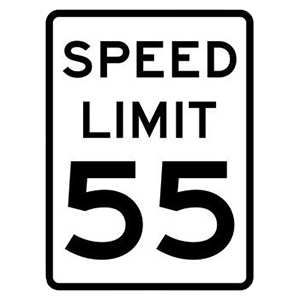
This road sign means:
You must travel through the intersection at the posted speed limit.
The maximum speed limit under ideal conditions is 55 mph.
You must not travel below the speed indicated.
Q.4.
You are driving on a one-way street. You may only turn left onto another one-way street if:
You increase your speed before the turn.
Traffic on the street moves to the right.
Traffic on the street moves to the left.
Q.5.
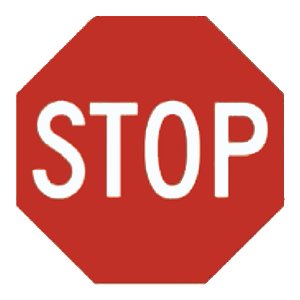
This road sign means:
Drive with caution and be ready to stop.
You must come to a complete stop.
Stop, if necessary.
Q.6.
A driver should:
Stare directly in front of their car.
Only focus on the middle of the road.
Watch beside, ahead, and to the rear of their car.
Q.7.
Where should drivers be particularly alert to children?
School zones and playgrounds
Residential neighborhoods
All of the above locations
Q.8.
If weather conditions are poor, drivers should:
Increase their speed.
Decrease their speed.
Maintain their normal speed.
Q.9.
Alcohol in any concentration is:
A stimulant.
A depressant.
Neither of the above.
Q.10.
The maximum posted speed limit should be driven only:
During the night.
During the day.
Under ideal conditions.
Q.11.
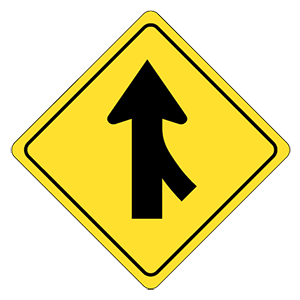
When you see this sign, you should:
Merge right.
Turn left.
Watch for traffic merging from the right.
Q.12.
After you have passed a vehicle moving in the same direction, it is safe to move back into the right lane:
After about three seconds.
When you can no longer see the passed vehicle over your right shoulder.
When you can see the entire front of the passed vehicle in your rearview mirror.
Q.13.
Only ____ can reduce blood alcohol content (BAC) and alcohol's effects on the body.
Drinking caffeine
Eating foods high in fat
Time
Q.14.
Which of the following statements about blind spots is true?
They are eliminated if you have one outside mirror on each side of the vehicle.
Large trucks have bigger blind spots than most passenger vehicles.
Blind spots can be checked by looking in your rearview mirrors.
Q.15.
Unless otherwise posted, the maximum speed limit on a rural interstate is:
70 mph.
55 mph.
40 mph.
Q.16.
If a traffic signal light is green and a police officer signals for you to stop, you should:
Obey the officer.
Obey the traffic signal.
Do what the vehicle in front of you does.
Q.17.
You should use your horn when:
Another vehicle is in your way.
It may help prevent a collision.
Another driver makes a mistake.
Q.18.
Which of the following statements about blind spots is true?
Blind spots are eliminated if you have one outside mirror.
Large trucks have bigger blind spots than most passenger vehicles.
Blind spots can be checked by looking in your rearview mirror.
Q.19.
At an intersection with stop signs on all corners, yield the right-of-way to any driver:
On your left.
Who arrived before you.
Across from your vehicle.
Q.20.
Which of these statements is true about drinking alcohol and driving?
If you can walk in a straight line after drinking, it is safe to drive.
If you are under the legal blood alcohol concentration limit, your driving isn't impaired.
Alcohol affects judgement, which is needed to drive safely.
Q.21.
Which of the following statements is true?
Driving too slowly is not an unsafe practice.
Driving too slowly on certain highways can be dangerous.
The speed at which you drive a vehicle does not affect safety.
Q.22.
When driving at night, you should:
Always use your high beams.
Look directly at the headlights of an oncoming vehicle.
Increase your following distance.
Q.23.
What should you do when you see this sign?
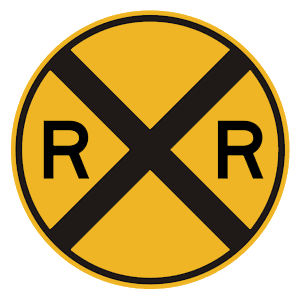
Look for a train station ahead.
Signal before going any further.
Slow down and yield to trains.
Q.24.
How many alcoholic drinks does it take to affect your driving ability?
Three
Two
One
Q.25.
When entering the interstate, check for a gap in traffic in the nearest lane, adjust your speed to match traffic, signal, and:
Expect traffic to allow you to proceed into the lane, since you have the right-of-way.
Merge carefully into the gap.
Wait for the lane to clear before merging.
Q.26.
When you drive through a construction zone, you should:
Stop to watch the workers.
Decrease your following distance.
Pass the construction zone carefully and not “rubberneck."
Q.27.
Using a cell phone while operating a motor vehicle is considered a distraction because:
It causes the driver to be concerned about the cost of the call.
It occupies the driver's hands, eyes, and mind.
It is an activity that draws the attention of other drivers.
Q.28.
If there is a deep puddle on the road ahead, you should:
Maintain the posted speed to make it through the water.
Avoid the puddle if possible.
Shift into neutral as you drive through the water.
Q.29.
This sign indicates that the road ahead:
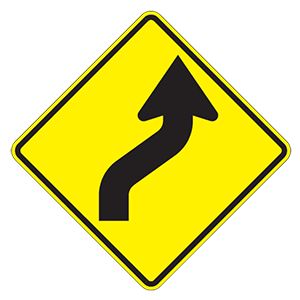
Turns sharply right, then left.
Curves right, then left.
Curves right.
Q.30.
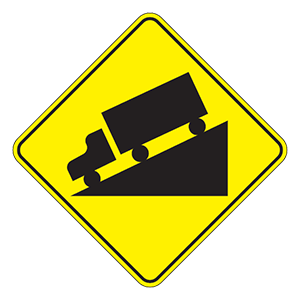
This sign means:
Trucks entering.
Truck exit only.
Steep downgrade ahead.
Support mcqgeeks.com by disabling your adblocker.
×
Please disable the adBlock and continue.
Thank you.
Reload page